|
Getting your Trinity Audio player ready...
|
A Chinese Solar Panel Cleaning Drone Demo Went Viral for the Best Possible Reason: It Washed a Dog
Sometimes the best way to prove a piece of hardware works isn’t a spec sheet, it’s finding the most shareable way to show it off. A technology company based in Linyi, in China’s Shandong Province, appears to have figured that out when it demonstrated its newly developed solar panel cleaning drone on a public street, not by spraying down a rooftop full of panels, but by giving a golden-coated dog an impromptu bath.
Footage of the demonstration, later verified through Reuters and picked up by outlets including Yahoo News, shows the drone hovering steadily above the dog and releasing a controlled spray of water down onto its coat, essentially treating the pup the same way it would treat a dusty solar panel. The dog, for what it’s worth, seemed to handle the unexpected shower with more patience than most dogs manage during an actual bath at home, standing more or less still while the drone did its work from above.
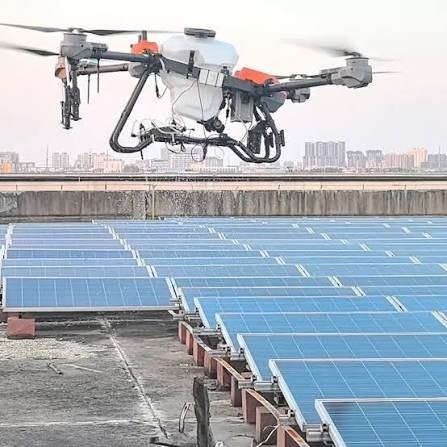
It’s a genuinely clever bit of product marketing when you think about what these drones are actually built to do. Solar panel cleaning has quietly become its own small industry as solar installations have scaled up across rooftops, commercial buildings and utility-scale solar farms worldwide, because dust, pollen, bird droppings and general grime steadily cut into how much sunlight panels can actually convert into electricity if nobody’s cleaning them. Sending workers up onto sloped rooftops or across large solar farm arrays to scrub panels by hand is slow, comes with real fall-risk safety concerns, and doesn’t scale well once you’re talking about thousands of panels spread across acres of land. Drones built specifically for this task, several of which are already commercially available from Chinese manufacturers, are pitched around exactly those problems: they can cover large areas quickly, reach panels mounted in awkward or hard-to-access spots, and cut out the physical risk of having someone balancing on a roof with a squeegee.
Using a dog as the demo subject instead of an actual panel was, functionally, a pretty smart choice for showing off precision and control. A dog moves, reacts to being sprayed, and gives immediate, visible feedback about whether the water pressure and spray pattern are gentle enough to use safely around something living, rather than just blasting grime off a flat, static surface. If a drone can hover accurately enough to comfortably rinse a dog without the animal bolting or getting knocked over, that’s a fairly convincing, low-effort way to demonstrate the kind of controlled, adjustable water delivery that matters just as much when the target is a fragile solar panel rather than a golden retriever.
Predictably, the clip took on a life of its own once it started circulating online, racking up shares and reactions well beyond anyone specifically interested in solar infrastructure or agricultural drone technology. Comment sections on the video have swung between genuine amusement at the dog’s reaction and a fair amount of only-half-joking speculation about other, less charming things a water-spraying drone could theoretically be modified to spray instead, the kind of dark humor that tends to follow any viral clip of Chinese drone technology given how much attention China’s broader drone and robotics industry has drawn over the past few years, including some genuinely unsettling military-adjacent robotics projects that have made headlines separately from anything related to solar panels.
Whatever people made of the video’s more speculative comment threads, the actual underlying technology it was built to showcase is fairly mundane in the best sense of the word. China has been steadily rolling out automated and drone-based cleaning systems for solar infrastructure over the past couple of years, with state media outlets like Xinhua previously covering rooftop cleaning robots deployed across solar installations in the country’s southwest as part of a broader push to keep China’s enormous and still-growing solar capacity operating at peak efficiency without needing armies of human workers scaling rooftops with brushes and hoses. A cleaning drone that can hover precisely, control its spray pattern, and operate without direct human handling fits squarely into that trend, even if the company behind this particular unit clearly understood that a video of dusty solar panels getting rinsed was never going to travel the internet the way a wet, patient dog would.