|
Getting your Trinity Audio player ready...
|
Technology News | October 30, 2026
The artificial intelligence boom is entering a more demanding phase as investors begin questioning whether the enormous sums technology companies are spending on AI infrastructure will translate into sustainable revenue and stronger profits. The latest third-quarter earnings reports from some of the world’s biggest technology companies have exposed a growing divide between businesses demonstrating measurable returns and those facing increasing pressure to justify their investments.
For much of the past two years, the AI investment story has been driven by expectations of rapid growth, expanding data centre capacity, advanced processors and rising demand for cloud computing. Companies such as Microsoft, Amazon, Alphabet and Meta have committed substantial resources to building the infrastructure needed to support increasingly sophisticated AI systems. However, the latest earnings season suggests that investors are becoming less willing to reward spending without clear evidence of financial returns.
The changing mood has created a difficult environment for AI-related stocks. Although some companies have reported strong revenue growth and encouraging demand, others have experienced sharp market reactions after announcing higher capital expenditure, weaker financial guidance or disappointing results. The difference between business performance and investor expectations has become particularly important, with even profitable companies facing pressure when their spending plans raise questions about future cash flow.
The latest earnings results have also put the spotlight on a broader question facing the technology industry: how much investment is too much when the commercial opportunity is still developing? For investors, the answer increasingly depends on whether AI infrastructure can generate enough recurring income to cover its construction, maintenance, energy and operating costs.
Microsoft and SK Hynix emerge as relative winners
Microsoft has provided one of the clearest examples of how AI investment can translate into measurable business growth. Its Azure cloud division recorded 48% revenue growth, reinforcing the company’s position in the expanding market for AI computing and enterprise cloud services. Its capital expenditure also came in below expectations, while its outlook for Azure revenue was stronger than analysts had anticipated.
The combination of accelerating cloud demand and more manageable spending gave Microsoft an advantage during an earnings season in which investors have become increasingly sensitive to capital expenditure. The company’s performance suggests that businesses with established cloud platforms, enterprise customers and the ability to monetise AI services may be better positioned to benefit from the current investment cycle.
However, Microsoft’s relative strength did not guarantee a positive stock market reaction. Its shares still faced pressure as broader technology stocks declined following disappointing reports from other major companies. This distinction is important because individual company performance and overall market sentiment do not always move in the same direction.
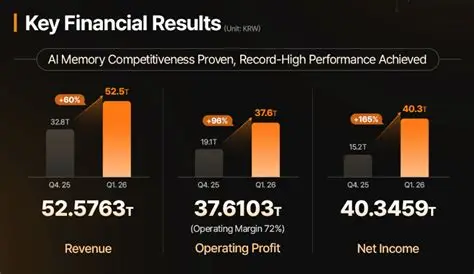
SK Hynix also stood out among the companies benefiting from AI demand. The South Korean semiconductor manufacturer reported record sales and operating profit, reflecting the growing importance of advanced memory products in modern AI infrastructure. Its announcement that it had secured long-term agreements covering more than half of its production capacity for 2027 and 2028 provided another indication of continued demand.
High-performance memory has become an essential part of AI computing. Advanced AI models require substantial memory capacity to process information efficiently, making specialised memory products increasingly important to data centre operators and semiconductor manufacturers.
SK Hynix’s results demonstrate that the AI economy is not limited to software developers and cloud platforms. Companies supplying the physical components required to operate AI systems can also benefit from the expansion. For investors, this creates an important distinction between businesses selling AI services and those supplying the infrastructure that makes those services possible.
Amazon faces questions over its AI infrastructure spending
Amazon’s latest quarterly results illustrate the tension between strong underlying business performance and investor concerns about the cost of expanding AI infrastructure.
The company reported third-quarter revenue of $201.9 billion, representing a 12% increase compared with the same period a year earlier. Its cloud computing division, Amazon Web Services (AWS), delivered particularly strong results, with revenue increasing 39.3% to $46 billion. Amazon also reported operating income of $28.1 billion, its highest operating margin in company history.
Despite these encouraging figures, the company’s investment requirements attracted considerable attention. Amazon said it continued to expect approximately $220 billion in capital expenditure for 2026, with a substantial portion directed towards artificial intelligence and related infrastructure.
The scale of that investment is putting pressure on free cash flow. Amazon reported a trailing 12-month free cash flow outflow of $42.4 billion, compared with an inflow of $14.8 billion in the corresponding period a year earlier. The company attributed the deterioration primarily to increased purchases of property and equipment, reflecting its infrastructure expansion.
For investors, the concern is not necessarily that Amazon is spending money on the wrong technology. Rather, the question is whether the additional computing capacity will generate enough revenue and operating profit to justify the financial commitment.
AWS remains a major strength for the company, and its latest growth rate suggests that demand for cloud infrastructure has not disappeared. Nevertheless, building data centres, acquiring specialised processors and securing the electricity needed to operate them require substantial upfront investment.
Amazon’s fourth-quarter revenue guidance of $240 billion to $247 billion also fell short of the midpoint of some analyst expectations, adding to investor caution.
The results demonstrate why strong cloud growth alone may no longer be sufficient to satisfy the market. Investors increasingly want to understand how infrastructure investments will affect profitability, cash generation and the company’s financial flexibility over the coming years.
Amazon’s official third-quarter 2026 earnings report provides further details about its financial performance and capital expenditure plans.
Meta’s AI ambitions come with a rising financial commitment
Meta Platforms is another major technology company facing questions about the financial implications of its AI strategy. The company has been investing heavily in computing infrastructure, AI models and products designed to improve engagement across Facebook, Instagram and its other platforms.
Its third-quarter 2026 results showed that these investments are supporting important parts of its advertising business. Revenue reached $64.60 billion, an increase of 26% year over year. Advertising performance benefited from improvements in engagement, recommendations and ad targeting, areas where AI has become increasingly important.
However, Meta’s spending also increased substantially. The company reported capital expenditure of $34.91 billion during the quarter, including principal payments on finance leases. It also revised its full-year 2026 capital expenditure outlook to between $135 billion and $145 billion.
The financial picture requires some context. Meta recorded a $9.89 billion charge connected to an agreement with US state attorneys general concerning litigation. This contributed to a reported 37% decline in operating income, even though revenue increased considerably. Excluding that charge, the company’s operating income would have been approximately $22.88 billion.
This distinction matters because it would be misleading to attribute all of Meta’s weaker reported operating income to AI investment. The legal charge was a separate factor, while infrastructure spending represents a longer-term commitment to expanding the company’s technology capabilities.
Meta’s management has indicated that it intends to continue investing aggressively beyond 2026. The company believes its AI systems can improve advertising performance, strengthen user engagement and support new products.
The challenge is convincing investors that these benefits will eventually outweigh the cost of building and operating increasingly powerful AI infrastructure. Meta has a substantial advertising business capable of funding its expansion, but the size of its spending commitments makes the timing and scale of future returns particularly important.
The company’s latest figures can be examined in its official third-quarter earnings announcement.
Alphabet faces a different kind of AI earnings challenge
Alphabet’s latest performance highlights another important development in the AI market: companies can experience rapid growth in one business division while facing financial pressure elsewhere.
Google’s parent company reported third-quarter revenue of $127.6 billion, representing a 25% increase year over year. Google Cloud was a particularly strong performer, with revenue rising 103% to $30.7 billion. The growth reflected demand for enterprise AI infrastructure, AI solutions and the company’s broader cloud computing services.
Google Cloud’s performance is significant because it provides evidence that businesses are increasingly paying for AI-related services rather than simply experimenting with the technology.
However, Alphabet is also making substantial investments to maintain its position in the AI race. Its spending on data centres, specialised processors and other infrastructure has become a major consideration for investors evaluating its future financial performance.
The company faces an additional strategic challenge involving Google Search. Generative AI is changing how people discover information, ask questions and interact with online services. While Google has introduced AI-powered features across its products, the transition requires the company to balance new experiences with the advertising model that has historically generated much of its revenue.
This is not simply a question of whether AI can improve search results. Alphabet must also ensure that new AI experiences can support sustainable commercial activity without undermining the economics of its existing search business.
The latest earnings figures indicate that Google’s cloud division is gaining considerable momentum. However, investors are also assessing whether the company’s overall spending trajectory can deliver acceptable returns as competition intensifies.
Alphabet’s position illustrates the complexity of the AI investment cycle. Its cloud business is benefiting from rising demand, but maintaining technological leadership requires continued investment in computing capacity, research and product development.
Intel’s results show that AI demand does not benefit every chipmaker equally
The semiconductor industry has been one of the most visible beneficiaries of the AI expansion. Demand for advanced processors, memory and networking equipment has created significant opportunities for manufacturers supplying data centres and technology companies.
However, Intel’s latest results show that the semiconductor market remains more complicated than a simple AI-driven growth story.
Intel reported third-quarter revenue of $16.5 billion, an increase of 21% compared with the previous year. Its data centre business also delivered its strongest revenue growth in 15 years, reflecting demand for processors used in modern computing infrastructure.
Nevertheless, the company’s outlook for the fourth quarter introduced fresh concerns. Intel forecast revenue between $15 billion and $16 billion, alongside non-GAAP earnings per share of $0.25.
The forecast raised questions about the company’s ability to maintain its improving financial performance while dealing with weakness in the personal computer market and ongoing manufacturing challenges.
Intel’s experience demonstrates that exposure to AI does not automatically guarantee positive investor sentiment. Companies must still manage production capacity, competition, product development and demand across their different markets.
The semiconductor industry also contains several distinct business models. Manufacturers supplying specialised AI accelerators, high-bandwidth memory and other essential components may experience different growth patterns from companies whose businesses depend more heavily on traditional PC processors.
This is why investors are increasingly examining individual company results rather than assuming every semiconductor stock will benefit equally from the AI boom.
Tesla and Caterpillar add to concerns about AI-related investments
The pressure surrounding AI-related investments is also extending beyond traditional technology companies. Tesla and Caterpillar have both become part of the wider conversation because of their exposure to technologies and infrastructure associated with the AI economy.
Tesla’s long-term ambitions include autonomous driving, robotaxis and humanoid robots. These projects depend heavily on artificial intelligence, advanced computing and large-scale technological development. However, the company’s decision to reduce its 2026 capital expenditure forecast raised questions about the pace of its investment plans.
For investors, the adjustment created uncertainty about how quickly Tesla intends to advance some of its most ambitious technology projects. Although a lower spending forecast can sometimes be viewed positively because it protects cash flow, it can also create concerns when investors expect a company to accelerate investment in future growth opportunities.
Caterpillar presents a different example. The industrial equipment manufacturer has attracted attention because of its exposure to power generation and equipment demand associated with expanding data centre infrastructure.
AI data centres require substantial electricity, cooling systems and supporting equipment. As technology companies build more facilities, demand for the infrastructure needed to operate them creates opportunities for industrial manufacturers.
However, Caterpillar’s latest outlook suggested that overall revenue growth in the following quarter would remain moderate. Its relatively modest earnings and sales performance did not provide enough reassurance to investors concerned about whether the AI infrastructure expansion would generate stronger financial results.
These developments show that the financial consequences of the AI boom extend across several industries. Companies involved in electricity generation, construction, semiconductor manufacturing and cloud computing are increasingly connected to the same investment cycle.
Why investors are becoming more selective about AI stocks
The changing market reaction reflects a broader shift in investor expectations. During the early stages of the AI boom, companies could attract considerable attention simply by announcing new AI products, expanding computing capacity or increasing their infrastructure budgets.
That environment is becoming more demanding.
Investors now want stronger evidence that AI investments can produce measurable financial benefits. Revenue growth, operating margins, free cash flow and future earnings guidance are becoming central considerations when evaluating companies involved in the technology.
One important distinction is the difference between spending money to build AI infrastructure and generating revenue from the services that infrastructure supports.
Data centres require expensive equipment, processors, electricity, cooling systems and ongoing maintenance. These costs can create substantial financial pressure before the facilities reach their full commercial potential.
Even when demand is strong, companies must ensure that their infrastructure investments are economically sustainable. Building additional computing capacity does not automatically mean that the resulting services will generate enough profit to justify the expense.
Another concern involves competition. Microsoft, Amazon, Alphabet and Meta are competing to attract enterprise customers, developers and businesses seeking access to AI computing services. Their investments are partly defensive because falling behind competitors could weaken their positions in an increasingly important technology market.
However, competition can also encourage companies to spend more aggressively than their financial returns currently justify. If several major providers continue expanding capacity simultaneously, the industry could eventually face questions about infrastructure utilisation, pricing and profitability.
This does not mean that demand for AI services is disappearing. Instead, it suggests that the market is moving towards a stage where commercial execution matters as much as technological innovation.
For readers following developments in the wider technology industry, BusinessTech also covers business, digital innovation and technology developments shaping the modern economy.
The AI investment boom is not necessarily over
Despite the latest market pressure, there are reasons to believe that artificial intelligence will remain an important source of technology industry growth.
Businesses are continuing to explore AI applications in software development, customer service, data analysis, cybersecurity, advertising and enterprise automation. These applications create opportunities for technology providers capable of delivering services that improve productivity and reduce operating costs.
Cloud computing companies are particularly well positioned because many organisations prefer accessing AI infrastructure through established cloud platforms rather than building expensive systems independently.
The strong growth reported by Azure and Google Cloud demonstrates the commercial potential of this approach. Amazon’s AWS performance also shows that demand for cloud computing remains substantial despite concerns about the cost of expanding infrastructure.
The semiconductor industry is another important part of the longer-term outlook. Advanced processors and high-performance memory remain essential to training and operating increasingly sophisticated AI models.
However, the distribution of financial benefits may change as the market develops. Some companies may generate substantial returns from supplying infrastructure, while others may struggle to turn their AI products into profitable businesses.
The same distinction could emerge among software companies. Businesses that successfully integrate AI into products customers are willing to pay for may establish stronger commercial positions than those relying primarily on announcements and experimental features.
Investors will also be watching how companies manage their capital expenditure over the next several quarters. If infrastructure spending continues rising faster than revenue, pressure on cash flow could remain a concern. Conversely, stronger monetisation, improved operating efficiency and more disciplined investment could help restore confidence.
Another important factor is the possibility that AI infrastructure demand will continue growing faster than available computing capacity. In that situation, companies with established data centres, access to advanced processors and reliable electricity supplies could retain significant competitive advantages.
The challenge is determining how much of that future demand is already reflected in company valuations. Even businesses with strong long-term prospects can experience stock market declines when investors believe expectations have become too optimistic.
What the latest earnings season means for the technology industry
The third-quarter earnings season has delivered an important message for the AI industry: investors are no longer treating every major AI investment as an automatic positive.
Microsoft and SK Hynix have provided encouraging examples of companies benefiting from strong demand and demonstrating clearer commercial opportunities. Amazon, Meta and Alphabet, meanwhile, have highlighted the financial pressures associated with expanding AI infrastructure, even as their businesses continue to generate substantial revenue.
Intel, Tesla and Caterpillar demonstrate that the impact of the AI economy varies considerably depending on each company’s products, financial position and growth strategy.
The Nasdaq 100’s position, approximately 6% below its recent highs during this earnings period, reflects the growing uncertainty surrounding major technology stocks. The market reaction also shows that strong quarterly results do not always translate into rising share prices when investors remain concerned about future spending.
For technology companies, the next challenge will be demonstrating that their investments can deliver sustainable growth rather than simply increasing their technological capabilities.
The AI industry still has considerable room to develop, but the financial expectations surrounding it are changing. Companies will increasingly need to demonstrate how their AI products generate revenue, improve profitability and create lasting competitive advantages.
The coming quarters will therefore be important for determining which businesses can turn the current wave of AI investment into durable financial success.
The AI trade is not necessarily losing its long-term potential. However, the latest earnings results suggest that investors are becoming more selective about where they place their money. In an industry that has attracted enormous financial commitments, the companies capable of proving that their AI strategies actually pay off may ultimately emerge as the biggest winners.