|
Getting your Trinity Audio player ready...
|
Microsoft and South Korean semiconductor manufacturer SK hynix are emerging as two of the strongest performers in the latest artificial intelligence (AI) earnings season, as their latest financial results highlight the growing commercial value of AI infrastructure, cloud computing and advanced memory chips.
The companies reported impressive third-quarter results on October 28, 2026, offering investors evidence that demand for AI-related technology continues to translate into substantial business growth. While several major technology companies face increasing questions about the cost of building AI infrastructure, Microsoft and SK hynix have demonstrated how investments in artificial intelligence can support revenue expansion and profitability.
Microsoft reported higher revenue, operating income and earnings per share for its first quarter of fiscal 2027, supported by strong performance across its cloud and infrastructure businesses. SK hynix, meanwhile, recorded its highest quarterly revenue and operating profit, benefiting from growing demand for high-bandwidth memory (HBM), server DRAM and other advanced semiconductor products used in AI data centers.
Their performances stand out against a broader technology earnings season in which investors are increasingly examining whether enormous investments in artificial intelligence will generate sufficient financial returns.
Microsoft’s latest financial report showed revenue of $92.3 billion for the three months ended September 30, 2026, representing a 19% increase compared with the corresponding period last year. Operating income climbed 21% to $45.9 billion, while net income increased 32% to $36.6 billion under generally accepted accounting principles (GAAP).
The company’s diluted earnings per share reached $4.92, up 32% year over year. On a non-GAAP basis, which adjusts for certain investment-related effects, earnings per share increased 18% to $4.89.
One of the most important developments in the results was the continued expansion of Microsoft’s cloud business. Microsoft Cloud generated $63.9 billion in revenue during the quarter, representing 30% year-over-year growth. The performance highlights the increasing importance of cloud infrastructure as businesses integrate AI-powered applications into their daily operations.
Azure, Microsoft’s cloud computing platform, was another major contributor to the company’s performance. Revenue from Azure increased 48% compared with the same quarter last year, demonstrating sustained demand for cloud computing capacity and AI-related services.
The growth is particularly important because Azure provides the computing infrastructure that many businesses require to develop, operate and deploy artificial intelligence applications. As organisations experiment with generative AI, automated workflows and increasingly sophisticated digital services, demand for cloud processing, storage and networking continues to expand.
Microsoft’s broader Agents and Infra business generated $76.8 billion in revenue, an increase of 25% year over year. Its commercial remaining performance obligation also increased 73% to $677 billion, indicating a substantial volume of contracted future business.
These figures provide a broader picture of Microsoft’s position in the AI market. Rather than relying entirely on individual AI products, the company benefits from several interconnected businesses, including cloud infrastructure, enterprise software, productivity applications and AI development tools.
Microsoft 365 also maintained positive momentum. Commercial cloud revenue increased 17% on a reported basis, while consumer cloud revenue rose 17%. This performance suggests that the company’s established software ecosystem continues to provide opportunities for incorporating AI capabilities into products already used by millions of customers.
Chief Executive Officer Satya Nadella said the company was delivering greater capability, choice, control and cost efficiency across its technology offerings. His comments reflected Microsoft’s strategy of helping organisations develop and manage their own AI capabilities while maintaining security and trust.
The company’s results also demonstrate that AI growth is not the only factor supporting its overall financial performance. Its established enterprise software operations, advertising business and cloud subscriptions continue to provide important revenue streams.
However, Microsoft’s latest results also reveal differences across its business segments. Revenue from Devices and Consumer declined 3% to $15.5 billion. Windows OEM and Devices revenue fell 22%, while Xbox content and services revenue decreased 2%.
These declines highlight the different growth conditions affecting Microsoft’s traditional consumer technology operations and its expanding enterprise infrastructure business.
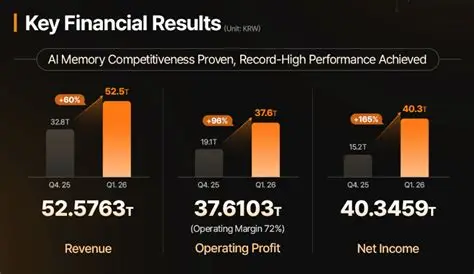
SK hynix delivered an even more dramatic earnings performance, recording quarterly revenue above 100 trillion South Korean won for the first time in its history.
According to its third-quarter financial announcement, the semiconductor manufacturer generated 104.6155 trillion won in revenue, up 328% compared with the same period in 2025. Operating profit reached 83.3338 trillion won, representing a 632% year-over-year increase, while net profit climbed 216% to 39.7756 trillion won.
The results reflect the growing importance of memory technology in the global artificial intelligence industry. Modern AI systems require enormous quantities of data to be processed quickly, creating demand for specialised memory products capable of supporting high-performance computing systems.
High-bandwidth memory has become particularly important in this market. HBM is designed to provide high data-transfer speeds and greater bandwidth, allowing advanced processors and AI accelerators to access information more efficiently.
As companies expand their AI data centers and deploy increasingly powerful computing systems, demand for these specialised memory products has increased significantly.
SK hynix has established a strong position in this segment through its HBM product development and manufacturing capabilities. Its latest earnings announcement highlighted increased sales of HBM4 and high-value-added server products, alongside stronger demand for server DDR5 memory.
The company also confirmed that shipments of HBM4 had begun in earnest. It expects the next-generation memory product to become its mainstream HBM offering during the fourth quarter of 2026.
SK hynix plans to increase production capacity at its M15X facility to support growing demand for HBM4. The company expects HBM4 to surpass HBM3E in both shipment volume and revenue during the fourth quarter.
This transition is significant because competition in the AI semiconductor industry increasingly depends on manufacturers’ ability to deliver advanced memory products at scale. Performance, production capacity, manufacturing efficiency and relationships with major technology customers all influence a company’s ability to benefit from the AI infrastructure expansion.
Beyond HBM, SK hynix is also expanding its server memory and enterprise storage businesses. Its sales of 321-layer triple-level cell enterprise solid-state drives increased during the quarter, reflecting demand for high-capacity storage solutions used in data centers.
The company plans to increase the proportion of its 321-layer NAND production to more than half of its domestic manufacturing capacity during the fourth quarter. This expansion is intended to support the supply of high-performance enterprise storage products.
Another important development is the company’s growing visibility into future customer demand. SK hynix disclosed that it had secured long-term agreements with 14 major customers, including leading global cloud service providers.
These agreements cover more than 50% of the company’s total production capacity for 2027 and 2028. The arrangements are particularly important in a semiconductor market where manufacturers must make substantial investments before additional production capacity becomes available.
By securing longer-term customer commitments, SK hynix can make better-informed decisions about production planning, investment and supply allocation. The company also indicated that its agreements incorporate pricing mechanisms designed to reflect market conditions within agreed ranges.
SK hynix expects the memory supply shortage to remain a significant industry issue through 2030. According to its assessment, the technical challenges involved in producing advanced memory chips and the lengthy process of constructing new manufacturing facilities could prevent supply from keeping pace with demand.
Although this outlook reflects the company’s assessment rather than a guaranteed industry outcome, it illustrates why memory manufacturers are increasingly important to the long-term development of artificial intelligence.
The company’s strong financial performance also creates opportunities for additional investment and shareholder returns. SK hynix announced plans to pursue approximately 100 trillion won in shareholder returns during 2026, including dividends and share repurchases.
The company also confirmed that it would distribute most of the gains realised from its investment in Japanese memory manufacturer Kioxia to shareholders through a special dividend.
The developments provide another indication of how the AI semiconductor boom is influencing the financial position of companies operating throughout the technology supply chain.
Nevertheless, the wider earnings season has shown that not every major technology company is benefiting equally from the expansion of artificial intelligence.
Large technology businesses are spending enormous amounts on data centers, computing equipment, networking infrastructure and specialised chips. While these investments are necessary to support future AI services, investors increasingly want evidence that the spending will produce sustainable revenue and profits.
This concern has created a distinction between companies demonstrating strong financial returns from AI-related activities and those whose infrastructure spending is growing faster than their immediate financial benefits.
Microsoft’s Azure growth offers investors a measurable indication that demand for its cloud services remains strong. Its expanding cloud revenue suggests that businesses are continuing to purchase the computing resources needed to support AI applications and other digital operations.
SK hynix provides a different but equally important example. Its record earnings show how suppliers of essential semiconductor components can benefit when demand for AI infrastructure increases.
Other major technology companies have faced greater scrutiny over their spending plans and financial outlooks. Amazon, Meta and Alphabet have all attracted attention as investors evaluate the relationship between their infrastructure investments, operating expenses and expected returns.
The contrast does not necessarily mean that these companies have weak AI businesses. Instead, it demonstrates that investors are becoming more selective about the financial evidence supporting the industry’s long-term growth expectations.
For the broader technology sector, the performances of Microsoft and SK hynix highlight two important parts of the artificial intelligence value chain.
Microsoft represents the cloud infrastructure and software side of the industry, where businesses pay for computing capacity, AI services and enterprise applications. SK hynix represents the semiconductor supply chain, providing memory components that help power the hardware behind those services.
Both businesses are connected to the same underlying development: the growing need for computing power and faster access to data as artificial intelligence becomes more widely adopted.
Their results also suggest that the next stage of AI competition will involve more than developing increasingly advanced models. Companies will need reliable computing infrastructure, specialised memory, efficient data centers and commercially sustainable services to support wider adoption.
For investors and technology businesses, this makes the financial performance of infrastructure providers and semiconductor manufacturers increasingly important indicators of the industry’s direction.
Looking ahead, Microsoft’s ability to maintain Azure’s growth while managing infrastructure investment will remain an important measure of its AI strategy. The company’s cloud performance suggests that enterprise demand remains healthy, although maintaining that momentum will require continued investment in computing capacity and technology development.
For SK hynix, the central challenge will be expanding production without weakening profitability. The company’s long-term customer agreements provide a stronger foundation for planning, but manufacturing expansion, technological competition and changes in memory market conditions will remain important considerations.
Ultimately, the latest earnings reports offer a clearer picture of where the financial benefits of artificial intelligence are currently emerging. Microsoft is converting cloud and AI demand into substantial revenue growth, while SK hynix is benefiting from the increasing need for advanced memory chips.
Their performances make them notable bright spots in the latest AI earnings season and reinforce the importance of cloud computing and semiconductor technology in the global artificial intelligence industry.
As businesses continue investing in AI-powered services and infrastructure, the ability to turn technological demand into sustainable financial results is likely to remain one of the most important measures of success.
For more technology, artificial intelligence and business developments, visit BusinessTech Nigeria.