
|
Getting your Trinity Audio player ready...
|
China’s Viral AI Blackboard Lets Kids Watch Their Sketches Turn Into 3D Models in Real Time
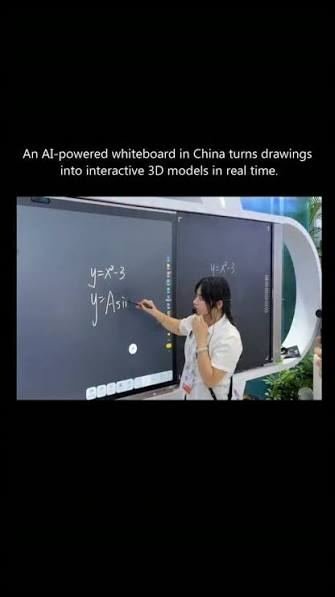
A video out of Shanghai’s World AI Conference has been racking up views across international social media for weeks, showing a teacher drawing a simple triangle on what looks like an ordinary classroom blackboard, only for the shape to instantly complete itself into a labeled geometric figure, then flip into a rotatable 3D model students can spin and inspect from every angle. The device behind the demo is Chinese tech company iFLYTEK’s Tongchuang AI Blackboard, unveiled at WAIC 2026, and it’s become one of the more talked-about pieces of Chinese AI hardware to go viral internationally this year.
The board works by combining several existing AI capabilities, optical character recognition, speech recognition, automated speech assessment, and natural language understanding, into one integrated teaching surface. A teacher writes an equation by hand using a smart pen, and a corresponding graph appears on the board immediately. Sketch a cube, and the system converts it into an interactive 3D shape with its angles and surface areas automatically labeled, all without a projector, a connected laptop, or clicking through a slide deck. The board can also recognize what topic, or knowledge point in the company’s terminology, a given lesson touches on, and surface related learning material for the teacher to pull up on demand.
Clips of the demo spread rapidly once foreign tech vloggers started reacting to it, with several praising the technology as a genuine glimpse of where classroom teaching is headed, and some going as far as calling it proof of China’s broader lead in applying AI to everyday life. Chinese state broadcaster CCTV picked up on that overseas reaction and reported on it directly, framing the international praise as validation of the country’s education technology push. One detail worth noting from the reaction itself: smart blackboards of various kinds aren’t actually new in Chinese schools. Some Beijing classrooms were already running simulated chemistry experiments on touchscreen boards as far back as 2024, meaning the WAIC demo represented a more advanced iteration of technology that had already been quietly working its way into Chinese classrooms rather than a completely novel invention appearing out of nowhere.
It’s also worth separating what the viral clip actually shows from some of the broader claims that spread alongside it. A fact-check published by explainx.ai traced the footage back to a specific July 23 demo of the Tongchuang board at WAIC, and confirmed the core interactions shown, the triangle completing itself, the cube converting into a 3D model, were genuine and matched iFLYTEK’s own described product capabilities. But the outlet also cautioned that online reactions had inflated a single conference booth demonstration into a broader assumption that every classroom across China already uses this exact experience as a matter of course. iFLYTEK does report meaningful deployment of its smart classroom technology nationally, but that figure comes from the company itself rather than any independent audit, an important distinction between a genuinely impressive live demo and a fully proven claim about nationwide classroom reality.
The blackboard fits into a much larger, state-driven push to embed AI throughout China’s education system. In April 2026, the country’s Ministry of Education launched a national initiative called AI Plus Education, aimed at integrating artificial intelligence across every level of schooling from kindergarten through university, with full implementation targeted by 2030. A survey of 530,000 teachers across 19 provinces found that more than 85 percent already believe AI is helping expand the resources available to them in the classroom. iFLYTEK itself has already landed major contracts tied to this push, including a 1.586 billion yuan deal with the city of Bengbu in Anhui Province to roll out its full smart classroom ecosystem, AI blackboards included, across 875 schools serving roughly 400,000 students, alongside tools for automated English speaking assessment and data-driven student tracking.
AI education in China has moved well beyond optional add-on status too. According to reporting from NPR, artificial intelligence is now a state-mandated part of the curriculum in many Chinese schools, with younger students learning AI basics, fourth graders working on coding and data concepts, and fifth graders being introduced to ideas like intelligent agents and algorithms, part of a deliberate effort by authorities to build a technically fluent workforce as competition with the United States over AI leadership intensifies.
Not everyone views the rapid rollout with the same enthusiasm as the viral clip suggests. Researchers and educators cited by outlets including Rest of World and ChinaTalk have raised genuine concerns about whether the push is outpacing the evidence for its actual benefits, warning that heavy reliance on AI tools could limit children’s social development and weaken foundational learning skills if not paired with proper teacher training and thoughtful implementation. There’s also a real worry about widening inequality, since rural students may end up spending long hours in front of screens with less access to qualified teachers, while their urban peers benefit from both AI tools and stronger in-person instruction. Some commentators have drawn comparisons to past technology rollouts elsewhere in the world where flashy hardware landed in classrooms without the reliable infrastructure, training, or supporting materials needed to actually make it work as intended.
Whether iFLYTEK’s blackboard ends up transforming Chinese classrooms at the scale the viral video suggests, or remains a genuinely impressive but still unevenly deployed piece of technology, is likely to become clearer as the country’s AI Plus Education plan works toward its 2030 target. For now, the clip has done exactly what conference demos are designed to do: get people talking, whether or not every classroom in China actually looks quite like the one in the video yet.