|
Getting your Trinity Audio player ready...
|
SpaceX’s Nasdaq-100 Weight Just Doubled: What Actually Matters Next for SPCX Investors
SpaceX shareholders got a mechanical boost to their stock this week that had nothing to do with a rocket, a satellite, or an earnings report. Following the Nasdaq-100’s quarterly rebalancing that took effect Monday, SpaceX’s weighting in the index more than doubled, jumping to 2.82 percent from roughly 1.28 percent, according to a Bloomberg report. That single adjustment made SpaceX the seventh-largest company in the entire index by market value, and it’s forcing a wave of buying that has nothing to do with whether the business is actually performing well.
Here’s why the change happened. When SpaceX went public in June and joined the Nasdaq-100 shortly after in July, its initial index weighting was held artificially low because only a small slice of its total shares were actually available for public trading, a factor index providers account for through what’s called free-float adjustment. Since then, lockup restrictions that had kept early investors and insiders from selling their shares expired, dramatically increasing the number of shares now circulating in the open market. With more shares available to trade, Nasdaq’s index methodology allowed SpaceX’s weighting to move up much closer to what its actual market capitalization, currently around $1.9 trillion, would normally justify.
The practical effect of that shift is significant purely from a mechanical standpoint. Any fund built to track the Nasdaq-100, including the widely held QQQ ETF and more than 200 other investment products tied to the index, is now required to hold roughly twice as much SpaceX stock as it did before the rebalance. Estimates cited by TipRanks put the total scale of that forced buying somewhere between $15.5 billion and $22 billion, a genuinely large sum flowing into the stock purely because of index rules rather than any judgment call by the fund managers involved.
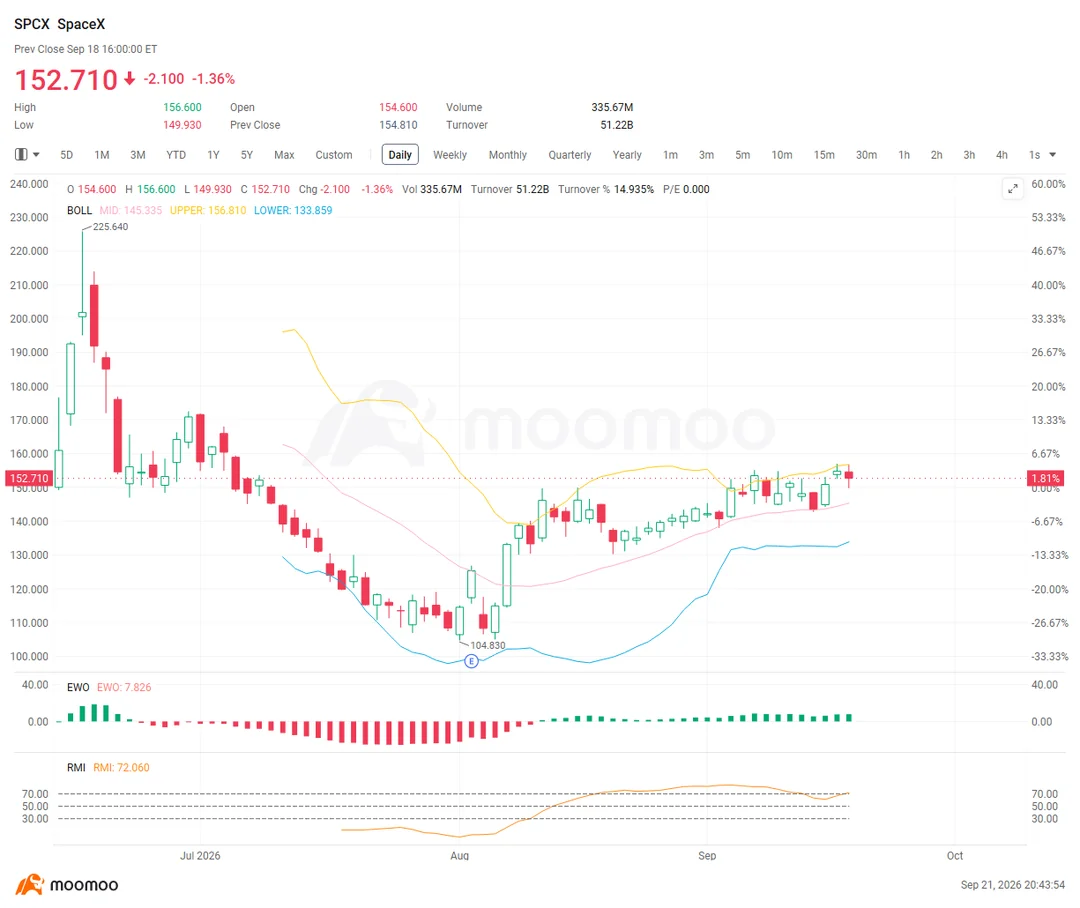
It’s worth being clear-eyed about what this kind of buying actually represents, and what it doesn’t. Index funds purchasing more SpaceX shares aren’t making a bet that the company’s earnings, profit margins, or execution risk have improved. They’re buying because their fund mandates require it, full stop. Once the rebalancing period concludes and funds finish adjusting their holdings to match the new weighting, that compulsory source of demand largely dries up, and the stock’s price will go back to being driven primarily by the same fundamentals that matter for any other company: actual business performance rather than index mechanics. SpaceX shares have gained about 15.5 percent from their $135 IPO price so far, though the stock remains roughly 5.1 percent below its first-day closing price of $160.95, and Barchart data shows the stock down about 4 percent over the past three months even amid this latest technical tailwind, a reminder that index-driven demand and actual investor sentiment don’t always move in the same direction.
So what should investors actually be watching once this rebalancing effect fades? The most immediate operational test is Starship, SpaceX’s massive next-generation rocket system, with another major test flight expected around September 28. A successful launch would matter for reasons well beyond bragging rights, since Starship’s payload capacity is central to SpaceX’s plans for deploying its heavier next-generation Starlink V3 satellites, a key piece of how the company plans to keep expanding its internet service business.
Beyond Starship, SpaceX’s business has increasingly split across three distinct segments: its traditional Space launch operations, its Connectivity business built around Starlink, and a newer, fast-growing AI segment. Wall Street analysts have floated some genuinely striking projections around that last piece, with some veteran analysts suggesting AI could eventually become SpaceX’s single largest revenue category, potentially reaching as much as $275 billion by 2030, and company management has reportedly set a target of reaching between 5 and 10 gigawatts of computing capacity by 2027. Musk’s broader AI venture, xAI, recently released its newest Grok 4.7 model, which posted a 46.3 percent score on the CursorBench benchmark, ahead of OpenAI’s GPT 5.6 Sol Max at 41.7 percent but behind Anthropic’s Claude Fable 5.1 Max at 51.8 percent, while reportedly undercutting both rivals on token pricing, a detail that’s being read as a positive signal for the broader AI ecosystem SpaceX is positioned within.
There’s also a longer-shot infrastructure bet worth watching: a chip manufacturing project reportedly called Terrafab, which Musk has said SpaceX will help fund in its initial phase. The scale being discussed is enormous, potentially spanning 100 million square feet and producing up to a terawatt of computing power annually, aimed at giving SpaceX, and potentially a combined SpaceX-Tesla operation, more direct control over the chip supply chain needed to support its AI infrastructure, robotaxi ambitions, and Optimus robot program. Nvidia CEO Jensen Huang has publicly questioned whether the project is realistic, pointing to how difficult it’s been for anyone to replicate what TSMC has built in advanced chip manufacturing, though he added that if anyone could actually pull it off, it would be Musk.
Founded back in 2002, SpaceX remains the world’s largest commercial space company by most measures, the top global launch provider, the largest satellite operator on the planet, and a major contractor for both NASA and the Pentagon, recently securing a $946 million NASA contract covering three additional International Space Station missions. This week’s index rebalancing is a real, measurable event for the stock, but as with any technical adjustment of this kind, it’s a supporting factor rather than a reason on its own to judge the company’s prospects. For investors weighing SPCX going forward, Starship’s next test flight, Starlink’s growth trajectory, and how quickly the AI segment actually scales are likely to matter far more than this week’s index mechanics once the passive buying wave runs its course. As always, this is general market information rather than investment advice, and anyone considering a position in SPCX should weigh their own research and risk tolerance, or consult a financial advisor, before making a decision.