|
Getting your Trinity Audio player ready...
|
China Builds Fully Equipped Mobile Barbershop Trucks for On-Demand Haircuts Anywhere
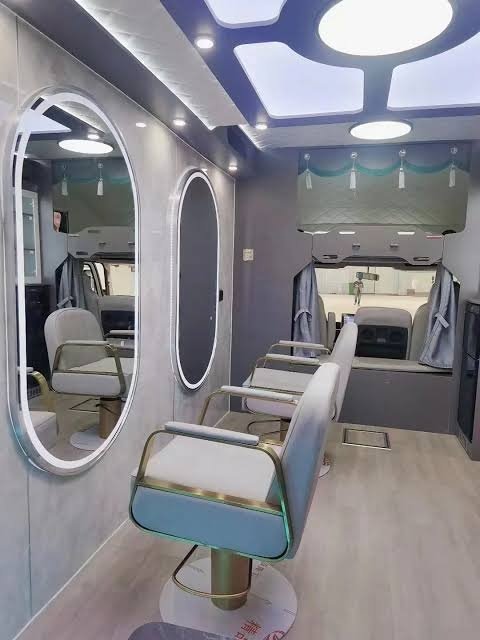
A haircut used to mean walking into a shop, waiting your turn, and sitting in someone else’s chair. In China, a growing number of barbers have started skipping that arrangement entirely, swapping the storefront for a truck. Manufacturers across the country are now building fully outfitted mobile barbershops, complete with barber chairs, mirrors, sinks, water tanks, and their own power supply, and shipping them to customers who want a working salon that can drive to wherever the next client happens to be.
The vehicles themselves are not improvised. Companies such as Chengli Automobile, based in Suizhou, Hubei province, manufacture these units on a commercial scale, building the body around a standard truck chassis with insulated walls, a flame-retardant interior lining, and electroplated anti-rust treatment so the cabin can hold up to years of daily use. Inside, the layout mirrors a conventional salon in miniature: a styling chair bolted to the floor, a mirror station, a wash basin plumbed to an onboard water tank, and enough counter space for clippers, combs, and styling products. Some models add air conditioning, LED lighting, and a small generator so the shop can operate anywhere, whether that is a city sidewalk with no available power outlet or a rural road with no infrastructure at all. According to industry marketplace listings, these trucks are being exported to more than 50 countries, a sign that the mobile barbershop concept has moved well past a niche curiosity and into an actual manufacturing category.
What is driving the demand is not just novelty. In China’s smaller cities and rural counties, many traditional barbershops have closed as younger stylists move to bigger cities for better pay, leaving older residents with few nearby options. A mobile barbershop parked outside a village market or an apartment complex solves a real logistics problem, bringing the service to people rather than asking them to travel for it. In Ningbo, a barber named Qiao Shuai has built a loyal following running his shop out of a well-worn vehicle, charging a symbolic 9.9 yuan for a men’s haircut, according to a report from China Daily. The publication described how the price and the setup drew curious onlookers who had seen mobile coffee stands before but never a complete barbershop built into a truck, and how Qiao has used the low-cost model to build both a customer base and a training pipeline for new barbers.
That same instinct, using a vehicle to reach people who cannot easily reach a shop, shows up again in China’s push to serve elderly residents in the countryside. Independent barbers have taken to hauling clippers and scissors out to remote villages specifically because the local shop shut down years ago and the nearest replacement is a long walk away for someone elderly and on foot. While that particular effort relies on a portable kit rather than a full truck build, it reflects the same underlying market gap that the manufactured mobile barbershop trucks are built to close on a larger, more commercial scale.
The trend is not unique to China, which suggests it is less a regional quirk and more a response to genuine shifts in how service businesses operate. In the United States, barbers in cities including Philadelphia and Las Vegas have converted box trucks and vans into full mobile shops after finding that a vehicle-based business avoids the overhead of commercial rent while still delivering a comparable experience, complete with shampoo sinks, televisions, and proper ventilation. In Vietnam, a barbershop chain built a mobile unit specifically to bring free haircuts to underserved communities outside the city. Canada has seen similar setups appear in cities such as Edmonton. What China’s manufacturers have effectively done is turn that same idea into an exportable product line, standardizing a category that elsewhere has largely been built one truck at a time by individual barbers with a welder and a plan.
There is a clear commercial logic behind why this is scaling out of China specifically. The country already has an enormous specialty vehicle manufacturing base built around food trucks, mobile clinics, and other purpose-built commercial vehicles, and adapting that same production line to barbershops is a relatively small engineering step. Suppliers can offer dozens of configurations, from compact trailers meant for a single chair to larger trucks that fit two stylists and two customers at once, and they can customize the build for climates ranging from humid coastal cities to dry inland provinces. Market researchers tracking the mobile barbershop and salon category have pointed to strong growth potential specifically in the Asia-Pacific region, driven by consumer appetite for convenience and lower operating costs compared to a fixed storefront.
For the barbers actually running these businesses, the appeal goes beyond cutting overhead. A mobile shop can chase foot traffic instead of waiting for it, setting up near a construction site during a lunch break, parking outside a factory gate on payday, or following a weekly circuit through villages where a fixed shop would never generate enough steady business to survive. That flexibility also lowers the barrier to entry for someone starting out, since a used van and a basic build can get a new barber working without the years of savings a storefront lease typically requires.
None of this replaces the traditional barbershop, and it is unlikely to. A shop with a fixed address still offers steadier hours, a larger service menu, and the kind of neighborhood presence that builds a loyal client base over years. What the mobile barbershop model offers instead is reach, letting a licensed barber serve people who would otherwise go without regular haircuts because there is nothing nearby. As more manufacturers refine the build and more barbers experiment with the format, the mobile barbershop looks less like a gimmick and more like a permanent, if smaller, part of how personal care services get delivered in places a fixed shop can’t easily justify opening.