|
Getting your Trinity Audio player ready...
|
By BusinessTech.ng Correspondent
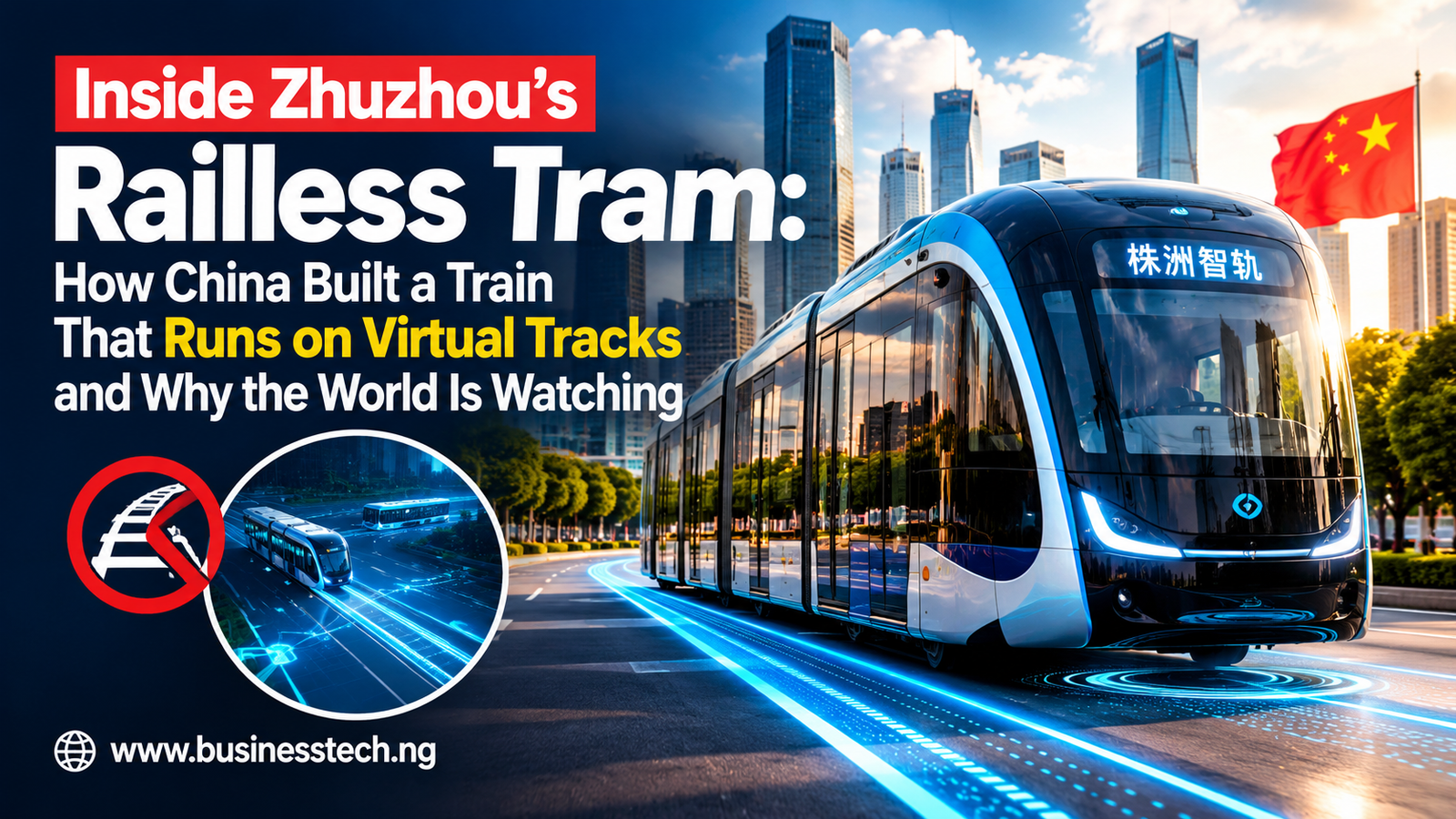
In the central Chinese city of Zhuzhou, in Hunan province, a sleek white vehicle glides along city streets each day with no steel rails beneath it and, on many routes, no visible track markings guiding it beyond a set of dotted white lines painted on the road. It looks like a tram, moves like a train and yet runs on rubber tires like a bus. Officially known as the Autonomous Rail Rapid Transit system, or ART, and widely described as the world’s first railless tram, the vehicle has become one of the more closely studied experiments in urban transport of the past decade, offering cities a way to get some of the benefits of light rail without the years of construction and billions in infrastructure spending that rail lines typically demand.
A train with no tracks to lay
The core idea behind ART is deceptively simple. Instead of running on physical steel rails embedded in the road, the vehicle uses onboard sensors, cameras and an autonomous optical guidance system to follow a virtual path, often marked only by painted lines on the street surface, and adjusts its steering in real time to stay within that path. Developed by CRRC Zhuzhou Institute, a subsidiary of Chinese state owned rolling stock giant CRRC, the system was first unveiled in June 2017 and underwent its first public road test in Zhuzhou that October. The first full public line opened in the city in May 2018, running 3.6 kilometers with four stations, marking what CRRC and Chinese state media described at the time as the debut of the world’s first intelligent rail system built entirely around virtual track technology.
Because it dispenses with rails altogether, the ART system sidesteps one of the most expensive and time consuming parts of building any tram or light rail network, the actual laying of track. According to figures reported by Chinese outlets at the time of the system’s launch, building one kilometer of subway can cost between 400 million and 700 million yuan, or roughly 58 million to 102 million dollars, while a standard streetcar line typically runs between 150 million and 200 million yuan per kilometer. A standard length ART vehicle, by contrast, has been estimated to cost around 15 million yuan, or about 2.2 million dollars, and CRRC has said the wider system can be built for roughly one fifth the cost of a conventional tram network, potentially saving well over a billion yuan on every ten kilometer route.
Speed, capacity and how it actually runs
The vehicle itself is built in a multi carriage configuration that can be adjusted depending on how many passengers a route needs to carry at a given time. In its standard three carriage form, stretching roughly 30 to 32 meters in length, the ART can carry around 300 passengers, while a five carriage configuration extends its capacity to as many as 500 passengers, giving operators the flexibility to scale service up or down without needing an entirely different vehicle. Its top speed sits at 70 kilometers per hour, comparable to many light rail systems, and the low floor design allows for easier boarding, including for passengers with reduced mobility.
Power comes from lithium titanate batteries rather than overhead wires or a diesel engine, which allows the system to avoid both emissions and the visual clutter of catenary lines running above city streets. The battery setup supports rapid charging, with roughly ten minutes at a station delivering enough charge for around 25 kilometers of travel, while shorter top up charges of about 30 seconds can be taken at intermediate stops along a route. On a full charge, the vehicle can travel up to 40 kilometers before needing to recharge again. In practice, human operators still drive the vehicle and control its speed, with the automated guidance system primarily assisting with steering and lane alignment rather than removing the driver entirely, a distinction that separates ART from a fully driverless metro system even as it markets itself around the language of autonomy.
From Zhuzhou to the rest of the world
What began as a demonstration project in Zhuzhou has since expanded well beyond that one city. ART lines or trial systems have since been introduced in Yibin in Sichuan province, Yichun in Jiangxi province, and other Chinese cities, along with a line in Wujiang district of Suzhou, in Jiangsu province, that opened in November 2021 and runs 5.1 kilometers with an operating speed of 70 kilometers per hour, matching the original Zhuzhou specification. The technology has also traveled abroad. In 2019, an ART vehicle underwent an overseas trial run in Doha, Qatar, tested over a seven kilometer route specifically to see how the system would cope with extreme heat, with local temperatures reportedly reaching as high as 70 degrees Celsius on some testing days, part of Qatar’s broader push to modernize urban transport ahead of hosting the 2022 FIFA World Cup. According to CRRC and industry reporting, more than 100 cities around the world have since expressed interest in the ART system or held discussions about potential cooperation, reflecting broader global interest in lower cost alternatives to conventional light rail as many mid sized cities look for ways to expand public transport without the price tag that comes with laying new track.
A serious alternative to light rail, not just a novelty
Transport researchers who have studied the system argue it represents something more substantial than a curiosity. Writing after visiting Zhuzhou to see the CRRC vehicle in operation, one prominent transport academic argued that trackless trams built on high speed rail derived technology have effectively taken the best features of light rail, including its speed, capacity and ride quality, and combined them with the flexibility and lower upfront cost of a bus, while avoiding the noise and emissions associated with diesel bus fleets. Critics have pushed back on that framing, with some observers comparing ART more closely to advanced guided busways used in other countries, arguing that a rubber tired, human driven vehicle following painted road markings is fundamentally still a sophisticated bus rather than a genuine successor to rail. Supporters counter that the cost savings alone, often estimated at around one fifth the price of building a conventional tram line, make the distinction largely academic for cash strapped city governments trying to expand transit networks quickly.
Implementing the system is not entirely without infrastructure demands of its own. Roads used by ART vehicles often require reinforcement to handle the weight of a multi carriage unit running repeatedly along the same corridor, and the virtual track markings need regular maintenance to remain legible to the vehicle’s guidance sensors. Even so, those requirements remain far less extensive than the excavation, rail laying and often lengthy road closures involved in building a conventional tram or light rail line from scratch.
What comes next
Nearly a decade after CRRC Zhuzhou Institute first unveiled the concept, the ART system has moved from a single demonstration line in Hunan province to a technology that Chinese manufacturers are actively exporting and pitching to city governments worldwide, particularly in fast growing mid sized cities that need more transit capacity than a bus network can offer but cannot justify the years long timelines and heavy capital costs that come with a traditional rail project. Whether the technology eventually becomes a mainstream fixture of urban transport outside China, or remains a niche solution adopted mainly by cities with tight budgets and specific route requirements, will likely depend on how well it performs in the wider range of climates and traffic conditions it is now being tested in, from the extreme heat of Doha to whichever city takes up CRRC’s pitch next.