|
Getting your Trinity Audio player ready...
|
Jaguar Land Rover to Cut 4,000 Jobs Over Next Two Years as UK Automaker Battles Rising Costs
Jaguar Land Rover has confirmed plans to eliminate roughly 4,000 jobs across its global operations over the next two years, marking one of the most significant restructuring moves yet for Britain’s largest carmaker as it tries to steady itself against a wave of external pressures ranging from a costly cyberattack to new U.S. tariffs and intensifying competition from Chinese rivals.
The Tata Motors owned company said the cuts, which amount to roughly 10 percent of its global workforce, are part of a broader push to save around £1.7 billion over the coming two years. JLR is also working to lower its production break even point down to 300,000 vehicles annually, a target that reflects just how much the ground has shifted beneath the luxury auto industry in a relatively short span of time. The company currently employs somewhere between 40,000 and 43,000 people worldwide, with the bulk of that workforce, close to 30,000 employees, based in the UK across its manufacturing hubs in the English Midlands.
Chief executive PB Balaji, who took over the top job last year after previously serving as Tata Motors’ finance chief, is now tasked with steering the company through what he has described as a period demanding greater organizational simplicity and operational resilience. JLR reported a revenue decline of close to 10 percent in the quarter ending June 2026, a drop that came on the heels of a cyberattack earlier this year that disrupted production lines and rattled supplier confidence across the company’s manufacturing network. Recovery from that incident has proven more expensive and drawn out than many analysts initially expected, compounding pressure that was already building from other directions.
Chief among those pressures is the 25 percent tariff the United States has imposed on imported vehicles, a policy that strikes directly at one of JLR’s most important export markets. Layered on top of that is a steady erosion of market share to lower cost Chinese electric vehicle makers, whose rapid technological progress and aggressive pricing have forced legacy automakers across Europe to rethink long standing assumptions about where they sit in the competitive hierarchy. Volkswagen has been navigating a similar reckoning with its own recent job reduction plans, and JLR’s announcement lands just months after fellow British luxury marques Aston Martin and Bentley disclosed their own cost cutting measures, suggesting the strain reaches well beyond any single manufacturer.
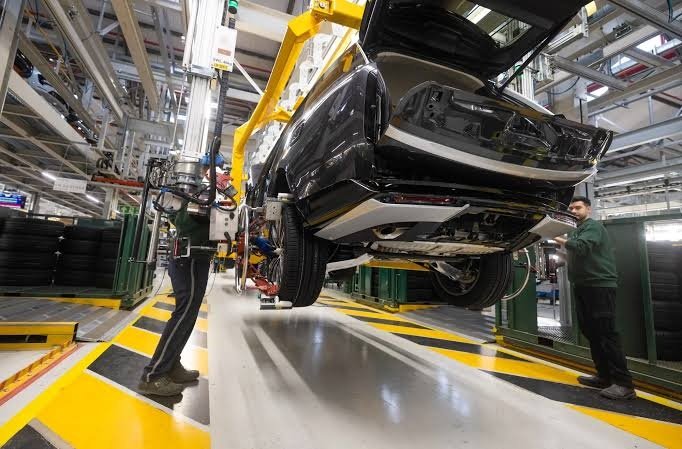
JLR has been careful to frame the layoffs as primarily voluntary, with the company indicating that factory floor production roles are not expected to bear the brunt of the reductions. Instead, the redundancy program appears aimed more heavily at office based and administrative functions as the company works to flatten its management structure. That approach mirrors moves made by other automakers navigating similar transitions, where the priority is often protecting frontline manufacturing capacity while trimming layers of corporate overhead that built up during periods of faster growth.
The announcement arrived as UK government officials weighed in on the broader implications for the country’s automotive sector. Business and Trade Secretary Jonathan Reynolds had already ruled out any direct government bailout for the company over the preceding weekend, signaling that ministers see this as a company specific restructuring rather than a sector wide crisis requiring state intervention. Even so, the scale of the cuts is likely to keep pressure on policymakers who have been vocal about wanting to support advanced manufacturing jobs in the Midlands, a region where JLR remains one of the largest private employers.
What makes this restructuring notable from a technology standpoint isn’t just the headline job number, it’s where JLR says the savings will ultimately be redirected. The company has committed to investing between £15 billion and £18 billion over the next five years into electrification, digital technologies, advanced manufacturing and improved customer experience systems. That figure underscores just how capital intensive the shift toward electric and software defined vehicles has become for legacy automakers, many of whom are essentially trying to fund two businesses simultaneously, the combustion engine platforms that still generate the bulk of near term revenue, and the electric, connected vehicle architecture that will determine long term competitiveness.
JLR is also planning to launch five new products over the coming twelve months, a signal that despite the workforce reductions, the company isn’t pulling back from its broader model refresh strategy. How successfully those launches land will matter a great deal for investor confidence, particularly given how closely Tata Motors shares are now tied to sentiment around JLR’s turnaround. The Mumbai listed stock dipped roughly 0.7 percent in the immediate aftermath of the announcement, though it remains up close to 9.5 percent for the year, suggesting markets haven’t lost faith in the broader restructuring story even as the near term headlines look difficult.
For workers and communities tied to JLR’s UK operations, the human impact of the announcement is significant regardless of how the numbers get framed on a balance sheet. A government spokesperson acknowledged as much, noting that the coming period will likely be an uncertain and difficult one for affected employees and their families. That reality sits alongside the strategic logic driving the decision, which is that JLR, like much of the legacy auto industry, is being forced to fund an expensive technological transition at the exact moment its traditional revenue base is coming under sustained pressure from tariffs, cyberattacks and a new generation of lower cost competitors.
The broader question hanging over this restructuring, and others like it across the industry, is whether cost cutting on this scale is enough to buy legacy automakers the breathing room they need to complete their pivot toward electric and software driven vehicles before Chinese manufacturers cement a lasting cost and technology advantage. JLR’s own investment commitments suggest the company believes it can still compete on that front, but the coming two years, marked by thousands of job losses and a leaner corporate structure, will be the real test of whether that bet pays off. Techora’s earlier coverage of the cyberattack that disrupted JLR’s production lines offers useful context on just how much ground the company has had to make up operationally even before this restructuring began. More details on the company’s electrification roadmap and investment plans are available through Jaguar Land Rover’s official newsroom, while Tata Motors continues to provide updates on the financial dimensions of the restructuring through its investor relations channels.