|
Getting your Trinity Audio player ready...
|
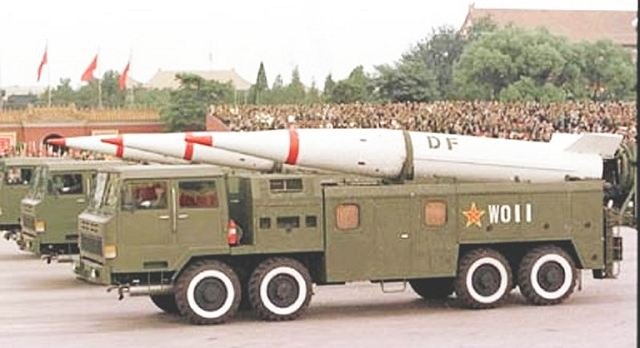
Wreckage identified as the booster stage of a Chinese-made DF-15A short-range ballistic missile has turned up in the Raghwan district of Marib Governorate in northern Yemen, prompting open-source analysts to speculate that Saudi Arabia may have used the weapon for the first time in its ongoing campaign against Houthi forces. Footage circulating online since September 14 shows men examining cylindrical debris under flashlight beams, with a section of the wreckage appearing to bear the marking DF-15A alongside other alphanumeric codes, according to analysis from South Front.
The find has generated significant attention because Saudi Arabia has no confirmed history of operating the DF-15A specifically, even though the kingdom’s relationship with Chinese ballistic missile technology stretches back decades. Riyadh acquired DF-3A intermediate-range missiles from China in the 1980s and has since been reported to have obtained DF-21 systems as well, but the shorter-range, road-mobile DF-15A has not previously been publicly linked to the Saudi arsenal. The DF-15A is a solid-fueled missile with an estimated range of 600 to 900 kilometers, capable of carrying a conventional warhead weighing roughly 500 to 750 kilograms, and relies on inertial guidance rather than satellite-assisted targeting.
Crucially, the footage and debris alone do not establish who fired the missile, when it was launched, or how the wreckage ended up in Raghwan. Analysts have floated multiple competing explanations rather than converging on a single confirmed account. Some open-source researchers believe the debris points to Saudi Arabia using the weapon for the first time, given the kingdom’s documented history of missile cooperation with China, including U.S. intelligence assessments describing Chinese assistance to Saudi Arabia in developing domestic solid-fuel ballistic missile production. Others have raised the possibility of an indirect Pakistani connection, since Saudi Arabia and Pakistan signed a mutual defense pact in September 2025 declaring that an attack on either country would be treated as an attack on both, building on decades of military cooperation that has included Pakistani troops training inside the kingdom. No source, however, has produced evidence directly tying Pakistani missile crews or hardware to the Marib wreckage, and that theory remains speculative.
At the same time, analysts have noted there is no publicly confirmed evidence that the Houthis or their backer, Iran, operate the DF-15A either, which leaves the weapon’s origin genuinely unresolved rather than pointing clearly toward any single party. Neither Saudi Arabia’s Ministry of Defense nor any other government has issued an official statement confirming which side fired the missile or acknowledging its presence in the Marib fighting at all. For now, every theory about the missile’s origin rests on the assessments of independent, open-source researchers analyzing publicly available footage rather than on any verified government source, and that distinction matters given how much international attention Chinese arms transfers to the region tend to attract.
The debris surfaced amid a sharp escalation in fighting around Marib, one of the last major population centers still held by Yemen’s internationally recognized government and a longstanding flashpoint in the country’s civil war. Houthi forces and government-aligned troops have exchanged strikes across multiple provinces since early September, with Saudi Arabia continuing to carry out airstrikes in support of government forces defending the city. The timing places the missile debris discovery directly inside a broader, rapidly shifting conflict that has also seen Houthi forces make significant territorial gains along Yemen’s western coast and complete a takeover of the strategically vital Bab el-Mandeb Strait in recent days, adding further intensity to a war that has already drawn in regional and international attention well beyond Yemen’s borders.
Whether or not the DF-15A theory holds up, the broader question of what other Chinese-made weaponry Saudi Arabia may hold in its arsenal has drawn renewed scrutiny following the find. Saudi Arabia’s decades-long relationship with Chinese missile suppliers has previously been described by nonproliferation researchers, including analysis published by the International Institute for Strategic Studies, as a significant complication for Western nonproliferation policy in the region, given that Riyadh’s missile imports and reported work on domestic solid-fuel motor production sit somewhat outside the scrutiny typically applied to Iran’s more closely watched missile program. That existing relationship is part of why analysts are treating the Marib debris as plausible evidence of an expanded, more capable missile capability inside Saudi Arabia’s arsenal rather than dismissing it outright, even without government confirmation.
The incident also underscores how difficult it has become to verify battlefield claims in Yemen’s current conflict, where multiple armed actors, external backers and open-source intelligence communities are all producing competing narratives in near real time. Similar ambiguity has surrounded earlier missile incidents in the region over the years, including previous cases where debris recovered in Saudi territory or along the Yemeni border required extended analysis before its origin could be reasonably established, if it ever was. The Marib find fits that same pattern of a physical artifact generating rapid speculation well ahead of any authoritative confirmation.
For now, the situation remains fluid. Saudi Arabia has not commented on the reported strike or acknowledged possessing the DF-15A, and no government has offered a definitive account of how the missile wreckage came to rest in Raghwan. Analysts monitoring the situation say further physical evidence, additional imagery, or an eventual government statement from either Riyadh or Beijing would be needed before the DF-15A theory, the Pakistani-connection theory, or any alternative explanation can be treated as more than an informed guess. Continuing coverage of how the Yemen conflict is evolving and drawing in regional military technology is available on Business Tech. Additional detail on the missile debris and its specifications can be found through Defence Blog’s original reporting on the find.