|
Getting your Trinity Audio player ready...
|
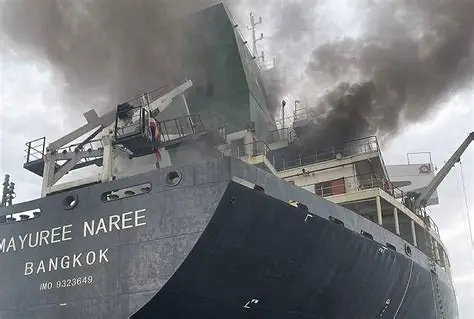
An Iranian commercial container vessel was struck by an unidentified projectile early Sunday near Hengam Island in the Strait of Hormuz, killing one crew member and wounding four others, according to Iranian state media. The attack, reported by the governor of Qeshm province, Hossein Amir Teymoori, adds to a mounting pattern of strikes against shipping traffic through one of the world’s most critical oil transit corridors, a waterway that has become the central flashpoint in the ongoing conflict between the United States and Iran.
The United Kingdom Maritime Trade Operations organization, which monitors shipping incidents across the region, separately confirmed that a vessel had been struck in the strait, reporting that a fire broke out on board and that local authorities were assisting with crew evacuation. Hengam Island sits roughly 1.2 miles south of Qeshm Island, itself the largest island in the Persian Gulf and a location Iran has treated as strategically central to its broader effort to assert control over shipping through the strait. As of this reporting, the United States has not claimed responsibility for the strike, and US Central Command had not issued a public statement on the incident.
This latest attack lands at a particularly tense moment. It struck just a day before Iran was scheduled to brief regional countries on its contested efforts to manage shipping traffic through Hormuz, and hours after Iranian President Masoud Pezeshkian posted defiantly on social media that Iran’s people cannot be bullied into submission and that the country will not surrender. That messaging reflects where negotiations currently stand between Washington and Tehran, effectively stalled. Ebrahim Azizi, head of the Iranian parliament’s national security committee, wrote separately on X that talks and dialogue remain useless as long as the American side refuses to accept all of Iran’s conditions.
Rather than negotiating directly with Washington, Iran has instead been pursuing a parallel diplomatic track with its Gulf neighbors. A senior Iranian government official and a Gulf diplomat told reporters that officials from Iran and Gulf countries were set to meet in Oman’s capital, Muscat, to sign an agreement establishing a dedicated Iran-Oman shipping route through the Strait of Hormuz, an arrangement aimed at creating safer maritime passage even amid the broader standoff with the US. Iranian officials have been careful to clarify what that agreement does and doesn’t mean in practice. One senior official told CNN the arrangement does not imply an automatic reopening of the strait, stressing that it will not become genuinely secure until the United States halts what Tehran characterizes as its naval blockade and broader economic pressure campaign.
The scale of disruption to shipping through Hormuz over recent months has been considerable. US Central Command said it destroyed ten Iranian tankers over the course of a single week, and separately confirmed that its forces have redirected 100 commercial vessels away from the strait over the past 60 days as part of a resumed naval blockade against Iran. That blockade, combined with the recurring pattern of projectile and missile strikes against vessels transiting the strait, has kept the Hormuz corridor severely disrupted for months, a disruption with direct consequences for global oil markets given that the strait normally carries roughly 20 percent of the world’s oil supply through its waters.
Sunday’s strike is far from an isolated incident. Just weeks earlier, on August 3, an unnamed bulk carrier, later identified through maritime security sources as the Minoan Pioneer, was struck in its engine room off the Musandam Peninsula in the Omani coastal channel, causing a complete power blackout and a fire in the ship’s accommodation area, with the vessel’s third engineer going missing following the blast. Maritime security consultancy Vanguard Tech attributed that and prior kinetic attacks in the same corridor specifically to Iranian forces, noting Iran’s objection to the neutral Omani shipping route as a workaround that bypasses the administrative control Tehran has tried to assert over strait traffic. A separate incident in early July saw a Qatari-flagged LNG tanker, the Al Rekayyat, struck by a projectile roughly 8 nautical miles off the coast of Limah, Oman, sparking a fire that risked triggering an explosion in the vessel’s engine room before the crew’s safety was confirmed.
The broader regional picture has grown more volatile still in recent days. Yemen’s Iran-backed Houthi rebels claimed responsibility Sunday for a separate attack on a Saudi military base in the Sharurah region, adding another active front to a conflict that already spans the Strait of Hormuz, Saudi energy infrastructure, and Red Sea shipping lanes simultaneously. More than 76,000 people have been reported fleeing their homes in Yemen amid the rising fighting tied to that broader Houthi offensive, underscoring how interconnected these separate flashpoints across the region have become.
For now, the practical reality facing commercial shipping in the Strait of Hormuz remains one of persistent risk and unpredictability, with vessels facing potential strikes from multiple directions amid an active US naval blockade, recurring Iranian and Houthi attacks, and stalled diplomatic negotiations that show little sign of producing a durable resolution in the near term. Whether Monday’s planned Iran-Oman meeting in Muscat produces a meaningful, if partial, improvement in maritime safety through the strait, or whether it becomes yet another diplomatic gesture overtaken by the next attack, will likely become clearer in the days immediately following Sunday’s strike.