
|
Getting your Trinity Audio player ready...
|
China Is Racing to Build Better Ways to Shoot Down Drones, and the Numbers Show It
Drones have quietly become the defining weapon of modern conflict, and China’s military and defense industry have noticed just as clearly as everyone else has. Watching how cheap quadcopters and loitering munitions have reshaped fighting in Ukraine and elsewhere, Beijing has poured serious money and research effort into a much less talked-about side of the same technology: figuring out how to stop drones rather than build them.
The scale of that effort shows up clearly in patent filings. According to research from the intellectual property law firm Mathys & Squire, global patent applications for anti-drone technology jumped 27 percent in the year ending March 2025, rising to 126 total filings from 99 the year before. China accounted for the overwhelming majority of that activity, filing 82 of those applications on its own, more than three times what the United States filed during the same period. Within that pool, laser-based systems made up 39 patents and microwave weapons another 24, both falling under a category defense researchers call directed energy, weapons designed to knock a drone out of the sky without ever physically touching it.
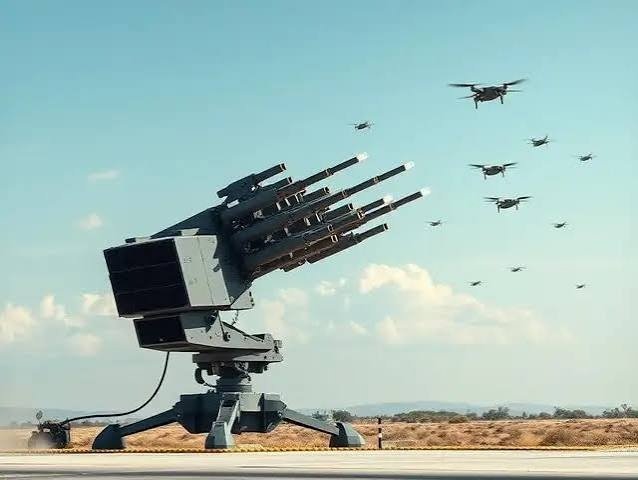
That patent activity lines up with a string of public demonstrations China has rolled out over the past year. In March, state broadcaster CCTV showed off two new laser systems, named Guangjian, built specifically to catch drones flying low enough to slip under conventional radar coverage, typically somewhere between 50 and 80 meters off the ground. One version pairs electronic warfare tools with a laser designed to scramble a drone’s onboard sensors and communication link rather than physically destroying it. The other is mounted on a vehicle and built for straightforward kinetic strikes, meant to keep firing while moving so it’s harder for an enemy to target in return. Both rely on a mix of radar and infrared tracking, letting them keep tabs on a target even in situations where jamming or heavy radio interference might otherwise blind a purely radar-based system.
A few months later, at Beijing’s Defense Information Equipment and Technology Exhibition, a company called Harbin Xinguang Optic-Electronics showed off something smaller and arguably more practical for battlefield use: a shoulder-carried laser weapon called Lijian, meaning roughly “sharp sword.” Unlike the vehicle-mounted systems, this one is built to be carried and operated by a single soldier, turning what used to require a dedicated vehicle or fixed installation into something a foot patrol could theoretically bring along. It’s a small piece of hardware, but it points at a bigger strategic idea China’s military planners have been chasing: cheap, mass-produced drones need cheap, widely deployable ways to counter them, not just a handful of expensive, centralized defense systems guarding a few high-value targets.
Behind these individual weapons sits a much bigger organizational puzzle, and it’s arguably the part China’s researchers seem most focused on solving. Researchers at the PLA Naval Research Institute have written about the need to fuse together radar, jamming, cameras and other sensors into one unified picture, feeding into command systems that can make split-second decisions when dozens or hundreds of drones show up at once rather than a single intruder. Chinese firms like Quansheng Technology and Chengdu Kongyu Technology have separately claimed their systems combine AI-driven detection with radio-frequency jamming to identify and disable drones with little human input needed once a swarm is spotted. Whether those claims hold up under real combat pressure is impossible to verify from public statements alone, but the direction of the research is consistent: China isn’t just trying to build better individual weapons, it’s trying to build a network that can react fast enough to matter against genuinely large numbers of drones arriving together.
That focus on swarms specifically has shown up in China’s own military exercises too. Footage released by CCTV as part of the PLA’s 2026 training cycle showed a naval unit running drills against waves of low-flying suicide drones attempting to reach simulated ships, with the exercise deliberately built around the kind of saturation attack that Taiwan and other regional militaries have increasingly leaned on as a low-cost way to threaten much larger, far more expensive naval assets. Separate research described in a July 2026 report from CNA noted that Chinese researchers have also been simulating what they call counter-swarm kill architectures, using networks of smaller interceptor drones working together to bring down incoming enemy swarms rather than relying purely on ground-based lasers or jammers.
None of this is happening in a vacuum, either. China has reportedly been running structured military-linked competitions, events with names like “Game of Huashan” and “Yuanrong Qihang,” specifically designed to push forward both offensive drone swarm coordination and counter-drone defense algorithms, treating these contests as a pipeline for moving promising ideas out of research labs and into fielded systems faster than a traditional procurement process might allow.
Stepping back from China specifically, the broader market forces at play here aren’t surprising. Firm Fortune Business Insights estimates the global counter-drone systems market at roughly $14.4 billion in 2026, on track to grow past $55 billion by 2034, driven by the same basic problem showing up everywhere from active war zones to airports and stadiums: drones have gotten cheap and capable enough that almost anyone can deploy dozens of them, and defenses built around stopping one aircraft at a time simply don’t scale. China’s aggressive push on lasers, jamming and AI-assisted detection reflects a country trying to get ahead of that problem before it becomes the deciding factor in a future conflict, rather than scrambling to catch up once one starts. More detail on China’s publicly disclosed counter-drone systems has been covered directly by Global Times, the state-run outlet that first reported on several of the laser systems mentioned above.