|
Getting your Trinity Audio player ready...
|
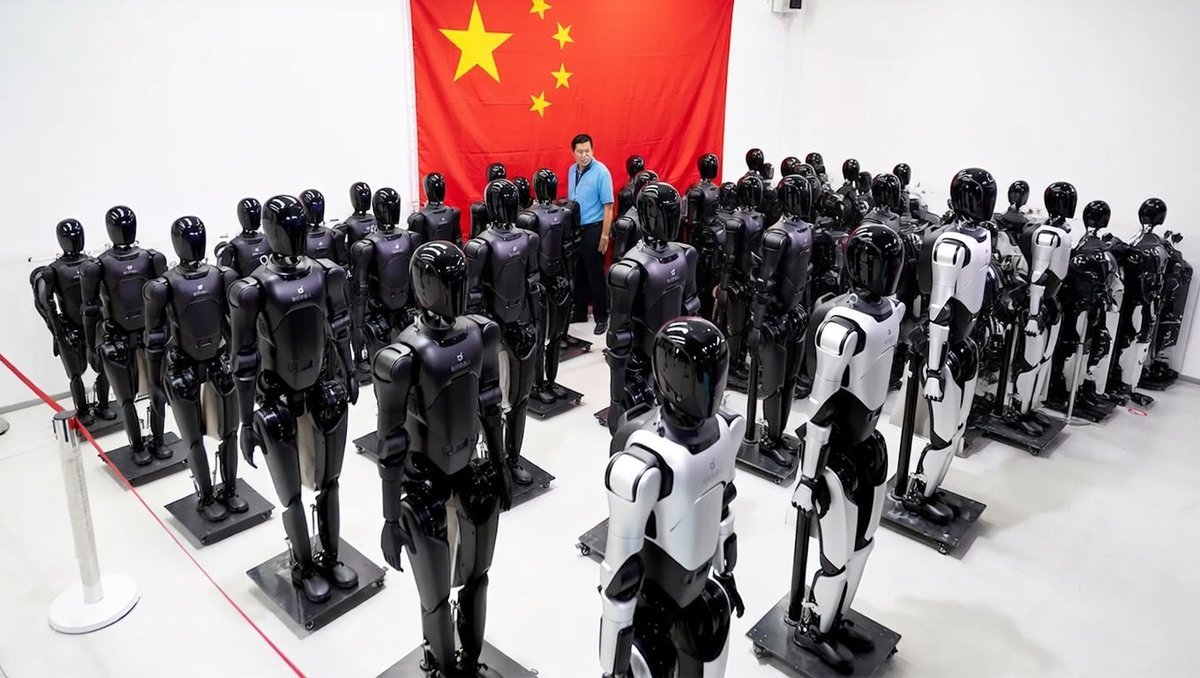
China took its most concrete step yet toward genuinely industrial-scale humanoid robot production this week, with UBTECH Robotics announcing the launch of what it calls the world’s first intelligent manufacturing facility built specifically for producing humanoid robots at 10,000-unit annual capacity. The plant, located in Liuzhou in China’s Guangxi Zhuang Autonomous Region, began operations on September 12, and UBTECH shares climbed more than 3 percent in early trading days later as investors responded to the news.
The Liuzhou facility, which UBTECH describes internally as a “super smart factory,” spans 14,000 square meters with a building height of 13.8 meters. It will focus primarily on manufacturing the company’s Walker S Series and Cruzr Series robots, both marketed as embodied intelligence platforms designed for industrial deployment rather than consumer or household use. The production line is engineered to complete a finished robot roughly every ten minutes, a pace that, if sustained, would put the facility on track toward its stated goal of producing more than 10,000 units annually.
What sets this facility apart from earlier humanoid robot production announcements is the depth of automation built into the manufacturing process itself, not just the assembly line but the surrounding logistics and quality control infrastructure supporting it. According to UBTECH, every completed robot undergoes more than four hours of whole-machine testing before leaving the factory, passing through an automotive-grade lighting inspection tunnel designed for full 360-degree, dead-angle-free appearance screening. The company has also built what it describes as the industry’s first fully automated stereoscopic warehouse specifically for humanoid robots, a compact 65-square-meter space capable of storing 112 finished units while improving space utilization by more than 50 percent compared to conventional storage methods. A full logistics network combining automated guided vehicles, unmanned forklifts, and dedicated transport vehicles connects every stage of the process, from sub-assembly through final testing and storage, specifically engineered to keep pace with the turnover demands of genuine 10,000-unit-level annual production.
UBTECH’s leadership has been fairly candid about why this level of manufacturing scale has become achievable in China specifically, and not elsewhere. Pang Jianxin, the company’s vice president, told the Global Times that mass production at this scale is inseparable from the support of China’s broader supply chain, arguing that without it, manufacturing complex robotic components at volume would be extremely difficult without sacrificing cost advantages entirely. According to Pang, China’s position at the front of the global robotics industry rests on a foundation built over the past decade or two, a large accumulated base of engineers, scientists, and real-world application scenarios that together have produced an unusually strong combination of supply chain depth, manufacturing capability, and research strength. He also pointed to China’s breadth of industrial application scenarios as a specific advantage, arguing the country’s manufacturing base offers the richest variety of real-world use cases for testing and refining these systems at scale.
It’s worth noting that UBTECH is far from alone in racing toward this particular milestone, and “world’s first” claims have become genuinely contested marketing language across China’s rapidly expanding humanoid robotics sector. Just months earlier, in March, a separate facility in Guangdong built by Leju Robotics in partnership with Dongfang Precision began operations with its own claimed capacity of 10,000 units annually, producing one robot every 30 minutes. That plant grew out of an earlier pilot production line Leju launched in Shenzhen’s Longhua district in April, initially producing 500 to 1,000 units a year while working toward full certification before scaling to the Guangdong facility. Separately, electric vehicle maker XPeng commissioned its own humanoid robot production line in Guangzhou on September 8, watching its IRON robot autonomously walk off the assembly line as a symbolic marker of the transition from prototype to production-line manufacturing, with the company citing core process automation exceeding 80 percent as a new benchmark for the industry.
The competitive intensity extends well beyond manufacturing capacity claims into actual deployment numbers as well. Rival firm Agibot recently announced it had rolled out its 10,000th humanoid robot, while Unitree Robotics has been pursuing a $580 million funding round specifically aimed at building a facility targeting 75,000 units per year, a figure that would dwarf the current generation of Chinese humanoid robot factories if achieved. Beyond dedicated manufacturers, China has also begun deploying humanoid robots directly into existing production environments, with battery giant CATL announcing what it called a world’s first at-scale deployment of humanoid robots at its Zhongzhou production base in Luoyang, where robots built by startup Spirit AI now handle high-voltage battery connector installation, a task traditionally considered risky for human workers on EV battery assembly lines.
China’s national industrial policy has clearly identified this sector as a strategic priority rather than leaving it purely to market forces. The country’s 15th Five-Year Plan, covering 2026 through 2030, explicitly included embodied intelligence among its development priorities for future industries, specifically calling for the creation of concept-validation and pilot-verification platforms to help translate robotics research into genuine industrial manufacturing capability. That policy framing helps explain why multiple Chinese cities and provinces have simultaneously pursued their own competing humanoid robot manufacturing facilities over the past year rather than consolidating around a single national champion, a pattern that mirrors how China approached earlier strategic manufacturing sectors like electric vehicle batteries and solar panels.
Whether UBTECH’s Liuzhou plant genuinely represents the definitive “world’s first” facility of its kind, or simply the latest and most publicized entry in a rapidly crowded field of competing Chinese humanoid robot factories all racing toward similar production milestones within months of each other, the broader trend is unmistakable. China’s humanoid robotics industry has moved decisively past the prototype and pilot-testing phase this year, and the question now facing the sector isn’t whether these companies can build robots at industrial scale, but whether AI systems sophisticated enough to make those robots genuinely useful workers, rather than expensive technological showcases, can keep pace with how quickly the manufacturing capacity to produce them is expanding.