|
Getting your Trinity Audio player ready...
|
A Shanghai robotics startup just put a price tag on how far the cost of humanoid robots has fallen, and the number is jarring next to what the Pentagon is currently paying for comparable hardware. AgiBot’s Lingxi X2, a compact humanoid that rides bicycles, balances on hoverboards and dances, sells through the company’s own store starting around $24,240, with configurations ranging from roughly $13,800 up to $55,000 depending on the version. That price sits in a completely different universe from the multimillion-dollar contracts flowing through American defense robotics programs right now, and the gap says a lot about where each side of this race is actually focused.
AgiBot, also known by its Chinese name Zhiyuan Robotics, was founded in February 2023 by Peng Zhihui, a former Huawei “Genius Youth” engineer who left a lucrative salary to build humanoid robots full time, along with co-founder Deng Taihua. In just under three years, the company has become one of China’s best-funded robotics startups, pulling in backing from BYD, Tencent, Hillhouse Investment, JD.com and HongShan across multiple funding rounds. Pitchbook valued the company at $2.1 billion as of March, and later funding activity has pushed some reported valuations considerably higher, positioning AgiBot among the most closely watched players in China’s crowded humanoid robotics field.
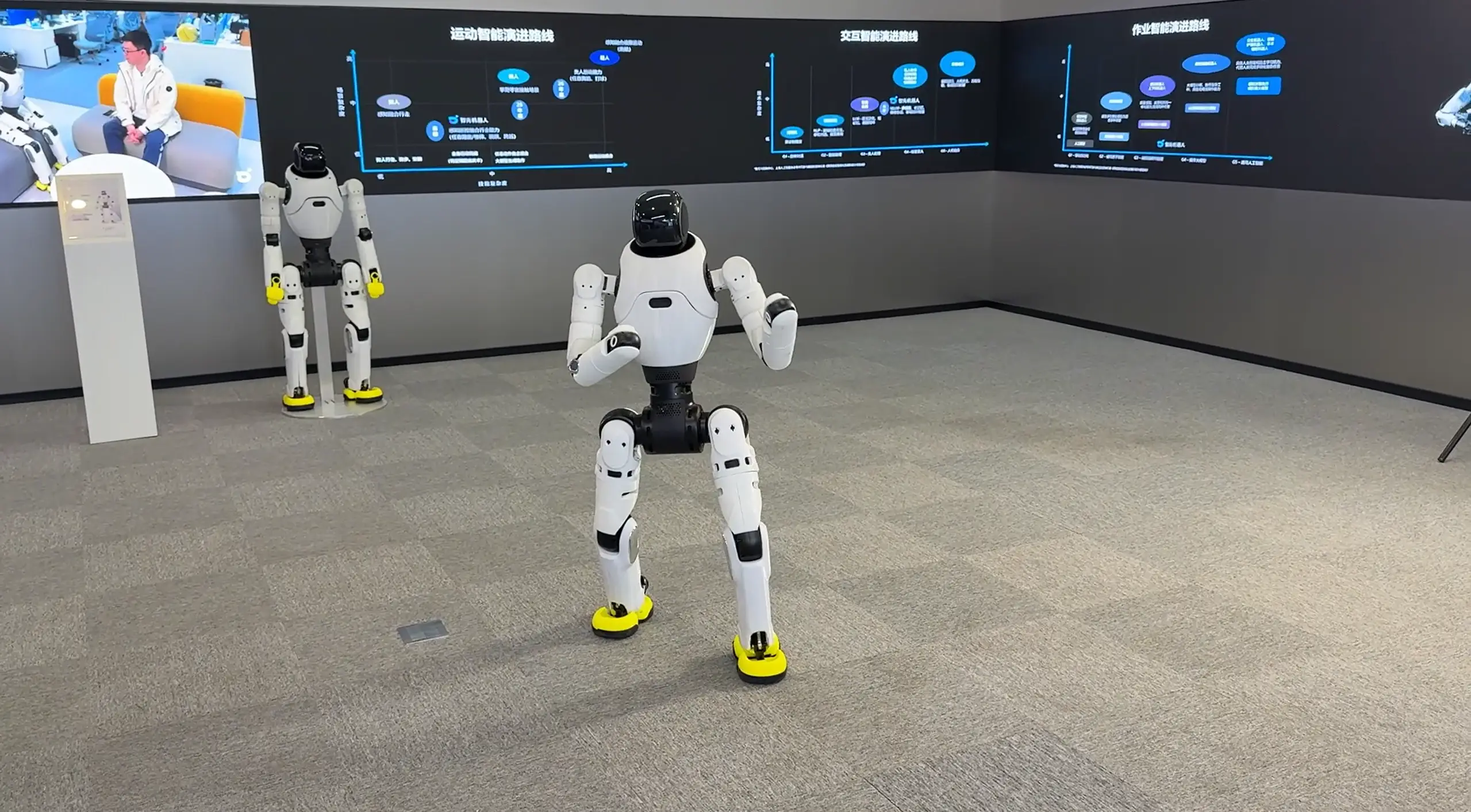
The Lingxi X2 itself, standing about 1.3 meters tall and weighing between 33 and 39 kilograms depending on configuration, was built specifically for education, entertainment, exhibition-hall hosting, and light service roles rather than industrial or combat applications. AgiBot markets it as its most interactive product line, capable of responding to human facial expressions and vocal tone in milliseconds, riding a self-balancing bicycle autonomously, and performing scripted demonstrations like dancing or reading medication instructions aloud. The robot runs on AgiBot’s GO-1 model, a vision-language system the company says allows it to generalize simple manipulation tasks without needing to be specifically trained on each one first.
What makes the pricing genuinely notable isn’t just that it’s cheap by robotics standards, it’s cheap relative to what full-sized, general-purpose Chinese humanoids from competitors typically cost. Unitree’s H1 and Fourier’s GR-2, both larger and more industrially capable platforms, run well into six figures, while smaller companion-style humanoids from firms like EngineAI and Booster Robotics start closer to $13,000 to $30,000, putting the Lingxi X2 squarely in the middle of an increasingly crowded and increasingly affordable Chinese humanoid market.
Compare that to what’s happening on the American defense side. Foundation Future Industries, a two-year-old California robotics startup, secured a $24 million contract with the Pentagon covering research work with the US Army, Navy and Air Force, and has already deployed its Phantom MK-1 humanoid to Ukraine for reconnaissance and weapons-handling support roles. Foundation doesn’t publish a straightforward purchase price, but leases the Phantom MK-1 to industrial and government customers at roughly $100,000 per year, a figure that reflects the far higher engineering and testing costs baked into a platform built for battlefield conditions rather than exhibition halls. Beyond individual company contracts, the Pentagon’s broader autonomous systems budget is set to expand dramatically, with the Defense Autonomous Working Group’s funding proposed to jump from $226 million this year to $54 billion under the 2027 spending plan, though that figure covers autonomous drone systems more broadly rather than humanoid platforms specifically.
The contrast reflects two very different starting points and goals rather than one side simply being more competent than the other. AgiBot’s Lingxi line was never designed to survive combat conditions, carry weapons, or operate in contested environments, its low price comes from targeting consumer, education and entertainment markets where mass production and simplified hardware keep costs down. Foundation’s Phantom line, by contrast, is being engineered specifically for battlefield logistics, reconnaissance, and eventually direct support roles alongside soldiers, which requires ruggedized components, secure communications, weapons-mount compatibility and far more extensive testing before any unit reaches an active conflict zone. Comparing the two price tags directly, as if they represent competing solutions to the same problem, misses that they were built to solve entirely different ones.
That said, the pricing gap does highlight a real structural advantage China currently holds in humanoid robotics: manufacturing scale and cost discipline built for consumer and commercial markets first. AgiBot has already moved well beyond prototype demonstrations, reportedly shipping hundreds of bipedal and wheeled units from its Shanghai factory and generating $10.8 million in revenue in 2025 with a roughly 200-person team, according to data compiled by GetLatka. That kind of production volume, aimed at driving unit costs down through scale, is precisely the model American defense contractors have historically not needed to follow, since defense procurement has traditionally prioritized capability and reliability over price competition, particularly for platforms destined for active conflict zones rather than mass consumer deployment.
Whether that manufacturing scale eventually translates into a meaningful military advantage for China remains a separate and far more complicated question than simply comparing sticker prices. Building a robot that can dance, ride a bike and read instructions off a screen is a fundamentally different engineering challenge than building one that can carry a weapon, survive rough terrain, and operate reliably without connectivity in an active conflict zone, and nothing in AgiBot’s public product lineup currently claims to do the latter. What the Lingxi X2’s price does demonstrate clearly is that China’s consumer and commercial humanoid robotics sector has reached a level of manufacturing maturity that lets it sell increasingly capable machines at prices American defense contractors, working in a fundamentally different cost and requirements environment, are nowhere close to matching for their own specialized platforms. Continuing coverage of how global robotics competition is reshaping technology and defense industries is available on Business Tech. Additional detail on the Lingxi X2’s specifications and pricing is available through AgiBot’s official site, and further reporting on Pentagon humanoid robotics contracts can be found through Semafor’s coverage of the Foundation Future Industries deal.