|
Getting your Trinity Audio player ready...
|
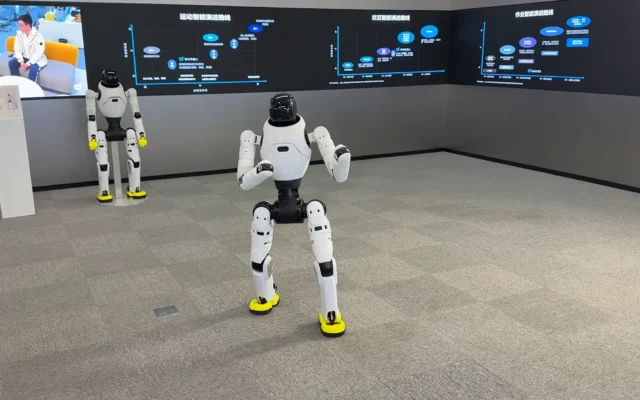
A Chinese security technology firm has unveiled a lightweight, modular net-launching system designed to let police officers immobilize suspects from a safe distance, without approaching them and without drawing a firearm. NEXWISE, a Guangzhou-based public safety and security technology company, showcased the device at the 2026 World Robot Conference in Beijing, where it demonstrated the system mounted on a robotic dog capable of identifying a target and firing a restraining net entirely on its own initiative before human officers move in to complete the arrest.
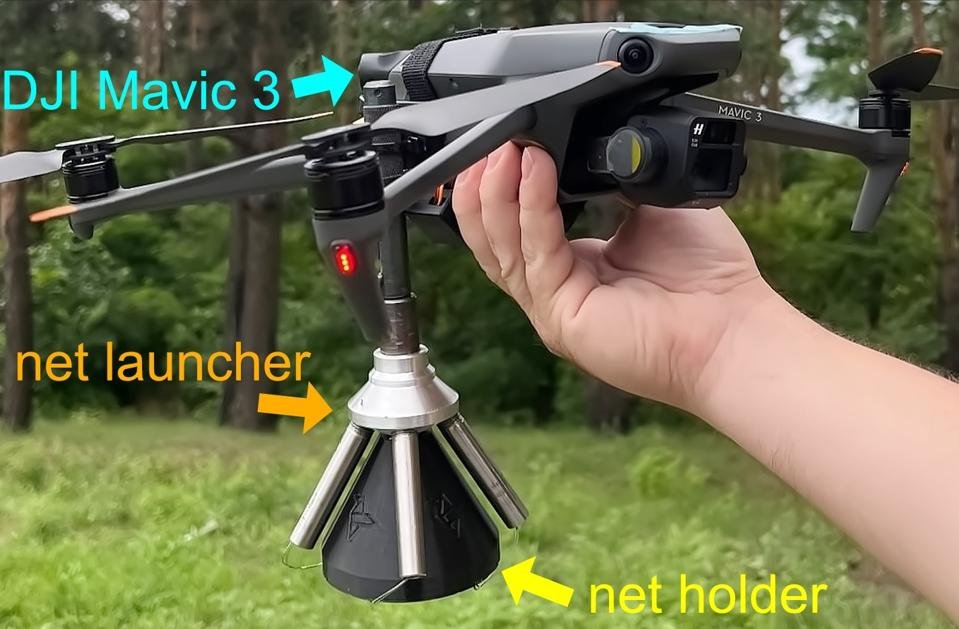
The core of the system is built around ultra-high-molecular-weight polyethylene, or UHMWPE, a synthetic fiber known for extreme tensile strength relative to its weight, the same material family used in bulletproof vests and cut-resistant gloves. According to company materials, the launcher fires a UHMWPE net that tightens and tangles further as a target struggles against it, effectively using the person’s own resistance to increase the restraint’s hold rather than requiring the net to be perfectly positioned on first contact. The system is designed to engage targets at ranges between 5 and 15 meters, and NEXWISE has built it to be deployable in multiple configurations, carried and fired by hand, mounted on drones, or attached to unmanned ground vehicles and robotic dogs, giving law enforcement agencies flexibility to deploy it across very different tactical situations.
What sets NEXWISE’s approach apart from more conventional net guns, a category of non-lethal device that’s existed in various forms since the technology was first developed for wildlife capture decades ago, is the launch mechanism itself. Rather than relying on gunpowder-based propulsion, the system uses electromagnetic launch technology, according to documents the company provided at the Beijing conference. NEXWISE staff told Global Times that the electromagnetic system runs quieter than traditional gunpowder-powered net launchers, reducing the risk of panic among bystanders during a live deployment, while also restraining suspects more quickly once fired. Company documentation describes the standard configuration firing a restraining net from between 5 and 10 meters, with a dual-shot version capable of launching two nets in succession, giving officers a second attempt if the first shot misses or fails to fully immobilize the target.
The robotic dog demonstration at the World Robot Conference illustrated how NEXWISE envisions the system actually working in practice. Rather than functioning purely as a remote-fired weapon under constant human control, the robot itself can lock onto a designated target and fire the restraining net autonomously once that target has been identified, a workflow the company describes as “front-end identification by robotic dog, remote control of net launcher and on-site handling by personnel.” That three-stage process, autonomous detection, remote-controlled firing, and human follow-up, reflects a broader pattern increasingly common across Chinese security robotics, where autonomous systems handle target identification and initial engagement while human officers retain final authority over the physical apprehension itself.
NEXWISE has pitched the technology specifically around reducing risk to law enforcement personnel during suspect apprehension, positioning it for use at schools, hospitals, banks, and government institutions, environments where police response to an armed or resistant individual carries genuine danger to both officers and bystanders if handled purely through direct physical confrontation or firearms. The company’s broader security robotics lineup extends beyond suspect capture as well, with its robotic dogs also demonstrated performing autonomous patrol duties at industrial facilities including power plants, using onboard cameras and basic decision-making capability to reduce the need for constant human patrol presence.
This isn’t NEXWISE’s first public showcase of the net-capture concept either. The company demonstrated a quadrupedal unmanned ground vehicle configured specifically for net-capture operations at April’s Defence Services Asia exhibition in Kuala Lumpur, alongside a separate configuration built for autonomous patrol tasks. According to Zeng Yuan-yuan, NEXWISE’s overseas business and group brand director, both systems are built on a modular platform developed through the company’s subsidiary ZanX, designed to accommodate a range of different payloads, including, notably, weapon systems beyond the net launcher itself. The company also provides an application programming interface that lets customers integrate different payloads onto the same base unmanned ground vehicle depending on their specific operational requirements, an approach that mirrors how modular military hardware platforms are increasingly designed to support multiple mission profiles from a single underlying chassis.
The broader context here matters for understanding why this particular technology has drawn international attention. NEXWISE’s net launcher fits within a rapidly expanding category of Chinese security and defense robotics increasingly showcased at major domestic exhibitions, alongside displays from companies including China North Industries Group Corporation and the China Electronics Technology Group Corporation’s 21st Research Institute at the same Beijing conference. Chinese robotics firms have been aggressively expanding the range of security and quasi-military applications built around commercially available quadrupedal robot platforms, a trend that’s drawn scrutiny internationally given how quickly these same robotic dog platforms have also appeared equipped with far more lethal payloads, including reports of Chinese-made robotic dogs modified with grenade launchers and machine guns for urban combat applications elsewhere in the military robotics sector.
For law enforcement agencies specifically, though, the appeal of a genuinely non-lethal, stand-off suspect capture system is fairly straightforward to understand. Traditional net guns have existed for law enforcement use for years, but combining that established non-lethal capability with autonomous target identification and multi-platform deployment options, hand-held, drone-mounted, or robot dog-mounted, represents a meaningful evolution in how police forces might approach de-escalating potentially dangerous confrontations without immediately resorting to firearms. Whether Chinese police agencies move toward actual operational deployment of NEXWISE’s system, or whether it remains primarily a conference showcase demonstrating future capability, will likely become clearer as the company continues marketing the technology to domestic security and law enforcement customers following its Beijing debut.
For more coverage of robotics and public safety technology developments, visit Business Tech.