|
Getting your Trinity Audio player ready...
|
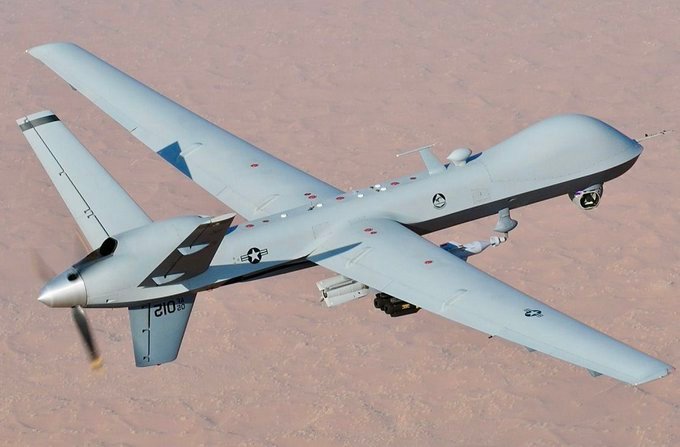
Iran’s Islamic Revolutionary Guard Corps announced it shot down another American MQ-9 Reaper drone, the latest in a long and escalating string of claimed downings stretching back to late February, when a renewed US-Israeli military campaign against Iran began. The IRGC credited the shootdown to what it described as a modern, advanced air-defense system, with state media reporting the incident occurred near the Strait of Hormuz, one of the most heavily contested and closely watched stretches of airspace in the current conflict.
This latest claim fits a pattern that has become almost routine over the course of the year. According to figures cited by Bloomberg, Iran has destroyed more than two dozen MQ-9s since the current war began, a toll representing close to 20 percent of the Pentagon’s entire pre-war Reaper inventory. Other reporting citing Iranian and allied claims puts the number considerably higher, with some accounts crediting Iran and its regional allies with more than 40 MQ-9 losses when combined with strikes at forward bases in Jordan and Kuwait, and total combat losses across all theaters climbing above 90 aircraft when Houthi shootdowns near Yemen are factored in as well. The US Air Force entered the conflict with roughly 185 Reapers in its inventory, split between 165 Air Force and 20 Marine Corps aircraft, meaning even the more conservative loss estimates represent a serious operational strain on one of the military’s most heavily relied-upon reconnaissance and strike platforms.
That strain has not gone unacknowledged within the US military itself. Air Force Lieutenant General David Tabor told Congress that the service is actively exploring options to acquire as many replacement MQ-9A aircraft as possible, a fairly direct admission that attrition has outpaced the fleet’s ability to sustain itself through the conflict’s current operational tempo. At roughly $30 million per unit, even the lower-end loss estimates put the cumulative cost of destroyed drones well into the hundreds of millions of dollars, a bill that continues climbing with each additional claimed shootdown.
Iran’s public messaging around these incidents has followed a consistent template throughout the year. IRGC statements typically frame each shootdown as a defensive response to what Tehran characterizes as continued American “aggression” or “air aggression” against Iranian sovereign territory and airspace, often released alongside warnings that any further American strikes will be met with what officials describe as a “legitimate and definite right” to retaliate. In several instances, the IRGC has paired MQ-9 shootdown claims with reports of firing on other American aircraft operating in the same airspace, including an RQ-4 Global Hawk surveillance drone and, on at least one occasion, an F-35 stealth fighter that Iranian forces claim they forced to leave the area.
It’s important to be precise about where this information actually comes from, since that distinction matters considerably for how the claims should be read. Shootdown announcements originate from the IRGC’s own public relations department and Iranian state media outlets including Press TV, Mehr News, Tasnim, and Fars News Agency, rather than from independent verification by the US military or neutral third parties. The Pentagon has periodically acknowledged specific drone losses, and Washington Post reporting cited by Iranian state media at one point placed total US MQ-9 losses since the war began at 45 aircraft, a figure that broadly corroborates the scale of Iran’s claims even if the two sides don’t always agree on the specific circumstances of individual incidents.
The technology behind these repeated successes has drawn particular attention in recent weeks. Iranian media introduced a mobile air-defense platform called Arash-e Kamangir earlier this year, and while it hasn’t been independently confirmed that this specific system was responsible for the most recent Hormuz-area shootdown, the timing and messaging around the claim strongly suggest a connection. Analysts covering the conflict have noted that Iran appears to be employing a doctrine built around highly mobile, tactical surface-to-air missile batteries that minimize their electromagnetic signature until the moment of weapon release, a strategy specifically designed to deny slow-moving, medium-altitude platforms like the MQ-9 sufficient warning time to attempt evasive maneuvers before impact.
The strategic significance of this sustained drone attrition extends well beyond the individual dollar cost of each lost aircraft. The MQ-9 Reaper has served as what US Air Force officials have themselves described as the “most valuable player” of the broader campaign against Iran, functioning as a central pillar of American intelligence, surveillance, and reconnaissance capability in the region, alongside its role conducting precision strikes without risking a pilot over heavily defended Iranian territory. Each confirmed or claimed loss chips away at that surveillance capacity, and the cumulative pattern across the year suggests Iran’s air defense network, whatever combination of systems it actually relies on, has proven considerably more capable of contesting American drone operations than US planners likely anticipated when the current phase of the conflict began in late February.
Whatever the precise number of MQ-9s actually lost since the war’s outbreak, the broader trajectory is unmistakable, and this latest claimed shootdown adds one more data point to a conflict in which American drone operations over Iranian and adjacent airspace have carried consistently high attrition risk for months running, with no clear indication that either the frequency of these incidents or the underlying air campaign driving them is likely to ease in the near term.