|
Getting your Trinity Audio player ready...
|
China’s Self-Driving Vending Machines Are Turning Parks and Subway Stations Into Shopping Aisles
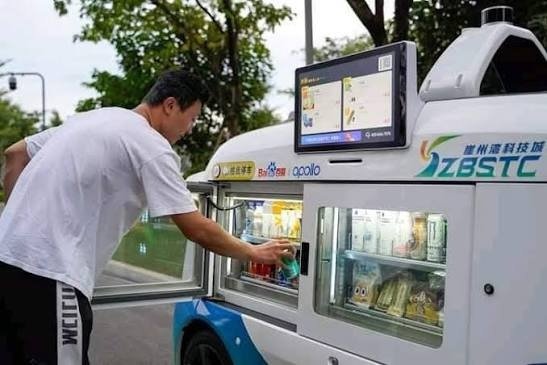
Walk through certain parks, subway concourses or scenic tourist spots in Chinese cities these days and you might notice something that looks like a cross between a food truck and a delivery robot slowly rolling past, stopping when someone waves it down, and opening up to sell drinks or snacks with nobody driving it. These are autonomous mobile vending vehicles, a category of unmanned retail robot that’s been quietly expanding across China for several years now, built to navigate crowded public spaces on their own, dodge pedestrians and obstacles in real time, and let people buy things directly off a moving storefront rather than walking to a fixed kiosk.
The company most closely associated with pioneering this idea is Neolix, a Beijing-based autonomous vehicle startup founded in 2018. Neolix built its business around a simple but useful insight: instead of trying to solve the extremely hard problem of full self-driving on open city roads right away, focus first on low-speed, tightly controlled environments where the stakes of a mistake are much lower, places like parks, campuses, logistics parks and pedestrian zones. By the end of its first full year, Neolix had already produced and delivered 225 of its unmanned vehicles to tech companies and local governments, with mobile vending as one of several use cases sitting alongside parcel delivery and food transport. In areas where the company hadn’t yet built the detailed high-definition maps that Level 4 autonomous vehicles typically rely on for optimal operation, Neolix leaned on a hybrid approach, letting a remote human operator manage vehicle movement from a control center until the system had enough real-world data to operate more independently.
The vending version of these vehicles works on a straightforward loop that Chinese industry analysts have described as goods looking for people rather than people looking for goods. A vehicle navigates a set route or roams within a defined zone, using onboard sensors and cameras to detect and avoid pedestrians, curbs, and other obstacles as it moves. When someone wants to make a purchase, they typically flag the vehicle down, either by waving, touching a display screen mounted on its side, or scanning a QR code, at which point the vehicle stops and lets the customer browse and select items directly from its built-in storage compartment. Payment happens the same way most purchases in China already do, through a QR code scan tied to a mobile payment app, completing the entire transaction without a cashier or attendant anywhere nearby.
These vehicles have found their clearest home in exactly the kinds of locations the original prompt describes: parks, subway station entrances, scenic tourist spots, and other high-foot-traffic public areas where setting up a fixed retail kiosk isn’t always practical or where demand shifts heavily by time of day. Industry coverage of the sector has noted that merchants deploying these vehicles specifically target crowded areas like subway entrances and business districts during rush hour and lunch breaks, when concentrated foot traffic creates a short but intense window of demand that a mobile, repositionable vending unit can capture more efficiently than a store that has to wait for customers to come to it. Common product categories sold this way include bottled drinks, breakfast items, fast food, fresh produce, and even smaller retail goods.
China’s local governments have played a direct role in scaling this technology rather than leaving it purely to private companies. Multiple regional pilot programs launched by transport authorities have explicitly included unmanned vending vehicles as a category alongside autonomous delivery vehicles, sightseeing vehicles, and even unmanned cleaning and security vehicles. A pilot program run in Beijing planned for 80 unmanned vending vehicles as part of a broader deployment that also included dozens of autonomous passenger cars and delivery vehicles, while a separate pilot at Binhai National Forest Park in Hefei incorporated unmanned vending vehicles specifically inside a children’s park, alongside autonomous sightseeing and cleaning vehicles, as part of an integrated smart park ecosystem.
This vending vehicle trend also sits within a much larger wave of unmanned retail and logistics robots that have become increasingly normal sights in Chinese cities. In Shenzhen, a fleet of roughly 40 autonomous delivery robots built by property developer Vanke’s logistics unit have been programmed to actually ride the subway themselves, boarding trains during off-peak hours, riding to designated stations, and wheeling directly into 7-Eleven stores to restock shelves, politely waiting for human passengers to exit train cars before boarding themselves. Separately, larger autonomous robovans, each capable of carrying up to 500 kilograms of cargo across roughly ten cubic meters of space, have been deployed inside metro stations by delivery giant SF Express to move parcels through otherwise idle subway infrastructure before staff transfer them onto trains bound for logistics centers.
Taken together, these systems point to a broader pattern in how Chinese cities are approaching automation in public spaces: rather than treating autonomous vehicles purely as a future replacement for human-driven cars on highways, companies and local governments have found nearer-term, lower-risk value in slower, smaller, more contained robots handling retail and logistics tasks in pedestrian environments. Mobile vending vehicles are one of the more visible, consumer-facing expressions of that strategy, turning ordinary foot traffic in a park or subway station into an opportunity for commerce that used to require a person standing behind a counter.