|
Getting your Trinity Audio player ready...
|
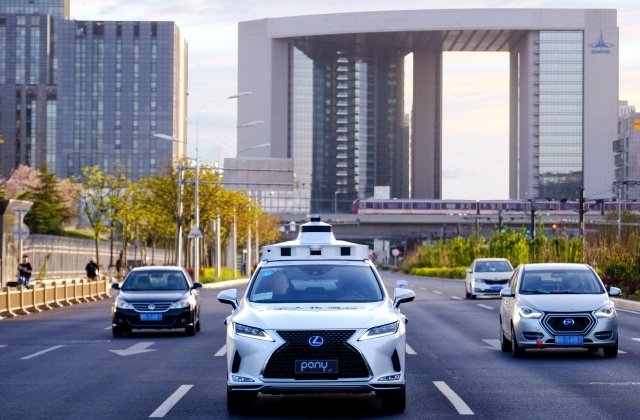
Hailing a taxi with no driver behind the wheel, paying noticeably less than a traditional ride, and gliding through traffic without a human hand on the wheel used to sound like science fiction. In China, it’s become a routine part of getting around several major cities. Baidu’s Apollo Go, alongside rivals Pony.ai and WeRide, has spent the past year turning autonomous ride-hailing from a cautious pilot program into a genuine transportation option millions of people now use without a second thought, and the economics behind it have shifted just as dramatically as the technology itself.
The scale of what’s happened is genuinely striking. Baidu’s Apollo Go crossed 100 million cumulative rides in the first half of 2026, a milestone that would have seemed implausible just a couple of years earlier when robotaxis were still confined to tightly restricted test zones. The service now operates across roughly 20 Chinese cities, up from a much smaller footprint even twelve months ago, and Baidu is targeting a fleet of more than 3,000 vehicles by the end of 2026, up sharply from fewer than 1,000 at the close of 2025. Weekly ride volumes have climbed past 300,000 trips, and in Wuhan specifically, Apollo Go’s ridership has grown large enough to sustain fares roughly 30 percent cheaper than equivalent taxi rides in Beijing or Shanghai, and considerably below what riders in the United States typically pay for comparable trips.
What’s made that pricing possible is a manufacturing cost curve that’s collapsed faster than most industry observers expected. The cost of building a single Apollo Go vehicle has dropped to roughly 200,000 yuan, around $27,778, a decline of nearly 80 percent compared to earlier generations of the hardware. That kind of cost compression matters enormously for a business model that depends on operating large fleets profitably rather than running a small number of expensive showcase vehicles, and it’s a big part of why Chinese robotaxi operators have been able to undercut traditional taxi pricing so aggressively while still working toward genuine profitability rather than treating every ride as a subsidized loss leader.
Baidu isn’t operating in this space alone, and the competitive dynamic between China’s three major robotaxi operators has arguably done as much to accelerate the industry as any single company’s technology roadmap. Pony.ai recently became the first operator to win regulatory approval to run robotaxis across the entirety of Shenzhen, the city often described as China’s Silicon Valley, while WeRide has pursued a strategy built around what it calls scenario diversity, extending beyond simple point-to-point robotaxi rides into robobus and robosweeper services in cities including Guangzhou. Pony.ai’s chief financial officer told the Wall Street Journal the company was aiming to reach profitability on a per-vehicle basis by the end of this year or early next, a target that reflects how close the entire sector has come to crossing from subsidized pilot programs into sustainable commercial operations. According to industry analysis, the unit economics of robotaxi service crossed the breakeven threshold for the first time in some Chinese cities during the first half of 2026, a genuine inflection point after years in which cost had remained the industry’s single biggest obstacle.
Regulatory support has moved in lockstep with that commercial progress. Since 2024, Chinese authorities have steadily loosened restrictions on autonomous vehicle operation, with multiple cities issuing permits for fully driverless commercial service, meaning rides that no longer require a human safety operator sitting behind the wheel as a backup. That regulatory loosening has been essential to scaling operations beyond the small, tightly controlled testing zones that defined the industry’s earlier years, though limits remain in place even today. In Beijing, self-driving taxis are still largely confined to Yizhuang, a suburb specifically designated for autonomous vehicle testing, and Wuhan’s local transportation bureau clarified operational limits on Apollo Go’s fleet size there after local taxi drivers protested the service’s expansion, worried about their own livelihoods amid growing robotaxi competition.
That tension, between rapid technological deployment and the very real economic disruption it creates for human drivers, remains one of the more uncomfortable undercurrents running through China’s robotaxi boom. Baidu CEO Robin Li has acknowledged those concerns publicly, emphasizing that scaling robotaxi operations responsibly will remain a gradual process likely stretching across many years rather than an overnight replacement of the traditional taxi and ride-hailing workforce. That acknowledgment sits somewhat uneasily alongside the industry’s own aggressive expansion targets, but it reflects a genuine awareness within at least some of these companies that technological capability and social acceptance don’t necessarily move at the same pace.
Having established a genuine domestic lead, China’s robotaxi operators are now turning outward. WeRide launched the Middle East’s first fully driverless robotaxi service in Abu Dhabi, partnering with Uber on pilot operations, and has laid out plans to expand into 15 additional cities globally over the next five years. Pony.ai has pursued its own Dubai push, targeting fully driverless commercial operations there while maintaining test programs in South Korea and Luxembourg, and Baidu has expanded into Dubai and Abu Dhabi as well, with reported ambitions to enter Singapore, Malaysia, and Switzerland through a potential partnership with PostAuto, a subsidiary of Swiss Post. That international expansion places Chinese operators in increasingly direct competition with Waymo and Tesla’s more limited robotaxi efforts, and by several measures, including total cumulative rides and the sheer number of active cities served, China’s combined robotaxi fleet has already pulled ahead of its American counterparts on scale.
Safety remains the industry’s most closely watched open question, given how directly public trust and regulatory approval both hinge on it. None of the major Chinese robotaxi operators has reported a fatality or serious injury directly caused by their vehicles to date, and companies including Apollo Go have begun publicizing low airbag deployment rates as an early indicator of operational safety, though independent, comprehensive safety data comparable to what regulators require of traditional vehicles remains limited across the entire industry. As fleets keep expanding into busier, more complex urban environments and eventually into international markets with entirely different traffic patterns and regulatory expectations, that safety record will face considerably tougher tests than the more controlled conditions under which most of the industry’s current track record was built.
For everyday riders across the roughly 20 Chinese cities where Apollo Go now operates, alongside Pony.ai and WeRide’s growing footprints, the experience of stepping into a car with no driver has largely stopped feeling remarkable. That normalization, arguably more than any single technical milestone, may be the clearest sign that China’s robotaxi industry has genuinely crossed from experimental technology into everyday infrastructure, even as the harder questions around driver displacement, cross-border safety standards, and long-term profitability remain very much unresolved.
For more coverage of autonomous vehicle technology and AI-driven transportation, visit Business Tech.