|
Getting your Trinity Audio player ready...
|
India’s Payment Stocks Jump as Government Ends Six Years of Free UPI Transfers to Merchants
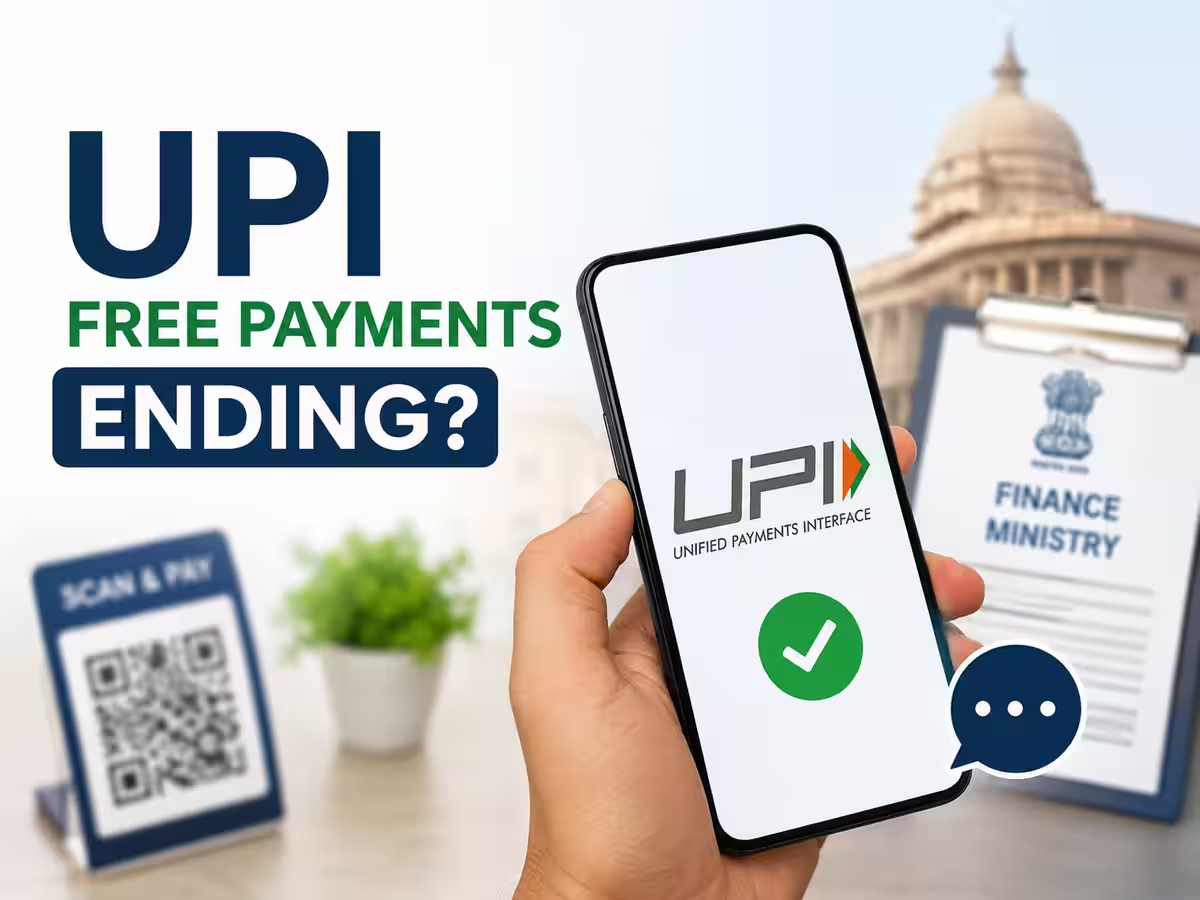
Shares of some of India’s best-known digital payment companies rallied sharply on Wednesday after the government did something it had resisted for years: put a price tag on part of the UPI ecosystem that had been free since the system launched. The move ends nearly six years of fully fee-free UPI payments and gives investors their clearest signal yet that India’s dominant payments rail is finally being allowed to generate meaningful revenue for the companies that run on top of it.
The National Payments Corporation of India, the body that operates UPI, announced Tuesday that a 0.4 percent Merchant Discount Rate will apply to person-to-merchant UPI transactions above 2,000 rupees, or roughly $20, starting October 15. The fee is capped at 300 rupees for transactions of 75,000 rupees or more, keeping the charge proportionate rather than letting it balloon on larger payments. Markets responded almost immediately once trading opened Wednesday. Shares of One97 Communications, the parent company behind Paytm, jumped as much as 7.24 percent intraday to hit a 52-week high on the BSE. One Mobikwik Systems climbed nearly 6 percent, and Yes Bank and Axis Bank both advanced as well, with gains across the group ranging roughly between 2 and 8 percent in early trade. Pine Labs saw a more volatile session, initially rising more than 2 percent before reversing and trading lower by the afternoon.
To understand why a fee announcement sent payment stocks higher rather than lower, it helps to know what UPI has actually cost these companies to operate for the past several years. Since January 2020, India’s government mandated zero MDR on UPI transactions, meaning banks and payment app providers couldn’t charge merchants anything for processing a UPI payment, no matter how large the transaction volume flowing through their platforms. That policy helped UPI become genuinely ubiquitous across India, now accounting for roughly 87 percent of retail digital payment transaction volume in the country according to industry data from CareEdge, but it also meant the companies building the apps, infrastructure and merchant tools around UPI were essentially running one of the country’s largest payment networks without a direct revenue stream tied to transaction volume itself. The government partially offset that gap for banks and payment providers through periodic incentive schemes, but those subsidies were never viewed by the industry as a stable, long-term substitute for an actual merchant fee.
Wednesday’s announcement changes that dynamic, though carefully. The new MDR structure is deliberately narrow in scope. Transactions between individuals, including everyday transfers among family and friends, remain completely free, protecting the peer-to-peer use case that most Indians associate with UPI in daily life. Small merchants earning up to 100,000 rupees a month through UPI QR code payments are also fully exempt, a carve-out the government says shields 96 percent of all merchant transactions from any new charge whatsoever. Payments to small vendors under the person-to-person-merchant category are similarly excluded. Apps aren’t permitted to tack on their own additional platform fees on top of the MDR, and banks have been explicitly instructed not to let merchants pass the new cost along to customers at checkout. A fifth of whatever revenue the new fee generates is earmarked specifically to fund continued UPI expansion among small merchants, tying the fee’s existence directly back to strengthening the broader ecosystem rather than simply padding company margins.
Analysts framed the move as giving the digital payments sector something it’s lacked for years: a predictable, transaction-linked revenue framework rather than one dependent on periodic government subsidy announcements. Paytm itself confirmed the shift’s significance directly in a regulatory filing late Tuesday night, stating that the new structure would generate additional revenue from its merchant business across many transactions that had previously been entirely free. That’s a meaningful statement coming from a company that has spent much of the past two years working through regulatory setbacks, including the Reserve Bank of India’s order last year to wind down Paytm’s banking unit over compliance issues, a move that caused its monthly transacting user base to fall sharply. Paytm has been gradually clawing its way back since then, helped in part by NPCI restoring its ability to onboard new UPI users earlier this year, a decision several brokerages including Morgan Stanley and Jefferies flagged at the time as removing a major regulatory overhang for the stock.
The MDR announcement also lands against a backdrop of other regulatory maneuvering in India’s UPI space that’s shaped how the market is positioned today. NPCI had previously proposed capping any single UPI provider’s market share at 30 percent of transaction volume, a rule aimed squarely at reining in the dominance of Walmart-backed PhonePe and Google Pay, which together have processed the overwhelming majority of UPI transactions in recent years. That cap has been repeatedly delayed, most recently pushed back to the end of December 2026, giving smaller players like Paytm and One Mobikwik more runway to grow their own share before any enforced rebalancing kicks in. The newly introduced MDR doesn’t touch that market share question directly, but it does reshape the economics every player in that market is now competing under, since revenue per transaction has just become a real, measurable line item for the first time in years rather than an afterthought dependent on subsidy cycles.
Whether Wednesday’s rally holds through October, when the fee actually takes effect, will likely depend on how merchants themselves respond once the charge starts showing up on their settlement statements. Merchant pushback over new transaction costs is a familiar pattern in payments markets globally, and India’s own retailers’ associations have previously lobbied hard against MDR reintroduction on UPI, arguing it undermines the very adoption drive that made UPI so dominant in the first place. For now, though, investors in India’s payment sector are treating Tuesday’s announcement as the clearest signal yet that the era of monetizing India’s massive UPI transaction volume is finally beginning, even if the government has been careful to wall off the vast majority of everyday transactions from the change.