|
Getting your Trinity Audio player ready...
|
Inside Volkswagen’s Twin Car Towers: The 60-Meter Glass Silos That Deliver New Cars With Zero Miles on the Clock
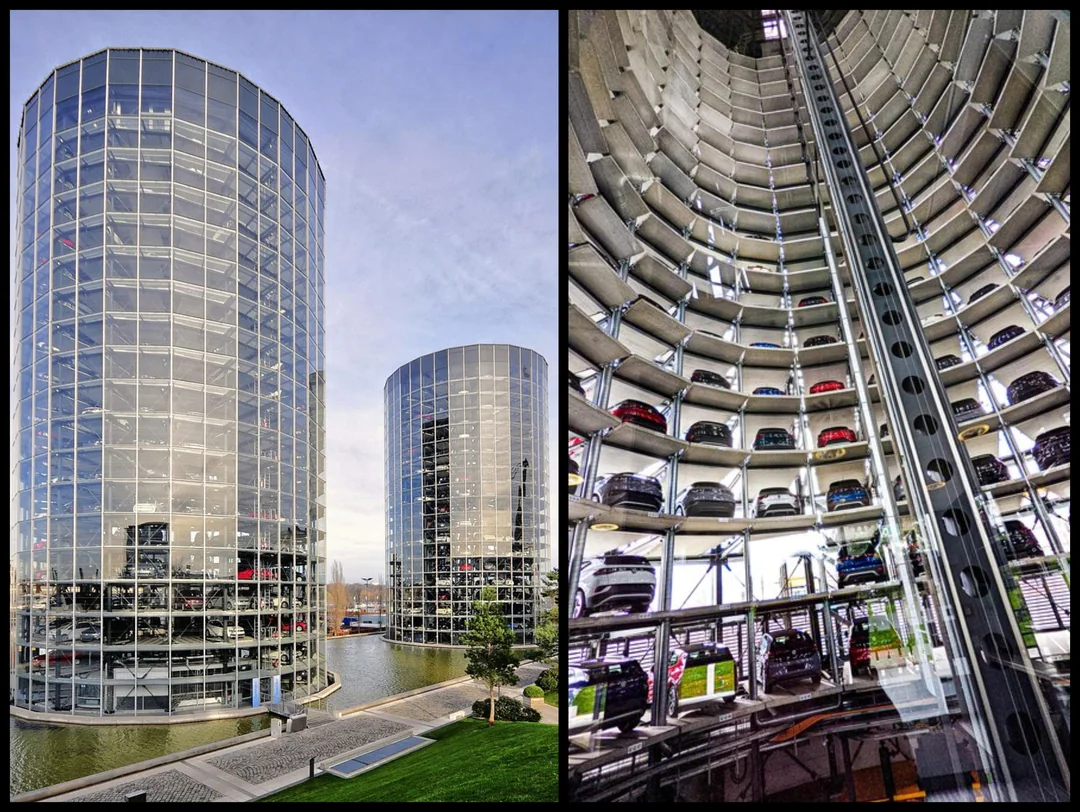
A short clip showing cars gliding in and out of two towering glass cylinders has been making the rounds online again, and it’s easy to see why people keep sharing it. It looks like something out of a sci-fi film, robotic arms sliding brand-new cars into place inside a giant illuminated tube, but this is a real, functioning piece of Volkswagen’s factory operation in Wolfsburg, Germany, and it’s been running for a quarter century.
The two structures are known as the Car Towers, or AutoTürme in German, and they sit at the center of Autostadt, Volkswagen’s sprawling visitor complex built right next to its main production plant. Each tower stands 60 meters tall, roughly 20 stories, and holds 400 vehicles at a time, giving the pair a combined capacity of 800 cars sitting in storage on any given day. They’re built from glass and galvanized steel, which is why they glow at night and photograph so well, but the look was never just for show. Volkswagen worked with the German architecture firm HENN to design the towers as functional vertical warehouses first, landmarks second.
Getting a car into one of these towers starts on the factory floor. Once a vehicle rolls off Volkswagen’s production line, it travels through a 700-meter underground tunnel connecting the factory directly to the towers, arriving at a basement level built specifically to feed cars up into storage. From there, a mechanical arm running along a central beam inside the tower picks the car up and slots it into an open bay, moving at a speed of two meters per second. When it’s time for a car to leave, the same system runs in reverse, and Volkswagen has said it takes roughly one minute and 44 seconds to bring a vehicle down from the very top floor to ground level. That speed isn’t just a fun bit of trivia either. Guinness World Records verified the towers as the fastest automatic parking system on the planet back in 2014, a title that still holds today.
What actually makes this system worth building at this scale isn’t the spectacle, it’s what happens for the customer at the end of it. Buyers who choose to pick up their new Volkswagen directly from the factory, rather than through a dealership, can opt for delivery through the towers as part of the experience. Autostadt gives those customers free entry to the complex, meal vouchers, and a front-row seat to watch on a screen as their specific car gets pulled from its bay and brought down. The car arrives at the customer’s hands having never been driven a single meter under its own power, so the odometer reads exactly zero. For anyone who’s ever wanted the genuinely rare experience of watching the exact car they’re about to own get retrieved like a prize from a claw machine, it’s hard to think of many other manufacturers offering anything comparable.
The towers have been doing this since May 2000, when Autostadt first opened its doors on a site that used to be home to a fuel company sitting next to the Volkswagen plant. More than 400 architects contributed to designing the wider Autostadt complex, and the whole project reportedly cost Volkswagen somewhere around 850 million German marks, or roughly $476 million, at the time. Since then, Volkswagen says more than two million customers have taken delivery of a new car through the towers, turning what started as a striking piece of industrial architecture into a genuinely popular tradition for German car buyers and enthusiasts traveling in from elsewhere.
Autostadt itself has grown well beyond just the two towers over the years. The site now includes pavilions dedicated to several brands under the Volkswagen Group umbrella, including Audi, Porsche, Škoda and Lamborghini, along with the Zeithaus, a museum tracing the history of automotive design more broadly, and a scent-based art installation by artist Olafur Eliasson called the Scent Tunnel. But the towers remain the visual centerpiece of the whole complex, visible from a distance across Wolfsburg simply because there isn’t much else in the town that competes with them in height.
Visitors who want to see the inside for themselves, rather than just admiring the towers from the ground, can ride a panoramic glass elevator up to an observation deck, giving a view stretching across the Volkswagen factory, the town of Wolfsburg, and the surrounding countryside. It’s one of the few places in the world where watching a parking garage in action counts as a genuine tourist activity, and after 25 years of quietly moving hundreds of thousands of cars in and out of storage at two meters per second, it’s easy to understand why the towers keep finding a new audience online every time someone stumbles across a clip of them in motion.