|
Getting your Trinity Audio player ready...
|
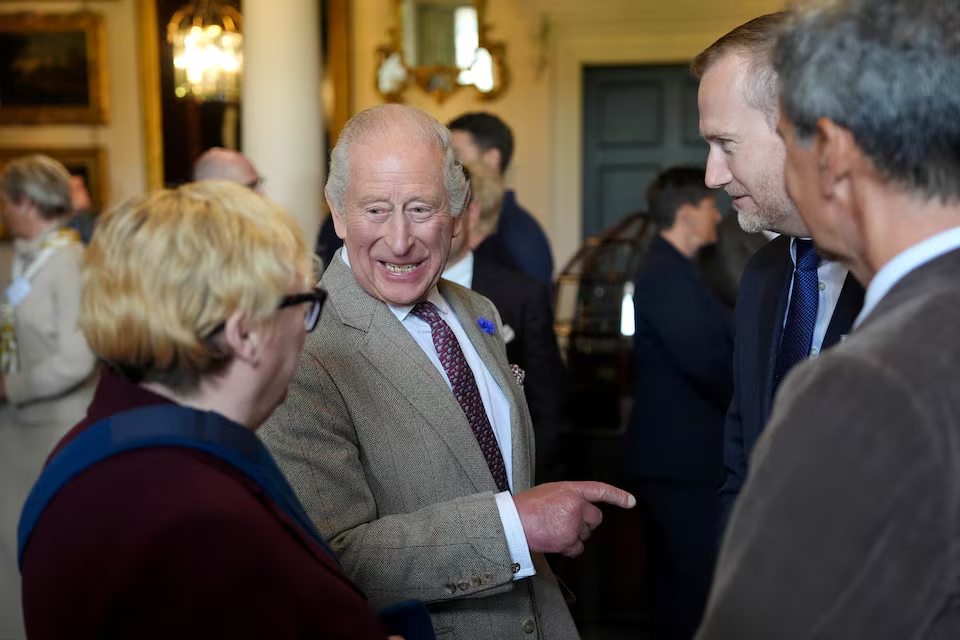
Britain’s King Charles will tell some of the world’s most powerful artificial intelligence executives that the technology must remain firmly in the service of humanity when he hosts them Thursday at his Dumfries House estate near Cumnock, Scotland. The gathering brings together leaders from Nvidia, Google DeepMind, OpenAI, Anthropic, and other major AI companies at a moment when the industry itself has become unusually vocal about the risks posed by the very technology it continues racing to build.
According to excerpts released ahead of the meeting, Charles will open proceedings by telling executives that the decisions made at this formative time will shape the world inherited by future generations. The king’s central message centers on reassurance, specifically the industry’s need to convince the public that people will not lose control of their own lives to autonomous AI agents operating with increasing independence. Buckingham Palace has framed the gathering’s purpose in similarly weighty terms, saying discussions would consider whether a shared set of principles could guide AI’s future application, not merely as a driver of capability and efficiency, but as a tool that upholds human dignity and contributes to the flourishing of both people and the planet.
The timing of this royal convening is not incidental. AI safety concerns have surged back into public conversation in recent weeks after two Anthropic researchers separately warned that rapidly advancing AI technology could lead to human extinction within a relatively near timeframe, a warning striking enough given that it came from insiders working directly on frontier AI development rather than outside critics. Anthropic CEO Dario Amodei has gone further still, publicly calling for companies across the industry to deliberately slow the pace of AI development, a call that drew a notably broad, if brief, wave of public agreement from rival executives typically locked in fierce competition with one another rather than making common cause.
That agreement hasn’t gone unquestioned, and a genuine debate has opened up over what’s actually motivating some of these public safety calls. Skeptics have raised several possible ulterior motives worth taking seriously alongside the stated safety concerns, including the possibility that some executives are angling to set industry rules that happen to preserve the competitive lead of their own particular companies, moving preemptively to get ahead of a broader government regulatory backlash before it arrives, or simply welcoming a slower pace as cover for reduced spending in an AI development race that has grown extraordinarily expensive to sustain. None of those alternative explanations necessarily contradict genuine safety concern, but they add a layer of complexity to how observers should read the current wave of industry caution, since the underlying incentives at play aren’t purely altruistic even when the public messaging sounds that way.
King Charles’s role in this particular conversation fits a pattern he’s built over decades, first as Prince of Wales and now as monarch, using his largely ceremonial but genuinely influential position to convene discussions around issues he considers urgent, most notably the environment and water scarcity, well before those topics reached mainstream political consensus. A source familiar with the meeting’s planning told the Sunday Times that the king sees his role here as a neutral convenor, present to listen, encourage discussion, and pose the fundamental question of how AI can be developed for humanity’s genuine benefit, rather than to arrive with a specific policy agenda of his own. That same source drew an explicit parallel to Charles’s earlier environmental advocacy, describing his hope to provide a neutral space for conversations around an issue that will affect essentially everyone, regardless of national or political boundaries.
It’s worth being clear-eyed about what this meeting realistically can and cannot accomplish. Thursday’s gathering is not expected to produce any binding agreements, commitments, or formal regulatory framework, and Charles himself is not known for particular technical expertise in artificial intelligence specifically. What the meeting offers instead is symbolic and convening weight, a moment where competing AI executives sit in the same room under royal auspices to at least publicly engage with questions of human dignity and control that have increasingly dominated headlines around their industry. Britain’s Minister for Artificial Intelligence is also expected to attend, adding a direct government presence alongside the private sector leadership and giving the gathering at least some connective tissue to actual UK policy conversations happening in parallel.
The broader question hanging over Thursday’s meeting is whether the AI industry can meaningfully regulate itself, or whether meaningful safety guardrails will ultimately require government intervention that goes considerably further than voluntary commitments companies choose to make at gatherings like this one. That tension has become one of the defining debates in global technology policy this year, playing out simultaneously through legislative efforts in the United States, formal AI safety frameworks emerging from individual American states, and now this kind of high-profile, symbolically weighted convening in the United Kingdom. Whatever specific principles emerge, or fail to emerge, from Thursday’s discussion at Dumfries House, the fact that Nvidia, Google DeepMind, OpenAI, and Anthropic leadership all agreed to sit together under a king’s roof to discuss exactly these questions says something meaningful about how seriously the industry now feels compelled to at least appear to be grappling with its own risks, even as skepticism persists about how much genuine change follows from conversations that produce no binding commitments at all.
For more coverage of AI governance and industry policy developments, visit Business Tech.