|
Getting your Trinity Audio player ready...
|
Federal Reserve Raises Interest Rates for First Time Since 2023, Citing Elevated Inflation
The Federal Reserve reversed course on interest rates Wednesday, raising its benchmark federal funds rate for the first time in more than three years as policymakers moved to address inflation that’s proven stickier than expected, driven in part by rising oil prices. The Federal Open Market Committee voted unanimously, 12-0, to lift the rate by a quarter percentage point, bringing the target range to 3.75 percent to 4 percent.
It’s the first rate increase the central bank has approved since July 2023, and it comes after a period in which the Fed had actually been cutting rates, moving toward what officials had described as a more neutral policy stance through late 2025 before pausing at 3.50 percent to 3.75 percent in March of this year. Wednesday’s hike effectively ends that pause and pivots the Fed back toward tightening, a shift that reflects growing concern within the committee that inflation hasn’t been cooling fast enough to stay comfortable holding rates steady, let alone cutting them further.
The move wasn’t a surprise to markets by the time it was announced. Futures traders tracked through CME Group’s FedWatch tool had priced in a 93 percent probability of exactly this quarter-point increase heading into the decision, following weeks of increasingly hawkish signals from Fed officials and persistently elevated inflation readings. In its brief post-meeting statement, the committee said simply that inflation remains elevated, language that, paired with the decision itself, left little ambiguity about where the Fed’s attention is currently focused.
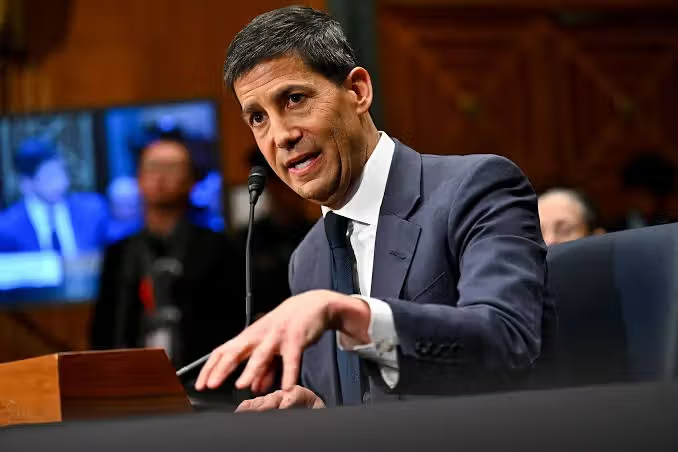
Fed Chair Kevin Warsh, who took questions from reporters following the announcement, said inflation is still too high, reinforcing the committee’s stated rationale for the hike. Notably, Warsh has continued a practice he also followed at the Fed’s June meeting of withholding his own personal rate forecast from the committee’s projections materials, even as he pushed the broader group toward Wednesday’s decision.
Those projections, released alongside the rate decision as part of the Fed’s quarterly Summary of Economic Projections, point toward more tightening potentially still to come this year. The so-called dot plot showed 16 of the committee’s 18 participants anticipate at least one more quarter-point hike before the year is out, with four of those officials penciling in two additional increases. Only two participants expect the Fed to stop at Wednesday’s single hike. Fed officials’ year-end rate projections now cluster between 4.1 percent and 4.4 percent, suggesting the committee broadly expects to keep pushing rates higher into early 2027 if current inflation trends persist.
The updated economic projections released alongside the decision paint a picture of an economy the Fed still sees as fundamentally solid, even as inflation concerns mount. GDP growth for 2026 was revised slightly higher to 2.3 percent, up from the 2.2 percent projected back in June, with 2027 growth also nudged up to 2.4 percent from 2.3 percent. At the same time, the Fed’s preferred inflation gauge, personal consumption expenditures, or PCE, is now projected to come in at 3.7 percent for 2026, up from the previous 3.6 percent estimate, though the 2027 forecast held steady at 2.3 percent, suggesting officials still expect inflation to eventually work its way back toward more normal levels even if the near-term picture has worsened slightly. Core inflation, which strips out volatile food and energy prices, was similarly revised up to 3.4 percent for this year from 3.3 percent, while the 2027 projection stayed unchanged at 2.5 percent. On the employment side, the unemployment rate forecast was actually revised down for both 2026 and 2027, now projected at 4.1 percent for both years, an improvement from the 4.3 percent previously expected, giving the Fed some cover to prioritize inflation fighting without appearing overly worried about damaging the labor market in the process.
Markets took the hike in stride rather than reacting sharply. The S&P 500 held in positive territory, last trading up about 0.4 percent on the day following the announcement, while the Nasdaq Composite climbed 0.8 percent. The Dow Jones Industrial Average was essentially flat, hovering near the unchanged line. In the bond market, the 10-year Treasury yield actually pulled back slightly, dropping close to 5 basis points to trade at 4.947 percent, a move that suggests bond investors had largely already priced in the hike and were reacting more to the accompanying economic projections and Warsh’s press conference commentary than to the rate decision itself.
For everyday borrowers, Wednesday’s decision carries fairly immediate practical consequences. The federal funds rate serves as the foundational benchmark that ripples through a wide range of consumer and business borrowing costs, including mortgage rates, credit card interest, auto loan pricing, and the yields banks offer on savings accounts and certificates of deposit. A higher federal funds rate generally means higher borrowing costs across all of those categories, even if the exact pass-through timing varies depending on the specific type of loan or credit product involved.
The committee pointed to spiraling oil prices among the factors behind the renewed inflationary pressure driving Wednesday’s decision, a detail that connects the Fed’s move to broader global energy market volatility that’s been unsettling several economies simultaneously this year. Whether Wednesday’s hike proves to be a one-off correction or the start of a more sustained tightening cycle stretching into 2027, as the dot plot currently suggests, will likely depend heavily on how inflation data trends over the Fed’s remaining meetings this year, with the central bank’s next scheduled policy decision now the one to watch for confirmation of whether this hawkish pivot has staying power.