
|
Getting your Trinity Audio player ready...
|
Russia has quietly turned a decades-old training missile, originally built solely as target practice for air defense crews, into one of the most heavily used weapons in its current bombardment of Ukraine, according to official Ukrainian data reviewed by Reuters. The repurposed missile, known as the RM48U, made up more than half of the 228 ballistic and hypersonic missiles fired at Ukraine in July and early August, a scale of deployment that hasn’t been previously reported and helps explain how Moscow has managed to intensify its aerial campaign this summer without depleting its stockpile of more sophisticated precision weapons.
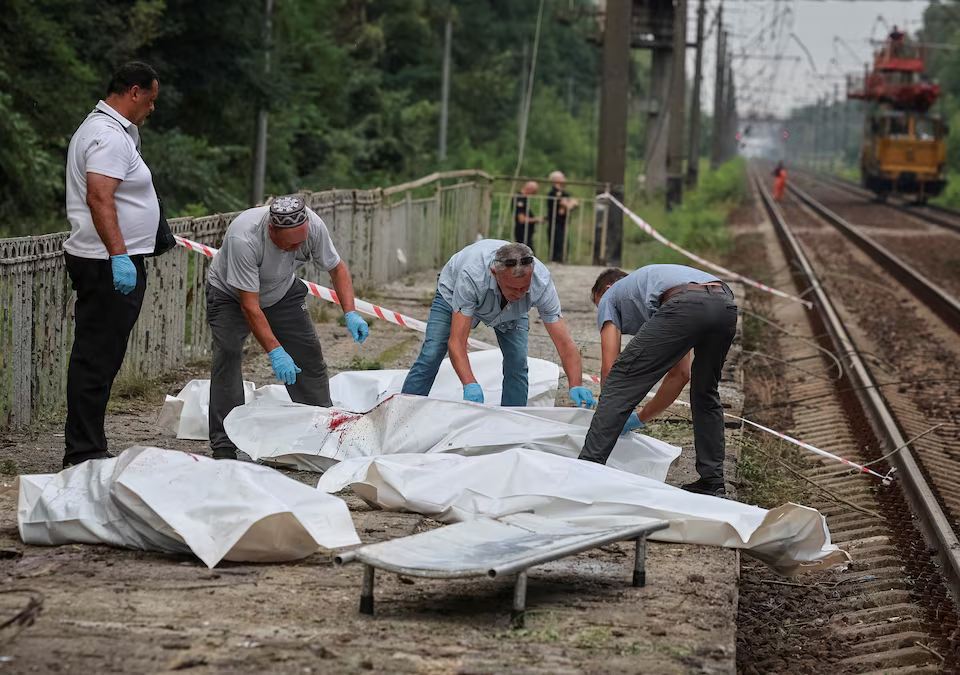
The human cost of this shift became grimly visible on August 5, when a barrage of Russian missiles struck the Brovary district near Kyiv, killing eight people, some of them found scattered across a suburban railway platform. Ukrainian investigators determined the strike on the railway wasn’t carried out by Russia’s primary Iskander strike missile, the weapon most associated with precision ballistic attacks throughout the war, but by the far less accurate RM48U instead. Volodymyr Bihun, head of Brovary’s military administration, said the rail attack happened shortly after midnight, and satellite imagery from Planet Labs later showed a nearby warehouse complex damaged, with two plumes of smoke visible rising from the site. Russia’s defense ministry said it had struck a logistics center in Brovary being used to store drone components, though it did not respond to questions about its broader use of RM48Us across the conflict.
The RM48U’s origins trace back to the S-300 and S-400 surface-to-air missile systems, repurposed from a role designed purely to give Russian air defense crews live-fire practice into an actual offensive weapon fired directly at Ukrainian territory. That repurposing carries a genuine tactical logic even accounting for the missile’s reduced accuracy. Justin Bronk, an analyst tracking the conflict, and Sidharth Kaushal at the Royal United Services Institute have both pointed to solid rocket motor production as a hard limiting factor on how many Iskander missiles Russia can actually manufacture, with Kaushal estimating Russian Iskander output at around 750 missiles annually, a constraint that forces Moscow to use its most precise weapons judiciously rather than firing them at lower-value targets. The cheaper, less accurate RM48U fills that gap, allowing Russia to strike targets like food warehouses, which Ukrainian officials say have been systematically targeted, without drawing down stocks of the missiles it reserves for higher-priority strikes.
What makes the timing of this shift particularly dangerous for Ukraine is the state of the country’s air defenses. Ukraine has virtually exhausted its stocks of US-made Patriot interceptors, the only weapons in its current arsenal capable of reliably shooting down Russian ballistic missiles, and there is little clarity on when fresh supplies might arrive, with more Patriot systems currently being funneled toward the US military and its allies in the Gulf than toward Ukraine itself. That scarcity means Russia’s decision to flood the skies with large numbers of cheaper, less precise RM48Us serves a second strategic purpose beyond simply conserving Iskanders, it actively drains whatever remaining interceptor stock Ukraine has left, forcing Ukrainian air defense crews to choose which incoming missiles are worth expending scarce Patriot interceptors on and which will be allowed through.
President Volodymyr Zelenskiy underscored just how directly that interceptor shortage translates into lost lives, saying hours after the August 5 Brovary attack that “ballistic missile interceptors could have saved the lives of those killed today.” That comment captures the core dynamic driving Ukraine’s current vulnerability, it’s not simply that Russia is launching more missiles, it’s that Ukraine increasingly lacks the specific tools needed to intercept the category of weapon doing the most damage, even as overall attack volume climbs toward record levels.
The broader numbers back up just how significant this escalation has been. According to official Ukrainian data, Russia fired the largest number of ballistic and hypersonic missiles in a single month since the start of its full-scale invasion in 2022 during July alone, based on figures that only include strikes independently confirmed by analysts on the ground, meaning the true total could be higher still. Beyond the RM48U and Iskander-family missiles, Ukraine’s military intelligence agency, the GUR, has also tracked smaller Russian stockpiles of KN-23 and KN-24 ballistic missiles alongside Zircon and Kinzhal hypersonic weapons, both capable of traveling more than five times the speed of sound, giving Russia a genuinely layered mix of weapon types to draw from depending on the target and the level of precision it requires for any given strike.
Moscow has consistently denied intentionally targeting civilians throughout the conflict, maintaining that its strikes are aimed exclusively at military infrastructure and related logistics. That position sits uneasily against incidents like the Brovary railway strike, where a weapon originally built purely for training purposes, lacking the guidance precision of Russia’s dedicated strike missiles, ended up killing civilians at a location officials say was primarily targeting nearby industrial and logistics facilities rather than the railway platform itself. Reuters noted it could not independently verify all of the Ukrainian findings surrounding the incident, a standard caveat given the difficulty of conducting fully independent battlefield verification amid an active conflict.
For Ukraine, the practical challenge this presents extends well beyond any single attack. If Russia has genuinely found a way to sustain record-level ballistic missile volume by leaning on cheap, repurposed training hardware rather than drawing down its limited stock of precision Iskanders, that suggests Moscow’s capacity to maintain sustained pressure on Ukrainian air defenses may be considerably more durable than previously assumed, even as production constraints continue capping how many of its more sophisticated missiles it can build each year. Whether Ukraine’s Western allies move to address the Patriot interceptor shortage that’s made this strategy so effective in the first place will likely determine how much longer Russia can keep exploiting exactly this gap between missile volume and Ukraine’s shrinking ability to shoot any of it down.
For more coverage of the Russia-Ukraine war and global defense industry developments, visit Business Tech.