
|
Getting your Trinity Audio player ready...
|
New York City has begun rolling out a fleet of high-tech public bathrooms that come with a genuinely strict catch, use the toilet within 10 minutes or the door opens automatically, whether you’re finished or not. The first two units, branded “Throne” bathrooms, opened this week on Fulton Street in Bedford-Stuyvesant, Brooklyn, part of a $4 million pilot program Mayor Zohran Mamdani unveiled to address a public restroom shortage that’s plagued the city for years.
The scale of the underlying problem the program is trying to solve is fairly stark. New York City currently has only around 1,000 public restrooms spread across its five boroughs, a figure city officials point to directly when explaining the shortage’s real-world consequences. According to data cited by the Coalition for the Homeless, the NYPD issued more than 10,000 summonses for public urination in 2025 alone, a statistic Mamdani referenced at Wednesday’s press conference when he said too many New Yorkers know what it’s like to have nowhere to go while out and about, framing the pilot as an effort to guarantee people access to a clean, safe bathroom whenever they actually need one.
Getting into one of these bathrooms requires a bit more technology than pushing open a door. Users can enter by texting a designated number to receive a code, scanning a QR code, using the Throne Bathroom Network app, or tapping a physical card distributed through local community partners. The app also lets users locate the nearest available unit, check real-time cleanliness ratings, and confirm whether a bathroom is currently occupied before heading over, features aimed at making the whole experience more predictable than the traditional gamble of finding an open public restroom in a major city.
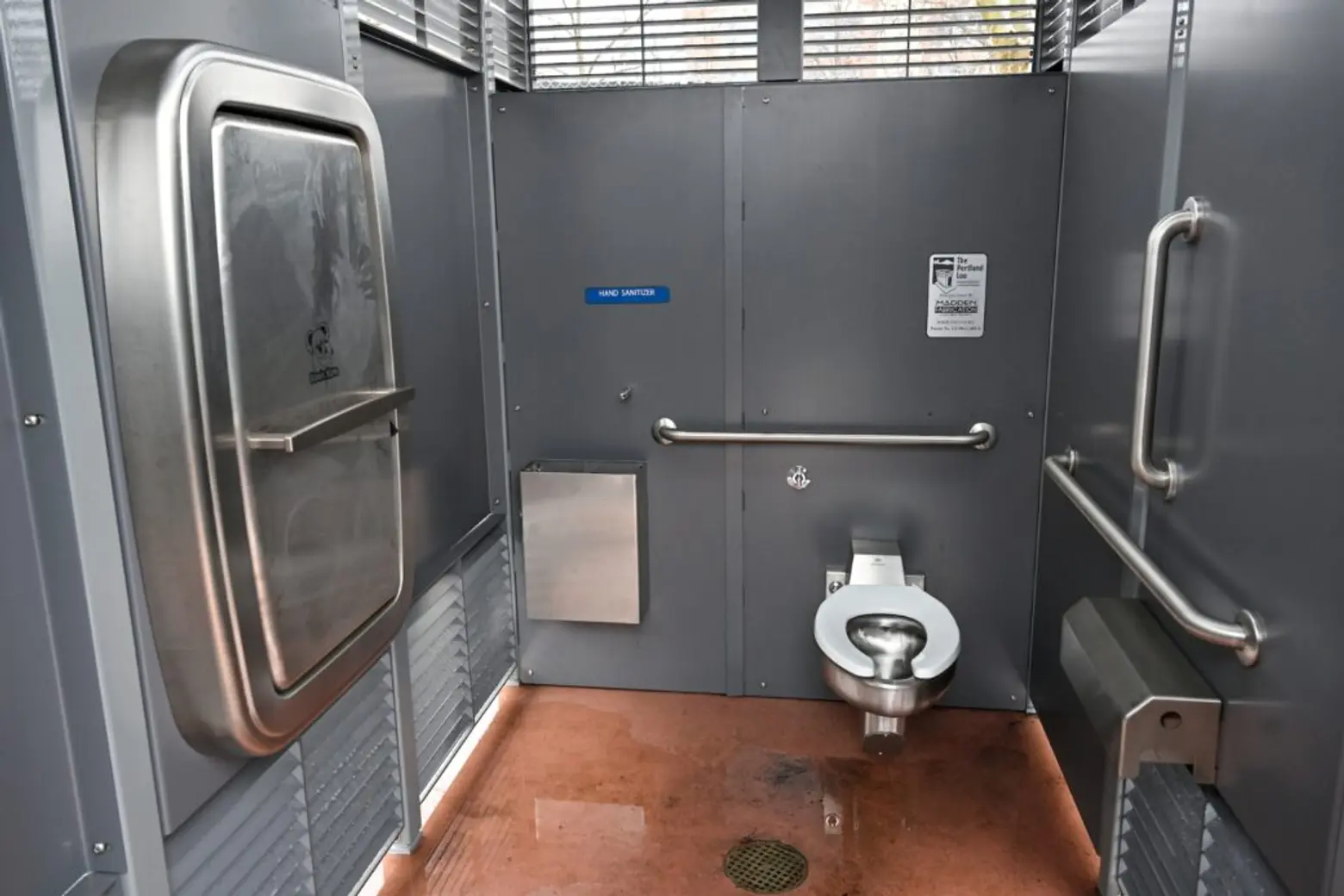
Once inside, the amenities themselves are genuinely more upgraded than what most New Yorkers are used to from public facilities. Each unit includes running water, a flushing toilet, climate control, a baby-changing station, free menstrual pad dispensers, and even background music, all wrapped in wallpaper depicting lush plant life rather than the stark, utilitarian look typically associated with municipal restrooms. The bathrooms are also fully self-contained, requiring no connection to existing water, sewer, or power infrastructure, which lets the city deploy, relocate, or remove units as neighborhood needs shift over time rather than committing to permanent, fixed installations.
That upgraded experience comes with a firm time limit, though, and the mechanics of how it’s enforced have drawn considerable attention. According to Throne Labs co-founder and chief operating officer Jessica Heinzelman, users receive reminder notifications at five and eight minutes into their visit, followed by flashing lights and an urgent audio warning once the 10-minute mark hits. The automated message, delivered in both English and Spanish, states plainly that the user’s time has expired and the door is opening. Heinzelman clarified that the door doesn’t slide open the instant the warning plays, there’s a roughly 30-second grace period built in specifically so the system doesn’t, in her words, open the door on someone mid-use. Mamdani himself described the philosophy behind the strict limit bluntly at the press conference, noting these bathrooms are not meant to be a place to scroll on your phone.
For anyone who genuinely refuses to leave once the countdown expires, Throne Labs workers receive an automated alert prompting an in-person check, and city officials have said employees can call police if someone remains inside for an extended period beyond that point. The company has cited data from its broader network of installations elsewhere suggesting 81 percent of users typically finish well within the allotted window, framing the 10-minute limit as generous for the vast majority of visits rather than a genuinely tight constraint, though that statistic naturally excludes the roughly one in five users who don’t finish in time.
New York isn’t the first city to test this particular time-limited model, and feedback from an earlier deployment offers a useful preview of how the system plays out in practice. Long Beach, California launched four Throne units back in 2025 and later extended its partnership with the company following the initial pilot. Community survey responses from that earlier rollout included at least one user explicitly asking the city to extend the time limit, describing a close call where they nearly faced public embarrassment after almost being caught still using the restroom when time expired, a real-world example of exactly the awkward scenario the design is meant to avoid but apparently doesn’t always fully prevent.
The rollout hasn’t been universally welcomed, and advocacy groups working with New York’s homeless population have raised specific concerns about who the technology-dependent entry system might exclude. The Free to Pee Coalition, led by VOCAL-NY and the Coalition for the Homeless, said in a statement that requiring a smartphone or tap card to access the bathrooms raises real access issues for homeless New Yorkers, precisely the population that often relies most heavily on public restrooms and that may be least likely to reliably carry a working phone or have already obtained one of the distributed access cards.
A total of 17 modular units are expected to open across all five boroughs in the coming months, deployed by Throne Labs, the company selected in June by the New York City Economic Development Corporation following a Request for Proposals Mamdani had publicized back in January. Mamdani noted that the entire 17-unit rollout costs roughly what a single traditional public restroom has historically cost the city to build, an economic argument he pointed to directly as explanation for why New York hasn’t built more public bathrooms over the years despite the clear and persistent need. If this first wave proves successful, the mayor indicated the city plans to purchase additional units by the end of next summer, potentially expanding the network considerably beyond its initial footprint.
For more coverage of urban infrastructure and civic technology developments, visit Business Tech.