|
Getting your Trinity Audio player ready...
|
The Privacy Backlash That Could Derail Tech’s Bet on a World After Smartphones
Every major tech company seems convinced the smartphone’s reign is nearing its end, and each has its own idea of what replaces it: glasses that see what you see, pins that listen to what you hear, pendants that quietly log your entire day. What none of them have quite figured out yet is how to convince people that wearing a camera and microphone constantly on their body is actually a good idea, and that gap is turning into a genuine business problem rather than just an awkward footnote.
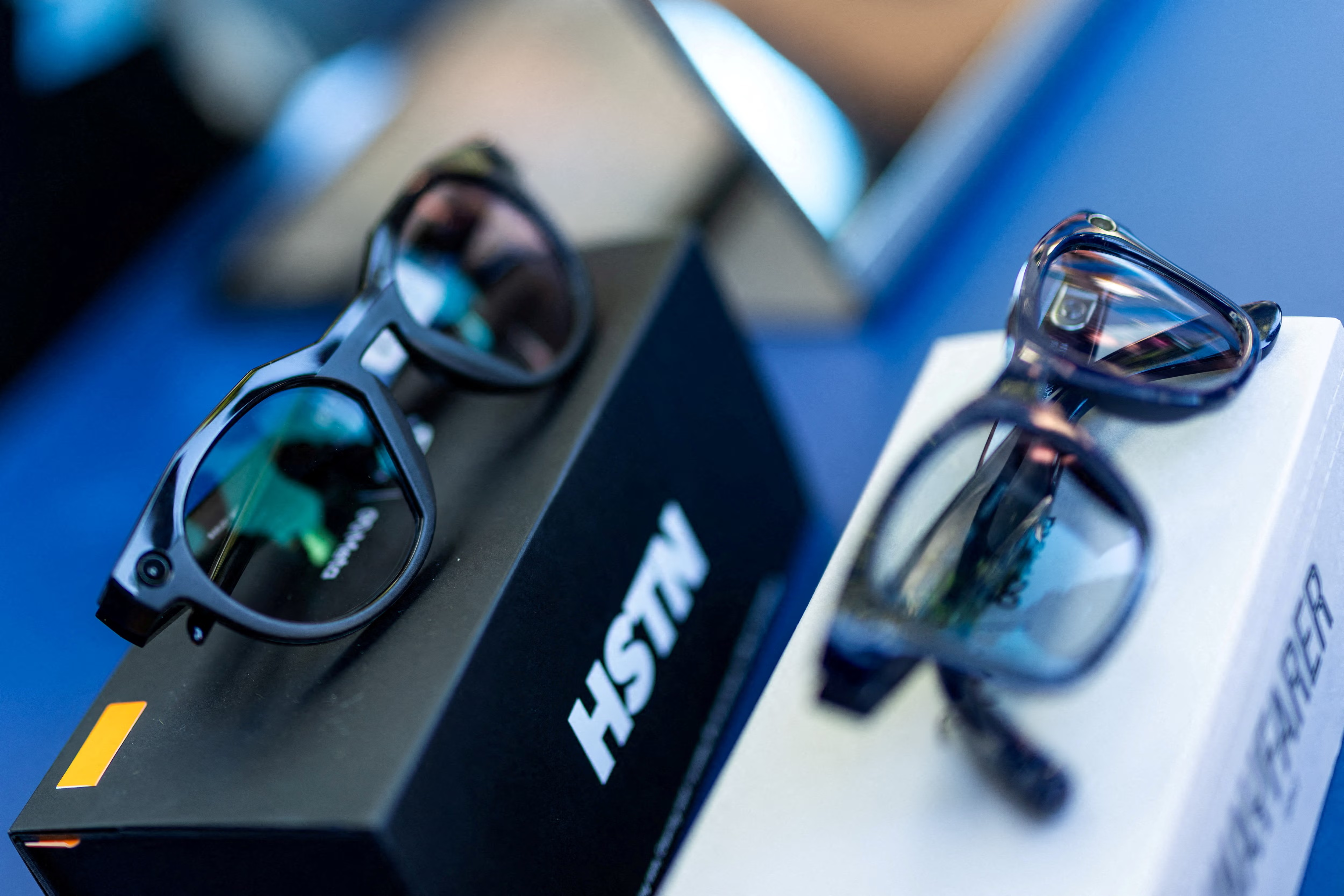
Nowhere is that tension more visible than with Meta’s Ray-Ban smart glasses, the device that arguably did more than any other to make AI eyewear feel like a mainstream product rather than a novelty. Built by pairing EssilorLuxottica’s fashionable frame designs with Meta’s own AI ambitions, the glasses have become the clearest lightning rod for public unease around this entire category, drawing lawsuits, government scrutiny, and a wave of venues around the world that simply don’t want them worn inside.
The legal exposure is genuinely serious. Attorney Ryan Clarkson, whose firm represents consumers suing Meta and EssilorLuxottica’s US arm over what the lawsuit describes as misleading privacy claims, told Reuters that most people have no real sense of what they’re actually giving up in exchange for a device marketed as convenient and frictionless. The complaint alleges something considerably more troubling than vague data collection concerns: that human annotators working for Meta viewed and labeled footage captured by the glasses showing people changing clothes, using bathrooms, and handling sensitive financial information, material that had been uploaded to Meta’s own servers to help train its AI systems. According to the lawsuit, many of the people caught in that footage appeared to have no idea they were being recorded at all. Clarkson didn’t mince words about what that means for anyone who bought the glasses believing Meta’s privacy assurances, saying no reasonable buyer promised privacy could have expected to end up filmed during their most private moments.
Regulators and businesses outside the courtroom have started reacting too. Several venues across the United Kingdom, including Wetherspoon, one of the country’s largest pub chains, have restricted customers from wearing the Ray-Ban frames on their premises. In France, authorities have opened an investigation into cases where smart glasses were allegedly misused in connection with sexual harassment incidents, a genuinely dark illustration of exactly the kind of covert-recording fear that’s been dogging this product category since it launched.
Meta appears to be responding to that pressure directly rather than ignoring it. According to media reports, the company is expected to unveil a camera-free version of its smart glasses as soon as this week at its Connect conference, a notable retreat from the feature that’s arguably been the biggest draw and the biggest liability of the entire product line simultaneously. It’s a telling move for a company chasing what CEO Mark Zuckerberg has repeatedly called personal superintelligence, suggesting even Meta recognizes that cameras built into eyewear worn in public spaces may currently be creating more resistance than adoption.
Other companies entering this space are trying to route around the privacy problem entirely rather than fight it head-on. Samsung plans to launch its own smart glasses later this year through partnerships with eyewear brands Gentle Monster and Warby Parker, though the company has been careful to frame the devices as a complement to smartphones rather than a replacement for them, a noticeably more modest pitch than Meta’s. San Francisco-based startup Pocket has taken a different design philosophy altogether, building a phone-mounted recorder that only captures audio when a user physically presses a button, deliberately making the act of recording as visible and intentional as pointing a phone’s camera at someone, rather than something that happens passively in the background. Plaud has followed a similar instinct with its Plaud One, a $249.99 earbud-and-case recording system that only activates on command and alerts nearby people through lights or audible cues when it’s actually capturing sound, an attempt to build consent signaling directly into the hardware itself.
For at least one company building an always-listening pendant device, an executive identified in Reuters’ reporting simply as Wang put the industry’s core dilemma bluntly back in July: consumers have increasingly come to associate smart glasses specifically with covert recording, and Wang argued cameras probably shouldn’t be added to these devices until companies can actually deliver stronger built-in safeguards. That caution hasn’t stopped the company’s growth entirely; its valuation crossed $1 billion in July, and it expects to reach a few hundred thousand users by the end of the year, with consumers making up roughly 90 percent of its total sales. Still, the fact that a company selling this exact category of hardware is publicly urging restraint on cameras says something about how seriously even insiders are taking the backlash.
OpenAI CEO Sam Altman has staked out perhaps the clearest technical answer to the whole dilemma. Speaking with journalists in December, he described his own vision for an always-on AI device capable of understanding a user’s surroundings while knowing precisely when to step in and help, and, just as importantly, when to stay quiet. Altman argued that trust in this entire device category ultimately depends on processing data locally on the device itself rather than continuously streaming it to a cloud server somewhere. In his view, a device meant to listen to and watch someone’s entire life simply isn’t something most people will accept running through remote servers they have no direct control over.
That’s the tension the whole industry is now racing to resolve, and it isn’t a small one. With the global smartphone market worth more than $600 billion, every company chasing a slice of whatever replaces it has real financial incentive to get consumer trust right the first time. For some of the smaller startups betting their entire existence on this category, solving the privacy question convincingly enough for regular people to strap a camera or microphone to their body all day isn’t just good practice. It may be the difference between building the next great consumer device and building the next cautionary tale.