|
Getting your Trinity Audio player ready...
|
Nigeria’s banking industry entered 2026 after a major recapitalisation exercise, tighter regulatory requirements and a significant reset in the way banks recognise credit risk.
The result is a banking sector where the biggest balance sheet does not automatically mean the highest profit, while rapid customer growth does not necessarily translate into the strongest earnings.
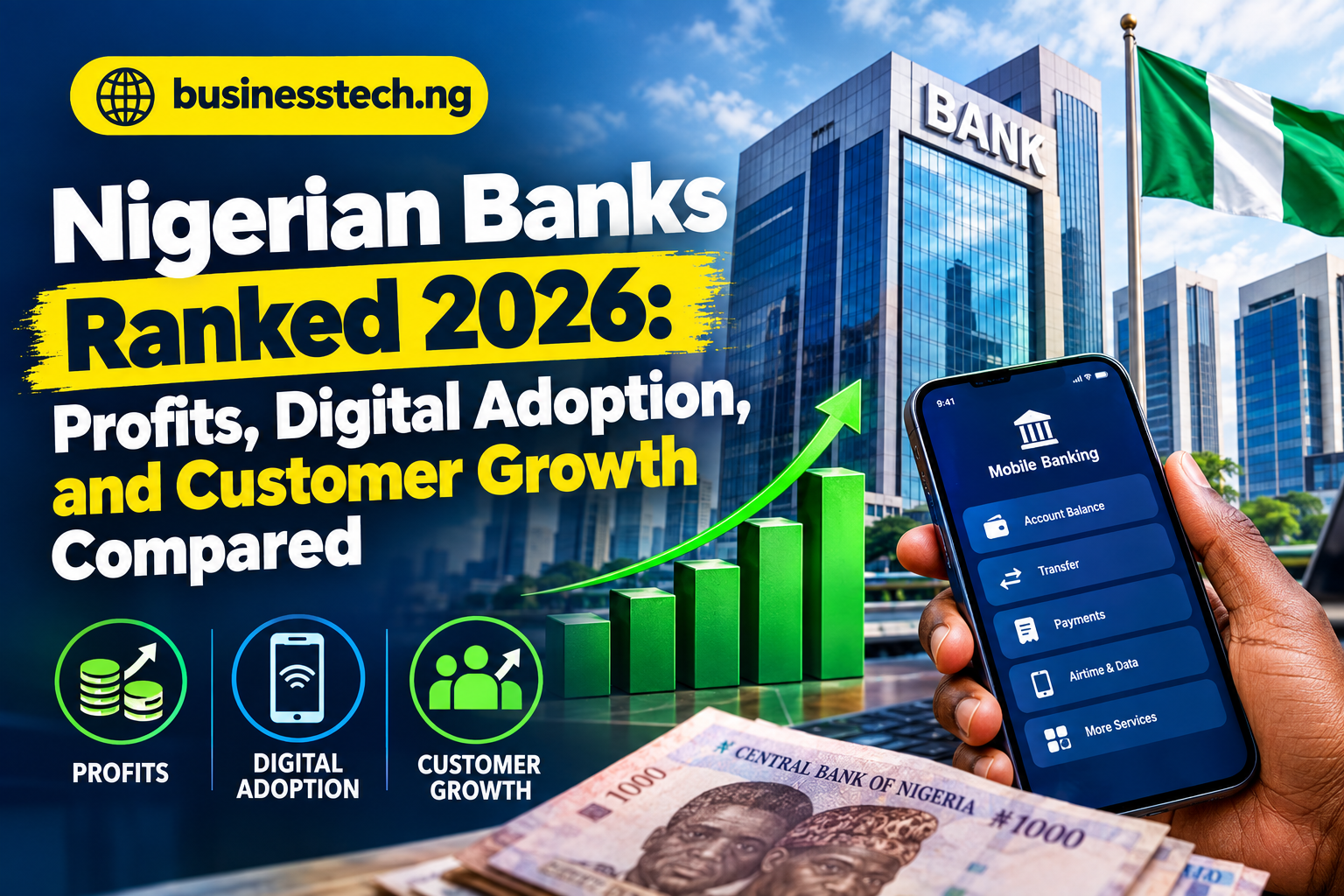
For this comparison, the banks are ranked primarily by latest comparable audited profit after tax for the 2025 financial year, with customer growth, deposits, digital adoption, asset quality and 2026 performance updates used to provide additional context.
This is important because full-year 2026 results are not yet available. Ranking banks using incomplete 2026 numbers would produce an uneven comparison.
The 10 banks examined are Zenith Bank, GTCO, Access Holdings, UBA, Stanbic IBTC, Fidelity Bank, Wema Bank, FCMB Group, First HoldCo and Sterling Financial Holdings.
How the 2026 Ranking Was Determined
The primary ranking metric is profit after tax (PAT) from the latest audited full-year results, covering the year ended December 31, 2025.
Additional indicators include:
- Profit growth
- Customer deposits
- Deposit growth
- Customer-base expansion
- Digital banking adoption
- Loan growth
- Asset quality
- Cost efficiency
- 2026 operating updates
The ranking should therefore be read as a financial-performance comparison, not a recommendation about which bank an individual customer should use.
Nigerian Banks Ranked by Profit After Tax
| Rank | Bank | FY2025 Profit After Tax | Key 2025 Signal |
|---|---|---|---|
| 1 | Zenith Bank | ₦1.041 trillion | Highest PAT among the banks compared |
| 2 | GTCO | ₦865.75 billion | Strong profitability and efficiency |
| 3 | Access Holdings | ₦743.05 billion | Large balance sheet and deposit expansion |
| 4 | UBA | ₦404.7 billion | Large Pan-African customer franchise |
| 5 | Stanbic IBTC | ₦380.8 billion | Strong ROE and asset growth |
| 6 | Fidelity Bank | ₦242.4 billion | Strong earnings and customer expansion |
| 7 | Wema Bank | ₦193 billion | Rapid profit growth and digital focus |
| 8 | FCMB Group | ₦177.3 billion | Fastest PAT growth among the group |
| 9 | First HoldCo | ₦147.25 billion | Earnings affected by large impairment charges |
| 10 | Sterling Financial Holdings | ₦76.3 billion | Strong percentage profit growth from a smaller base |
The ranking is based on audited FY2025 figures, not stock-market performance.
1. Zenith Bank
Zenith Bank recorded the highest profit after tax among the banks compared, with ₦1.04 trillion for 2025.
Its gross earnings rose 5.6% to ₦4.19 trillion, while profit before tax declined 4.8% to ₦1.26 trillion. Despite the decline in PBT, profit after tax increased slightly from ₦1.033 trillion in 2024 to ₦1.041 trillion.
Customer deposits increased 10.8% to ₦24.33 trillion, while total assets reached ₦31.46 trillion.
The bank’s 2025 performance also shows why profitability alone does not tell the entire story. Its return on average equity was 23.2%, down from 32.5% a year earlier, while its non-performing loan ratio improved from 4.7% to 3.8%.
Zenith also continued investing heavily in digital and retail banking.
Its 2025 annual report says the bank added more than 2.3 million new retail accounts, onboarded more than 17,000 new merchants and agents, and expanded its agency network to 131,724 agents.
2026 update
Zenith’s 2025 results provide the most complete basis for its position in this comparison. Its technology and retail expansion remain important parts of the bank’s strategy as Nigerian banking becomes increasingly digital.
2. GTCO
GTCO recorded ₦865.75 billion in profit after tax in 2025, placing it second in this comparison.
The holding company reported ₦1.23 trillion in profit before tax, while total assets reached ₦17.76 trillion.
One of GTCO’s most notable characteristics is profitability relative to its balance sheet.
Its return on average equity stood at 28.3% for 2025, while the group maintained a relatively low cost-to-income ratio compared with several major competitors.
GTCO’s 2025 performance was affected by lower fair-value gains compared with 2024, but core interest and fee income continued to grow.
The group also operates beyond conventional commercial banking, with interests spanning payments, pension management and fund management.
2026 update
GTCO reported ₦302.9 billion in profit before tax in Q1 2026, with interest income rising 17.5% year-on-year and fee income increasing 7.1%.
Deposits rose from ₦12.87 trillion at the end of 2025 to ₦13.69 trillion by March 2026.
That suggests the group entered 2026 with continued balance-sheet expansion.
3. Access Holdings
Access Holdings recorded ₦743.05 billion in profit after tax in 2025, placing it third by this measure.
The group reported profit before tax of approximately ₦1.01 trillion, while gross earnings reached about ₦5.52 trillion.
Access also had one of the largest balance sheets among Nigerian banking groups.
Customer deposits grew strongly during 2025, and the bank continued its strategy of expanding its African and international footprint.
Access Bank’s current corporate profile states that the banking group serves more than 63 million customers across 24 countries, making its customer franchise one of the largest among Nigerian banking groups.
Access also has a significant SME banking franchise.
According to Euromoney’s 2026 Nigeria banking awards coverage, Access Bank’s SME customer base reached 7.6 million businesses in 2025, up 14.3%, while SME revenue increased 32.7% to ₦162 billion.
The bank also provided ₦280 billion in financing to more than 13,000 businesses during the year.
2026 update
Access Holdings reported ₦272.21 billion in profit before tax in Q1 2026, representing a 22.19% increase from the corresponding period of 2025.
The group’s audited half-year 2026 results were subject to regulatory approval and reporting procedures during the third quarter.
4. UBA
United Bank for Africa recorded approximately ₦404.7 billion in profit after tax for 2025.
The result was considerably lower than the ₦766.5 billion recorded in 2024, with impairment charges and other factors affecting profitability.
However, UBA remains one of Nigeria’s largest banking franchises by customer reach.
The bank said its customer base exceeded 37 million at the end of 2025, while its wider group serves more than 45 million customers across its markets.
Digital banking is an important part of UBA’s strategy.
The bank’s AI-powered LEO platform has been expanded to support cross-border transactions through the Pan-African Payment and Settlement System, while its RedApp mobile platform was upgraded in 2026.
UBA also won the African category at the 2026 Banker Technology Awards for its technology and AI initiatives.
2026 update
UBA’s Q1 2026 results showed profit before tax of ₦160.7 billion.
Management described 2026 as a transition period involving continued investment, disciplined provisioning and a focus on improving the quality of earnings.
5. Stanbic IBTC
Stanbic IBTC Holdings recorded ₦380.8 billion in profit after tax in 2025.
Profit before tax rose to ₦551.8 billion, while operating income reached ₦895.7 billion.
Total assets increased 25% year-on-year to ₦8.6 trillion, while customer deposits increased 45% to ₦4.37 trillion.
Return on equity reached 42.4%, one of the strongest figures among the major banks in this comparison.
Stanbic’s digital strategy is particularly visible in lending.
Its digital lending platform allows customers to view eligible loan products, request loans and receive automated decisions.
According to Euromoney’s 2026 Nigeria awards coverage, product utilisation doubled within months of the platform’s launch, while loan turnaround times fell from around 30 days to between two minutes and 72 hours for applicable products.
6. Fidelity Bank
Fidelity Bank recorded ₦242.4 billion in profit after tax for 2025.
Gross earnings rose 45.6% to approximately ₦1.52 trillion.
Customer deposits increased 16.1% to ₦6.89 trillion, while total assets increased 18.6% to ₦10.46 trillion.
Fidelity’s customer and financial-inclusion expansion is also notable.
Its 2025 annual report showed savings accounts rising sharply to 2.37 million from 644,661 in 2024.
USSD banking users increased, while the bank added more than 5,600 agents during 2025 and expanded its agency network to more than 41,200 agents.
The bank currently says it serves more than 10 million customers through its physical and digital channels.
2026 update
Fidelity’s Q1 2026 figures showed total earnings of ₦434.9 billion, up 37.9%, while customer deposits increased 7.1% to ₦7.4 trillion.
Profit before tax was ₦92.5 billion, down 12.6% year-on-year, showing the difference between strong revenue growth and bottom-line performance.
7. Wema Bank
Wema Bank’s 2025 performance places it among the strongest mid-sized lenders by profit growth.
The bank recorded approximately ₦193 billion in profit after tax, according to its audited financial statements.
Its 2025 performance was supported by substantial growth in interest income and its continued focus on digital banking.
Wema’s ALAT digital banking platform remains a central component of its retail strategy.
The bank’s performance illustrates an important trend in Nigeria’s banking industry: smaller banks can achieve rapid earnings growth without matching the absolute balance-sheet size of the largest tier-one institutions.
8. FCMB Group
FCMB Group recorded ₦177.3 billion in profit after tax in 2025.
Although its absolute profit was below the largest banks, its growth rate was notable.
Profit after tax increased from ₦73.34 billion in 2024 to ₦177.27 billion in 2025.
Gross earnings increased 41.8% to ₦1.13 trillion.
This represented one of the strongest year-on-year profit increases among the banks examined.
FCMB’s performance shows why a ranking based solely on absolute profit can overlook important growth stories.
A large bank can generate more profit in absolute terms while a smaller bank can grow its earnings much faster.
9. First HoldCo
First HoldCo recorded approximately ₦147.25 billion in profit after tax in 2025.
The result represented a substantial decline from the previous year.
The main factor was a sharp increase in impairment charges, which reached approximately ₦826.3 billion.
Despite the earnings pressure, First HoldCo remains one of Nigeria’s largest financial groups by scale, supported by the extensive FirstBank franchise.
The 2025 results demonstrate how credit-loss recognition can significantly affect bank profitability even when underlying banking activity remains substantial.
10. Sterling Financial Holdings
Sterling Financial Holdings recorded ₦76.3 billion in profit after tax in 2025.
That represented a 74.8% increase from ₦43.7 billion in 2024.
Gross earnings rose 44.4% to ₦486.8 billion, while customer deposits increased 18.5% to ₦2.98 trillion.
Loans and advances grew 28% to ₦1.41 trillion.
The bank also improved its non-performing loan ratio from 5.4% to 4.7%.
Sterling therefore ranks tenth by absolute PAT in this comparison but recorded strong percentage growth.
Profit Ranking Does Not Tell the Whole Story
The most important conclusion from the numbers is that profit size and growth are different measurements.
Zenith had the largest absolute profit, but FCMB delivered much faster year-on-year PAT growth.
Access had a huge balance sheet and customer franchise, while Stanbic IBTC reported very strong return on equity and deposit growth.
UBA has one of the largest customer bases, while GTCO combines substantial earnings with strong efficiency metrics.
The following table provides a broader view.
| Bank | FY2025 PAT | Customer / Scale Indicator | Notable Digital or Growth Signal |
|---|---|---|---|
| Zenith | ₦1.04tn | 40.1m domestic retail customers | 2.3m new retail customers in 2025 |
| GTCO | ₦865.75bn | 37m+ group customers | Strong digital financial-services ecosystem |
| Access | ₦743.05bn | 63m+ group customers | 7.6m SME customers |
| UBA | ₦404.7bn | 37m+ customers at FY2025 | AI-powered LEO and upgraded RedApp |
| Stanbic IBTC | ₦380.8bn | Large multi-business franchise | Digital lending platform |
| Fidelity | ₦242.4bn | 10m+ customers | USSD and agency banking expansion |
| Wema | ~₦193bn | Growing retail/digital franchise | ALAT digital banking |
| FCMB | ₦177.3bn | Growing retail and business franchise | Strong earnings growth |
| First HoldCo | ₦147.25bn | Large FirstBank franchise | Large physical and digital network |
| Sterling | ₦76.3bn | Smaller customer franchise | Digital-focused banking model |
Customer figures are not perfectly comparable because some banks report group customers across multiple countries and subsidiaries, while others report Nigerian banking customers. They should therefore be treated as indicators of scale rather than a precise league table.
Digital Banking Is Changing the Competition
Nigeria’s banking competition is increasingly moving away from branches alone.
Mobile applications, USSD, agency banking, digital lending, instant payments and AI-powered customer-service platforms are becoming central to how banks acquire and retain customers.
Zenith’s addition of more than 2.3 million retail customers in 2025 demonstrates the scale of physical and digital customer acquisition.
UBA has invested heavily in AI-powered financial services.
Stanbic IBTC has focused on digital lending and faster credit decisions.
Fidelity has expanded USSD and agency banking.
Access has combined digital services with a large SME franchise.
GTCO has expanded beyond traditional banking into payments, pensions and asset management.
The implication is that customer growth in Nigerian banking is increasingly connected to technology, convenience and ecosystem services.
Which Banks Grew Customers Most?
There is no single industry-wide customer-growth dataset that allows a completely consistent ranking of all Nigerian banks.
Some institutions report total group customers. Others report active banking customers, retail customers, accounts or customers across several subsidiaries.
Among the banks with clearly disclosed figures:
- Zenith added more than 2.3 million retail customers in 2025.
- Access reported a customer base of more than 63 million across its international network.
- UBA reported more than 37 million customers at the end of 2025.
- GTCO’s group banking franchise serves more than 37 million customers.
- Fidelity says it serves more than 10 million customers.
These figures demonstrate scale, but they should not be interpreted as directly comparable measures of active customers.
What the 2026 Banking Numbers Mean for Customers
For customers, the most important lesson is that bank size alone does not determine the quality of the banking experience.
Different banks are competing on different dimensions.
A retail customer may care about:
- Mobile-app reliability
- Transfer speed
- ATM availability
- USSD functionality
- Fees
- Savings products
- Customer service
A business customer may place greater importance on:
- Working-capital loans
- Foreign exchange
- Trade finance
- Merchant services
- POS infrastructure
- Cash management
- International payments
An investor may focus more heavily on:
- Profitability
- Return on equity
- Asset quality
- Capital adequacy
- Dividend capacity
- Deposit growth
- Loan growth
This explains why one bank can lead in profitability while another grows customers faster.
Nigerian Banking Industry in 2026: What to Watch Next
The next major phase of competition will be shaped by five factors.
1. Recapitalisation
The CBN’s recapitalisation requirements have pushed banks to strengthen their capital bases.
NGX reported that 10 banks had raised funds through the capital market as part of the recapitalisation process, including GTCO, Access Holdings, Zenith, UBA, First HoldCo, Fidelity, FCMB, Wema, Stanbic IBTC and Sterling.
2. Digital customer acquisition
Banks will increasingly compete for customers through apps, USSD, agency networks, digital lending and integrated payment platforms.
3. Credit quality
The withdrawal of regulatory forbearance has forced banks to recognise more credit losses.
This is one reason why some banks experienced significant profit declines despite strong gross earnings.
4. Deposit mobilisation
With deposits remaining a crucial source of bank funding, customer acquisition and retention will remain strategically important.
5. Efficiency
As technology becomes more important, banks will increasingly seek to reduce the cost of serving customers while increasing transaction volumes.
Final Takeaway
The 2026 Nigerian banking landscape is more complicated than a simple ranking of the biggest banks.
Zenith Bank leads this comparison by 2025 profit after tax, followed by GTCO and Access Holdings. UBA and Stanbic IBTC follow, while Fidelity, Wema, FCMB, First HoldCo and Sterling complete the top 10 based on the latest comparable audited earnings.
But the numbers also reveal different competitive strategies.
Zenith combines high profitability with significant retail customer acquisition.
GTCO stands out for profitability and efficiency.
Access combines a large international customer base with significant SME expansion.
UBA has one of the largest customer franchises and continues to invest heavily in digital and AI banking.
Stanbic IBTC has delivered strong balance-sheet growth and digital lending innovation.
Fidelity has expanded customers, deposits and financial inclusion.
FCMB and Wema demonstrate the growth potential of mid-sized lenders, while Sterling has produced strong percentage earnings growth from a smaller base.
For customers, businesses and investors, the more useful approach is therefore to look beyond a single ranking and examine the specific metric that matters most.
Profit tells you how much a bank earned. Customer growth tells you how quickly its franchise is expanding. Digital adoption shows how it is changing the way customers interact with the bank. Asset quality and capital show how resilient that growth may be.
Those measures together provide a more complete picture of Nigeria’s banking sector in 2026.
Frequently Asked Questions
Which Nigerian bank recorded the highest profit in 2025?
Zenith Bank recorded the highest profit after tax among the 10 banks compared, with approximately ₦1.04 trillion.
Which Nigerian bank had the fastest profit growth?
FCMB Group recorded one of the strongest profit-after-tax growth rates in the comparison, with PAT rising from ₦73.34 billion in 2024 to ₦177.27 billion in 2025.
Which Nigerian bank has the largest customer base?
Customer figures vary by reporting methodology. Access Bank currently reports more than 63 million customers across its international network, while UBA and GTCO also report customer bases exceeding 37 million.
Which bank is leading in digital banking?
There is no single official measure that ranks all banks by digital adoption. Zenith, UBA, Stanbic IBTC, Fidelity, Access and GTCO have all disclosed significant investments or developments in digital banking, but their reported metrics are not directly comparable.
Are Nigerian banks profitable in 2026?
Yes. Nigerian banks continue to report significant earnings in 2026, although performance varies considerably between institutions. Full-year 2026 results are not yet available, so the most comparable ranking currently uses audited 2025 results alongside 2026 interim updates.
Why did some Nigerian banks record lower profits in 2025?
Higher impairment charges were a major factor. The sector’s transition away from regulatory forbearance required banks to recognise credit risks more fully, putting pressure on earnings at several large institutions.