|
Getting your Trinity Audio player ready...
|
Japan is confronting a growing misinformation problem as false and misleading claims about foreigners spread across social media, intensifying an already heated debate over immigration and contributing to the political environment in which the country’s far right has gained greater attention.
Researchers and misinformation analysts have warned that fabricated stories about crimes allegedly committed by foreign nationals are increasingly being used to reinforce negative perceptions of immigrants. One of the latest cases involved videos falsely presented as showing foreigners stealing metal from railway tracks in Japan. The footage attracted roughly 4.3 million views across social media platforms by September 15, according to an investigation by Constella Security Japan reported by Kyodo News.
The videos are significant because the footage itself was not necessarily fabricated. Instead, the deception came from the context attached to it.
Constella traced one widely circulated video to an earlier Instagram post written in Arabic that had been published overseas in August 2025. The footage was unrelated to railway theft in Japan, but versions circulating on Japanese social media were given captions suggesting that foreigners were stealing railway cables or other metal infrastructure.
That method of misinformation is becoming increasingly difficult to tackle because it does not depend on sophisticated artificial intelligence or digitally generated imagery. A genuine piece of footage can be taken from one location, stripped of its original explanation and presented as evidence of an entirely different event.
Once that material begins circulating, subsequent users may encounter only the altered version. The original source can disappear from view while the false explanation becomes the dominant narrative.
For Japan, the timing is particularly important.
The country is experiencing a significant increase in the number of foreign residents and visitors while simultaneously dealing with a declining population and persistent labour shortages. Japan’s Immigration Services Agency said foreign entrants in 2025 reached 42.43 million, the highest figure on record, while new foreign entrants also reached a record 39.18 million. Those figures include large numbers of short-term visitors and therefore should not be confused with the number of foreign residents living permanently or long-term in Japan.
The growing foreign presence has become a more visible part of everyday life, particularly in major cities and tourist destinations. It has also created a more politically sensitive environment in which legitimate questions about immigration policy can become mixed with unverified claims about crime, welfare, employment and public services.
That distinction is crucial.
Japan has real policy questions surrounding foreign workers, immigration enforcement, tourism, housing, social insurance and integration. But a misleading video cannot establish the scale of a national crime problem, and an isolated incident involving an individual cannot reasonably be used to describe millions of foreign residents.
The social media environment makes that distinction harder for users to maintain.
A dramatic video can generate an emotional response within seconds. A viewer may see people apparently cutting cables and immediately associate the footage with a caption claiming that foreigners are stealing railway infrastructure. By the time a fact-check appears, the original post may already have reached hundreds of thousands or millions of users.
The Constella investigation illustrates precisely that problem. According to the reported findings, accounts in Japan that circulated the railway video included users who had previously posted messages opposing the acceptance of foreign workers. One account reportedly had about 70,000 followers.
This does not mean that every person sharing such material knowingly intends to spread false information. Some users may simply believe what they see. Others may share content because it confirms concerns they already hold.
That is one of the reasons misinformation can become politically influential without requiring a centrally coordinated campaign.
A false claim can move through a network of ordinary users, each adding another layer of visibility. Repetition then creates familiarity, and familiarity can make a claim appear more credible even when the underlying evidence has not changed.
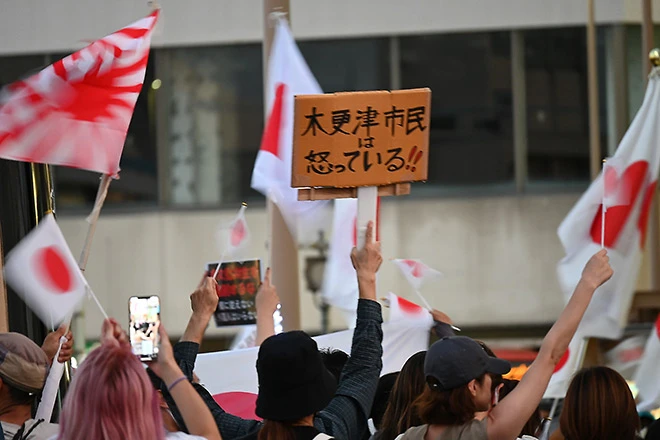
The Sanseito party, which promotes a “Japanese First” political message and has called for tougher policies concerning foreigners, made major gains in the July 2025 House of Councillors election. Reuters reported that the party gained 14 seats in the election, moving from a marginal political position into a more significant presence in Japan’s upper house.
The party’s rise has been associated with a mixture of issues rather than immigration alone. Its campaign included concerns about economic conditions, taxation, welfare, national identity and immigration. Reuters reported that its online presence, including a substantial YouTube following, was an important part of its political strategy.
Academic research published by Cambridge University Press in 2026 has examined the emergence of anti-foreigner populism in Japan and the role of social media, changing attitudes toward foreign workers and the increasing visibility of foreigners in Japanese society. The study describes the 2025 election as a significant moment in the mainstreaming of anti-foreigner populism.
That research also highlights why it would be too simplistic to explain the political shift through fake news alone.
Economic pressure, demographic change, the rapid growth of tourism and foreign employment, concerns about fairness and changing social conditions all form part of the wider political environment. Social media misinformation can interact with those existing concerns, but it does not create every underlying grievance.
The more immediate danger is that false information can turn those concerns into claims that are presented as facts.
For example, a debate over whether Japan should accept more foreign workers is a policy question. A fabricated video claiming to show foreign workers committing crimes is a factual claim that can be checked.
Those two things should not be treated as equivalent.
Yet online platforms can place them side by side, allowing an unverified video to become part of a political argument about immigration before its authenticity or context has been established.
The problem extends beyond Japan. Social media has changed the way political narratives develop across many countries. Videos, photographs and short posts can now travel across borders almost instantly. Material produced in one language and country can be repackaged for an entirely different audience.
The Japanese railway video demonstrates how simple this process can be.
There was no requirement for an advanced deepfake. The footage only needed a new caption.
That makes the problem particularly challenging for platforms and fact-checkers. Detecting manipulated pixels is one task. Establishing whether the description attached to genuine footage is accurate requires a different kind of investigation.
Researchers must determine where the video originally appeared, when it was recorded, what was happening at the time and whether the location matches the claim being made.
This is also why reverse-image and video searches, source verification and careful reading of original posts have become increasingly important tools for journalists.
For ordinary social media users, the same principle applies. A video showing an apparent crime is not necessarily evidence of where the crime occurred, when it happened or who was involved.
A caption is not proof.
The problem becomes even more serious when the claim assigns collective responsibility to people based on nationality or immigration status.
Japan’s foreign population is diverse, encompassing workers, students, permanent residents, family members and people from many different countries and backgrounds. The country’s immigration system itself contains multiple categories of residence and entry, making broad claims about “foreigners” particularly difficult to substantiate.
Official immigration statistics also show how large and varied the movement of people into Japan has become. In 2025, the Immigration Services Agency recorded more than 39 million new foreign entrants, with short-term stays accounting for the overwhelming majority of new entries.
That number should not be interpreted as 39 million foreign residents. Many were tourists or other short-term visitors. The distinction matters because misleading statistics can themselves become a form of misinformation.
The political debate surrounding immigration is therefore occurring against a complicated statistical and economic background.
Japan needs workers in sectors affected by demographic decline, while policymakers also face pressure to address concerns about immigration management and integration. Businesses, local governments and communities are consequently dealing with both the economic benefits and social challenges associated with a larger foreign presence.
The information environment can either clarify those questions or make them harder to answer.
When genuine statistics are replaced by viral anecdotes, the public loses the ability to distinguish between a documented trend and an emotionally powerful story.
This is where the recent wave of anti-foreigner misinformation becomes particularly important for technology journalism.
The issue is not simply about politics. It is also about how digital platforms determine what information receives attention, how algorithms amplify highly engaging material and how quickly false context can travel through online communities.
The railway video is a clear example of how the architecture of modern social media can turn a relatively obscure piece of footage into a national political talking point.
It also shows why misinformation does not always need to look obviously fake.
Some of the most effective false claims may use authentic photographs, authentic videos or real events. The manipulation happens in the explanation surrounding the material.
That creates a difficult responsibility for technology companies. Platforms can remove content that violates their rules, but content moderation alone cannot resolve every case in which an authentic piece of media is paired with a false claim.
Users, journalists, researchers and public institutions all play a role in determining whether a viral story survives scrutiny.
The Japanese government has already been working with specialists to examine online misinformation. Constella Security Japan, a Tokyo-based cybersecurity company commissioned to assist with countering disinformation, held a webinar in August involving officials and media representatives that examined false information targeting foreign residents.
Such efforts are becoming increasingly relevant as political discussions move further onto social platforms.
The challenge for Japan is not simply stopping individual fake videos. It is preventing an information cycle in which misleading claims about foreigners reinforce public suspicion, public suspicion increases demand for tougher political rhetoric, and political rhetoric creates an even larger audience for similar online content.
That cycle can develop without every participant knowing that the original information was false.
Japan’s experience therefore offers a wider warning about the relationship between technology and politics.
A country can have genuine concerns about immigration while also being exposed to fabricated claims about immigrants. Those two realities can exist simultaneously. The existence of legitimate policy debates does not validate false evidence, just as the existence of misinformation does not mean every concern about immigration is fabricated.
Keeping those distinctions clear is becoming increasingly important.
For Japan, the stakes are particularly high because demographic decline means the country is likely to remain dependent on foreign workers and international migration in some form. At the same time, political parties that campaign on restricting immigration have demonstrated that the issue can attract substantial electoral attention.
The result is a difficult balancing act.
Japan must debate immigration policy while ensuring that the debate is based on verifiable information rather than fabricated videos, misleading statistics or unsubstantiated accusations.
The rapid spread of the railway footage shows how easily that standard can be undermined.
As social media becomes an increasingly important source of news for voters, the ability to verify what appears on a screen is becoming as important as the ability to produce the content itself.
For technology companies, policymakers and journalists, that means the fight against misinformation is no longer a peripheral internet issue. It is becoming part of the wider question of how modern societies make decisions.
And in Japan, where immigration, demographics, economic pressure and political identity are increasingly colliding online, the consequences of getting that information environment wrong could extend well beyond a single viral video.