|
Getting your Trinity Audio player ready...
|
Global Shares Rise as Bond Market Turmoil Eases Ahead of Key US Jobs Report
Stock markets around the world climbed Friday as the wild swings that had gripped bond and currency markets in recent sessions finally began to settle, with investors turning their attention to a closely watched US jobs report that could reshape expectations for the Federal Reserve’s next move.
Europe’s pan-regional STOXX 600 index rose 0.8 percent in early trading, though it remained on track for a weekly decline of roughly 1 percent given how rough the preceding sessions had been. US futures pointed to a similarly steadier mood heading into Wall Street’s open, with Nasdaq futures up 0.7 percent and S&P 500 futures gaining 0.4 percent. In Asia, the broader picture was more mixed. MSCI’s index of Asia-Pacific shares outside Japan was little changed and still headed for a weekly loss of about 1.2 percent, even as individual markets posted gains, with Australia’s S&P/ASX 200 up 0.8 percent and Taiwan’s Taiex adding 0.3 percent.
Major European indexes bounced back from a sharp selloff the day before, when a surge in government bond yields had dragged stocks sharply lower across the continent. Britain’s FTSE 100 climbed 0.5 percent to 10,485, France’s CAC 40 rose 0.6 percent to 7,883.49, and Germany’s DAX gained 0.8 percent to 25,129.78. Technology shares led the rebound across European markets, climbing 2.2 percent as a sector, with chip materials maker Aixtron and Austrian semiconductor firm AT&S among the standout gainers.
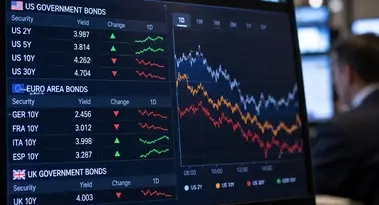
The turbulence that preceded Friday’s calm traces back to a now-familiar source. Global bond markets have been under sustained pressure for weeks as the war between the US, Israel and Iran keeps pushing energy prices higher, a combination that’s complicated the inflation outlook for central banks worldwide while straining government finances already stretched thin. Japan’s long-term bond yields hit multi-decade highs on Friday, and the US benchmark 10-year Treasury yield climbed to its highest level in 24 years on Thursday, just a day ahead of the jobs data investors were bracing for.
Europe’s bond markets showed their own warning signs of fiscal stress building beneath the surface. While longer-dated sovereign bonds broadly gained ground Friday, prices in more heavily indebted countries like France and Italy lagged behind the rally seen in Germany, with Germany’s 10-year yield falling 6.5 basis points while France’s edged down just 4 basis points to 4.892 percent. The gap between German and French 10-year yields widened to as much as 149 basis points, the widest spread since the euro zone debt crisis back in 2012, a signal that investors are demanding considerably more compensation to hold French and Italian debt relative to Germany’s as concerns about fiscal sustainability resurface. Mazars chief economist George Lagarias summed up the mood cautiously, saying he wouldn’t yet call the situation a crisis, but that it has the potential to become one if the pressure continues building over the next few weeks.
All eyes Friday were on the US nonfarm payrolls report for September, with economists forecasting a gain of roughly 90,000 jobs and the unemployment rate expected to hold steady at 4.1 percent. The stakes attached to that number are higher than usual given where Fed policy currently stands. The central bank raised interest rates earlier this year for the first time in three years, and markets are currently pricing in only about a 25 percent chance of a second rate increase this month, a probability that’s come down after two senior Fed officials said this week they want to see more data before committing to another move. A stronger-than-expected jobs number could quickly revive bets on that second hike, adding fresh upward pressure on yields right as markets were finally finding some stability.
Oil markets moved in a somewhat counterintuitive direction Friday, with crude prices actually declining even as the US deployed another aircraft carrier and thousands more troops to the Middle East, and as President Trump continued threatening further escalation against Iran. That disconnect between rising military tension and falling oil prices suggests traders were weighing other factors, including recovering export volumes from Gulf producers and lingering hope for diplomatic progress, more heavily than the latest show of American military force in that specific moment, even though the broader conflict has repeatedly proven capable of sending prices sharply higher on short notice.
The broader rout in European government bonds appears to have pushed some investors back toward traditional safe havens, with flows returning to US Treasuries, the dollar and the Swiss franc even as those same US Treasury yields sat near multi-decade highs. That combination, investors seeking safety in an asset whose price has been falling, reflects just how unusual the current market environment has become, with inflation risk, fiscal stress and geopolitical conflict all pulling markets in different directions simultaneously. Whether Friday’s calmer tone holds through the jobs report, or gives way to another round of volatility depending on what the data shows, is likely to set the tone for how markets head into the rest of October.