|
Getting your Trinity Audio player ready...
|
Trump Announces $200 Billion South Korean Investment, But Seoul Won’t Commit Yet to the Alaska Pipeline
President Donald Trump announced Wednesday that South Korea will invest up to $200 billion across a series of US energy and industrial projects, but Seoul moved almost immediately to clarify that one of the most prominent pieces, a roughly $54 billion natural gas pipeline in Alaska, is far from a done deal.
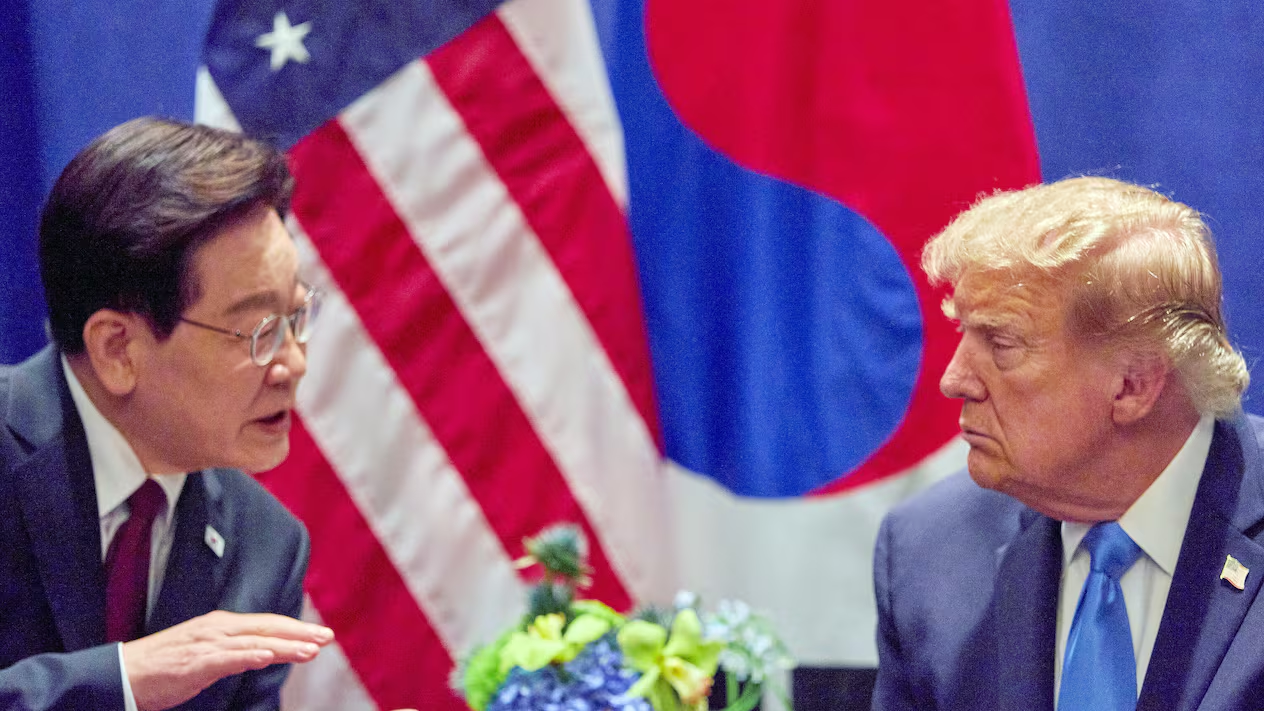
Speaking from the Oval Office, Trump credited his administration with securing the commitment, saying South Korea will invest up to $200 billion thanks to agreements his administration has reached with the country. The announcement marks the first concrete set of projects to emerge from a much larger $350 billion strategic investment package South Korea agreed to as part of a trade deal with Washington last year, a package that also includes a separate $150 billion commitment toward shipbuilding.
The confirmed portion of Wednesday’s announcement covers real money already earmarked for specific projects. South Korea has committed $120 billion toward building eight large-scale nuclear power plants in the US, along with $22.3 billion for a natural gas power facility in Texas designed to supply the growing electricity needs of AI data centers. Those two pieces alone account for a substantial share of the $200 billion figure Trump cited, and South Korean officials have confirmed both as settled commitments.
The Alaska piece is a different story entirely. South Korea’s trade ministry said the project would move forward only if certain commercial and legal conditions are met, and that no decision has yet been made on whether the country will invest at all, let alone at what scale. South Korean President Lee Jae Myung reinforced that caution directly, emphasizing that participation in some of the projects under discussion remains subject to ongoing commercial review rather than settled policy. That stands in some tension with Trump’s own framing. In a Truth Social post Wednesday evening, he said the two countries had agreed to work together on the Alaska LNG project, putting its value at $50 billion, a figure close to but not identical with the roughly $54 billion pipeline cost cited elsewhere in the announcement, underscoring how much of this deal’s specific terms still appear to be in flux even as the headline numbers get repeated publicly.
The project at the center of the disagreement is the long-discussed Alaska LNG pipeline, an 807-mile line that would carry natural gas from Alaska’s North Slope down to a liquefaction facility on the state’s southern coast, from where it could be shipped to buyers across Asia, including South Korea, Japan and China, three of the world’s largest LNG importers. As designed, the pipeline would move about 3.9 billion cubic feet of gas a day and support production of up to 20 million metric tons of LNG annually. Glenfarne, the company developing the project, welcomed Trump’s announcement, though it had said back in March that it had secured commitments for only 13 million tons a year of the capacity it needs, with another 3 million tons still required before financing could be finalized and commitments made binding. Some energy analysts have estimated the pipeline wouldn’t actually become operational before 2040 at the earliest, a timeline that adds to the sense that Wednesday’s announcement reflects political momentum more than imminent construction.
There’s also a potential minority investment in Westinghouse, the nuclear technology company, by Korean firms under discussion, though South Korean officials have said the terms of that arrangement remain subject to further commercial negotiation rather than being finalized.
Politics shape this story on both sides of the Pacific. In the US, the pipeline carries real stakes for Alaska’s upcoming Senate race, where Republican incumbent Dan Sullivan faces a competitive challenge from Democrat Mary Peltola, giving any visible progress on the long-stalled project added electoral weight. More broadly, Wednesday’s announcement is one of a string of investment deals Trump has been showcasing ahead of November’s midterm elections, part of an effort to highlight his economic record at a moment when voters have expressed concern over the ongoing Iran war and elevated gasoline prices.
In South Korea, the picture is more cautious. Opposition lawmakers have raised concerns about the commercial viability and fiscal risk of committing such large sums to US-based projects, particularly given that the overall $350 billion package represents more than 80 percent of South Korea’s total foreign currency reserves. South Korean officials have previously pushed back against parts of the broader US investment framework, including seeking a currency swap arrangement with Washington to cushion the country’s foreign exchange markets against the shock of moving that much capital abroad. Lee has said publicly that Korean companies will likely hesitate to commit further investment in the US unless outstanding concerns, including worker visa arrangements following an earlier immigration enforcement incident at a US facility linked to Korean business operations, are properly resolved. South Korea’s Foreign Ministry has said Washington has since agreed to allow Korean workers into the country on short-term visas or through a visa waiver arrangement specifically to help staff these industrial projects.
Whether the Alaska pipeline ultimately becomes part of South Korea’s finalized investment, or gets quietly set aside while the confirmed nuclear and Texas power projects move forward on their own, is likely to depend on exactly the kind of commercial viability reviews Seoul has repeatedly said it’s still conducting. For now, Wednesday’s announcement gives both governments a headline figure to point to, even as the two sides appear to be describing the same deal in noticeably different terms.