|
Getting your Trinity Audio player ready...
|
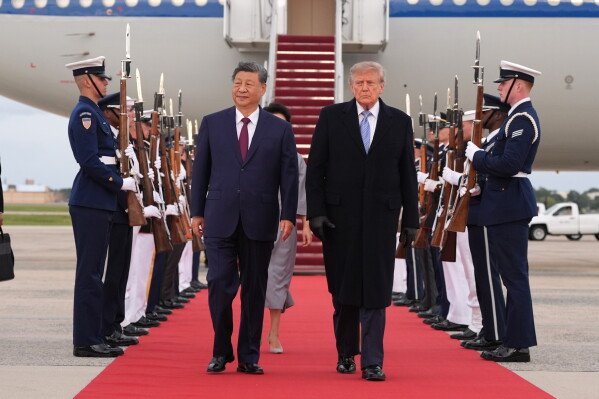
President Donald Trump welcomed Chinese President Xi Jinping to Washington this week for a state visit heavy on pageantry, as the leaders of the world’s two largest economies looked to project stability in a relationship still shadowed by deep, unresolved tensions.
Xi’s arrival marks his first trip to Washington in more than a decade, and the second meeting between the two leaders this year following Trump’s own visit to Beijing back in May. Trump personally greeted Xi on the tarmac at Joint Base Andrews on Wednesday evening, a gesture with real symbolic weight attached to it. According to C-SPAN, which tracks presidential events, it was the first time in eleven years that a sitting US president had personally welcomed a foreign leader at the base, the last occasion being when President Barack Obama greeted Pope Francis there back in 2015.
The gesture appeared designed, at least in part, to return the favor. When Trump visited Beijing in May, he was met with a genuinely elaborate welcome, including a 100-foot red carpet rolled out at the foot of his plane, a 21-person military honor guard, a military band, and roughly 300 Chinese youths waving flags from both countries while chanting greetings. Notably, Xi himself wasn’t actually at the airport for that occasion, sending Chinese Vice President Han Zheng in his place. Trump has made clear in the weeks leading up to this week’s visit that he wanted to match, if not exceed, that level of spectacle, telling reporters he was pleased his newly built helicopter landing pad, which he’s called a work of art, would be ready in time, while expressing some disappointment that a separate White House ballroom project wouldn’t be finished for the occasion. Thursday’s events are set to unfold across the White House South Lawn, State Floor and Rose Garden.
Substantively, expectations for the visit remain modest. Analysts widely expect the summit to produce few, if any, major breakthroughs, with the most tangible outcome likely being an extension of an existing trade truce between the two countries. Treasury Secretary Scott Bessent confirmed that extension as Trump greeted Xi at Andrews on Wednesday, though further details on its specific terms weren’t immediately laid out. In a statement carried by China’s Xinhua news agency upon arrival, Xi struck a conciliatory tone, expressing hope for a more stable relationship going forward and saying the two countries should approach each other as partners rather than rivals.
Beneath the ceremonial warmth, the underlying dynamics between the two countries remain genuinely complicated. Xi arrives in what many observers consider a comparatively strong negotiating position, having overseen a surge in China’s trade performance while maintaining significant control over global supplies of rare earth minerals, leverage that gives Beijing real bargaining power in any trade discussion. Both leaders, though, have clear incentives to project calm regardless of where the actual balance of leverage sits. Trump remains entangled in an unpopular military conflict involving Iran, while Xi continues managing considerable strain on China’s domestic economy, giving both men reason to avoid reigniting open confrontation with each other right now.
That doesn’t mean the harder disagreements have gone away. Export controls, competition over artificial intelligence, and the status of Taiwan remain unresolved points of friction that could easily flare back up once the ceremonial portion of the visit concludes. Taiwan, the democratically governed island Beijing claims as its own territory, remains the single most sensitive of these issues. According to sources briefed on the visit, Xi is expected to press Trump to halt US arms sales to Taipei, potentially raising the issue directly during a planned joint visit the two leaders are scheduled to make to the National Archives on Friday. In exchange, those sources say China has signaled a willingness to help apply pressure on Iran, a trade-off that has left US allies across Asia uneasy, given concerns that Trump could be tempted to soften Washington’s longstanding support for Taiwan in pursuit of a more favorable economic outcome with Beijing.
Thursday’s state dinner is drawing a notably prominent guest list from the American technology industry, including Apple’s Tim Cook, Amazon’s Jeff Bezos, Alphabet’s Sundar Pichai, OpenAI’s Sam Altman, Tesla’s Elon Musk and Nvidia’s Jensen Huang. Despite that lineup of executives whose companies have real commercial interests in China, people familiar with the administration’s plans say Trump is expected to hold firm on existing export controls covering advanced US technology, restrictions China has been pushing to have loosened as part of any broader trade normalization.
For Trump, a president known for placing considerable value on ceremony and high-profile relationships with powerful foreign leaders, the visit carries weight both as a matter of personal and national prestige and as an opportunity for substantive, if limited, diplomacy. Whatever concrete outcomes actually emerge from the two days of meetings, both sides appear to be treating the appearance of a stable, functioning US-China relationship as valuable in its own right, even as the harder disputes over trade, technology and Taiwan remain largely unresolved beneath the surface of Thursday’s carefully choreographed pageantry.