|
Getting your Trinity Audio player ready...
|
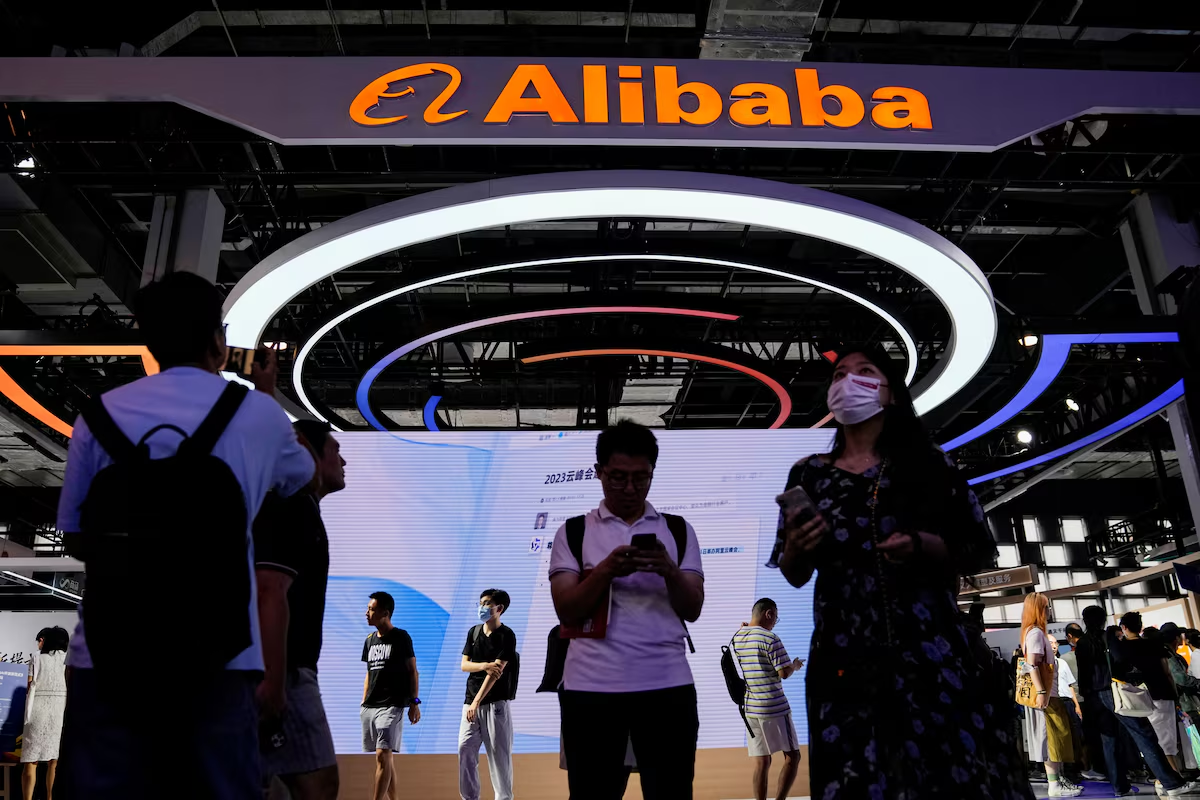
Alibaba shares climbed roughly 3 percent in Hong Kong trading on Tuesday after the Chinese technology giant unveiled a powerful new AI chip and laid out an ambitious plan to more than triple its global data center capacity over the next several years, the latest sign that China’s largest cloud provider intends to compete directly with Western hyperscalers on the infrastructure powering the AI boom rather than just on software and applications.
The announcements came at Alibaba Cloud’s annual Apsara Conference in Hangzhou, where the company introduced the Zhenwu V900, its next-generation AI chip built through its T-Head semiconductor division. Alibaba said the new chip delivers roughly three times the performance of its predecessor, the Zhenwu M890, which launched in May, and can be linked together in clusters of up to 500,000 units to support training the kind of frontier AI models that require enormous computing power. The V900 is scheduled to enter mass production and reach commercial release in the first quarter of 2027, and Alibaba’s existing Zhenwu chip lineup already counts more than 650 customers spanning automotive, finance, energy and manufacturing industries.
Alongside the new chip, Alibaba Group CEO Eddie Wu announced a target of expanding Alibaba Cloud’s global data center capacity to more than 20 gigawatts by 2032, a figure that represents a dramatic scaling up of the company’s physical infrastructure footprint and puts a concrete long-term number behind what has so far been a rapidly accelerating spending campaign. According to CoinCentral’s reporting, Alibaba has already committed to spending more than $53 billion, equivalent to roughly 380 billion yuan, on AI-related infrastructure over a three-year period, and the company raised approximately $10.2 billion through a follow-on stock offering in Hong Kong back in August specifically to help fund that buildout.
Wu framed the moment in sweeping terms during his remarks at the conference, comparing the current stage of AI development to the early era of electrification and describing today’s AI coding tools as functioning much like the light bulb did during that earlier technological transition, a comparison meant to convey that Alibaba views AI infrastructure spending as still in its foundational, early-growth phase rather than approaching any kind of plateau. He said machine intelligence still has what he called an enormous growth runway ahead of it, a framing that echoes the broader confidence major AI infrastructure players globally have expressed about the durability of current spending trends.
The chip and infrastructure announcements arrived alongside updates on Alibaba’s large language model roadmap as well. The company confirmed its next-generation Qwen 4 model is currently in training, with Qwen 4.5 and Qwen 5 model series already planned for future release, giving the market a clearer sense of Alibaba’s product pipeline extending well beyond this year. That combination, new custom silicon, an expanding physical data center footprint, and a defined model roadmap, positions Alibaba’s AI strategy as an integrated stack spanning hardware, infrastructure and software rather than a series of disconnected initiatives.
Alibaba’s latest move follows a broader pattern of escalating AI infrastructure announcements from the company throughout 2026. Just weeks earlier, Alibaba had partnered with Nvidia to develop physical AI capabilities including data synthesis, model training and environmental simulation, while separately announcing plans to open new data centers in Brazil, France and the Netherlands, with additional facilities planned across Mexico, Japan, South Korea, Malaysia and Dubai, expanding a network that already spans 91 data centers across 29 regions worldwide. That Nvidia partnership announcement had sent Alibaba’s Hong Kong-listed shares surging nearly 10 percent to a four-year high at the time, while its U.S.-listed shares jumped a similar amount in premarket trading, reflecting just how closely investors have been tracking the company’s AI infrastructure commitments in recent months.
Domestic competition has been a significant factor pushing Alibaba to move aggressively on custom chip development specifically. The company separately signed a deal with China Unicom, the country’s second-largest telecom operator, to deploy its homegrown Pingtouge, or T-Head, AI accelerators in a new data center project in Qinghai province, a deal that sent Alibaba’s stock up more than 5 percent in Hong Kong at the time it was confirmed. Building proprietary AI silicon has become an increasingly important strategic priority for major Chinese technology companies as U.S. export restrictions have limited access to Nvidia’s most advanced chips, pushing firms like Alibaba to develop domestic alternatives capable of supporting large-scale AI training and inference workloads.
The timing of Tuesday’s announcements also carried some geopolitical weight, landing on the eve of a planned summit between U.S. President Donald Trump and Chinese President Xi Jinping. Alibaba’s domestic rival Huawei had separately unveiled its own new AI infrastructure just a week earlier, claiming its system could scale to as many as one million processors, underscoring how intensely competitive China’s homegrown AI infrastructure race has become even as both companies simultaneously position themselves against Western hyperscalers like Amazon Web Services, Microsoft and Google on the global stage.
For investors, Tuesday’s roughly 3 percent share price jump reflects continued confidence that Alibaba’s aggressive, multi-year infrastructure commitment is translating into tangible product milestones rather than remaining purely aspirational, even as the sheer scale of capital required, more than $53 billion committed over three years and a 20-gigawatt data center target still six years out, means the company’s AI bet will take considerable time to fully play out. Whether that spending ultimately delivers the returns investors are currently pricing in will likely become clearer as the Zhenwu V900 moves toward its 2027 commercial launch and Alibaba’s broader data center expansion continues rolling out across new international markets. Continuing coverage of how major AI infrastructure investments are reshaping global technology markets is available on Business Tech. Additional detail on the Zhenwu V900 and Alibaba’s broader AI roadmap is available through Alibaba Cloud’s official site, and further reporting on Tuesday’s announcements can be found through CNBC’s coverage of the Apsara Conference.