|
Getting your Trinity Audio player ready...
|
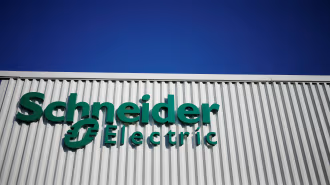
France’s Schneider Electric struck the largest acquisition in its history on Monday, agreeing to buy Boston-based industrial software company PTC in an all-cash deal that values PTC’s equity at roughly $22.6 billion.
Under the terms announced Monday, Schneider will pay $205 for every PTC share, a price that represents a 42.3 percent premium over PTC’s closing price of $144.03 the day before the deal became public. Once PTC’s existing debt and other liabilities are factored in, the transaction carries a total enterprise value of about $23.7 billion. Both companies’ boards have unanimously approved the agreement, and PTC’s board is recommending shareholders vote in favor when the deal comes up for approval at a special shareholder meeting. The acquisition still needs regulatory sign-off in multiple jurisdictions, and the two companies expect it to close by the third quarter of 2027.
Investors gave the announcement a cool reception out of the gate. Schneider Electric’s shares fell 4.7 percent on Tradegate before European markets had even officially opened Monday, as traders weighed the sheer size of the premium against concerns that PTC’s software business, like much of the sector, faces real valuation pressure and uncertain growth prospects in an industry increasingly being reshaped by artificial intelligence. Analysts at JP Morgan noted in a client note that large acquisitions of this scale typically draw initial skepticism from European investors, though they added that Schneider’s past deals have generally proven strategically sound over time, even when their pricing looked debatable at the moment they were announced.
Schneider’s own framing of the deal leans heavily on that strategic logic. Chief Executive Olivier Blum said the combination of the two companies would create what he called the industry’s most complete Software and AI powerhouse, a statement that points directly at what Schneider is actually buying: PTC’s expertise in computer-aided design and product lifecycle management software, tools manufacturers rely on to design, develop and track physical products throughout their entire life cycle, from initial engineering through production and ongoing management.
That product and engineering data focus fills a specific gap in Schneider’s existing software portfolio. The company already owns AVEVA, which concentrates on process and energy data, and is in the process of closing a separate $3.1 billion acquisition of Cognite, an industrial data and AI software provider it agreed to buy back in June, a deal that hasn’t yet been finalized. PTC rounds out that lineup by adding the product and engineering side of industrial software that Schneider’s other recent acquisitions don’t directly cover. Once the PTC deal closes, Schneider expects software and services to make up roughly 24 percent of its overall group revenue, supported by more than 15,000 software-focused employees and a combined customer base exceeding 50,000 software users.
The financial structure behind the acquisition splits between new equity and new debt. Schneider plans to fund the purchase through €5 billion to €6 billion in newly issued shares alongside €16 billion to €17 billion in fresh debt, a combination that will materially change the company’s balance sheet and capital structure once the transaction closes. Schneider also said it expects the deal to generate approximately €250 million in annual cost savings by the third year following completion, savings the company is presumably counting on to help justify the steep premium it’s paying relative to PTC’s pre-deal market value. Given the scale and complexity of the transaction, Schneider has moved up the timing of its own financial reporting, confirming it will release third-quarter revenue figures on October 16, earlier than its usual schedule.
The timing of the deal is no accident either. Schneider’s push deeper into industrial software and AI-linked offerings comes as the company has been benefiting from the broader surge in investment in AI infrastructure and data centers, a trend that’s driven rising demand for the kind of energy management and industrial automation technology Schneider specializes in. Buying PTC gives the company a more complete software stack to pair with that underlying hardware and energy management business, positioning it to sell customers a broader, more integrated package spanning the physical and digital sides of industrial operations.
This isn’t Schneider’s first major acquisition by any stretch. The French conglomerate, headquartered in Rueil-Malmaison and reporting €40.15 billion in revenue for 2025, has a long history of buying its way into new capabilities, including its $6.1 billion purchase of American Power Conversion years earlier, a joint $2.73 billion acquisition of Areva’s transmission and distribution business alongside Alstom, a $1.5 billion purchase of Larsen & Toubro’s electrical and automation operations in India, and a €1.4 billion takeover of German company RIB Software completed in 2020. What sets the PTC deal apart from that history is simply its scale, making it the single largest transaction Schneider has ever pursued, and a clear signal of how aggressively the company is now betting on software and AI as the next major source of growth beyond its traditional electrical and energy management business.