|
Getting your Trinity Audio player ready...
|
The head of Nigeria’s specialized Mining Marshals unit has told policymakers that the country needs a firmer, more nationally focused approach to managing its mineral wealth. Assistant Commandant Attah John Onoja, who commands the Mining Marshals of the Nigeria Security and Civil Defence Corps (NSCDC), called for what he termed “strategic resource nationalism” in a keynote address in Abuja. His message was that national interest should sit at the center of how Nigeria explores, extracts and uses its solid minerals, at a moment when the government is also courting foreign investors for the same sector.
Onoja spoke at the 4th Nigerian Nation Builders Annual Conference, whose theme was the effective harnessing and use of solid minerals for nation building. PRNigeria reported that he urged the federal government to put national interests at the heart of the exploration, exploitation and utilization of the country’s mineral resources. The conference was chaired by Defence Minister General Christopher Gwabin Musa, who was represented by Rear Admiral Olusanya Bankole (retired). Bankole praised the commander’s courage and professionalism, and recognized the unit’s work against illegal mining, according to the same report.
The commander’s argument, as reported by Daily Nigerian, is that Nigeria’s mineral resources could strengthen its economic sovereignty and reduce its long-standing dependence on crude oil revenue. He pointed to Japan, China and India as examples of countries that put national interests first in managing strategic resources, and he said Nigeria should draw lessons from them. In his telling, security operations by the Mining Marshals have disrupted illegal mining and helped restore the confidence of legitimate investors. That claim is his own assessment, and the reports reviewed here do not include independent data on investor sentiment.
Onoja also gave figures on what his unit says it has achieved. He said the Mining Marshals have arrested about 700 people in connection with alleged illegal mining and restored more than 100 mining sites to their legitimate owners, as reported by Leadership and other outlets. He described illegal mining as a major threat to national development and warned that it can facilitate crimes including banditry, terrorism and money laundering. He called on government institutions, traditional rulers, the judiciary, the legislature and local communities to support efforts to stop illegal mining and protect the country’s mineral assets. Arrests are not convictions, and the reports do not say how many of the roughly 700 cases have gone to court.
To make sense of the phrase, it helps to know what resource nationalism usually means in practice. Governments that adopt it generally aim to capture a larger share of the value from natural resources. The tools range from higher royalties and tighter licensing to requirements that ore be processed at home before export, and in some cases state ownership stakes or outright export restrictions. Indonesia’s ban on raw nickel ore exports and Zimbabwe’s restrictions on exporting unprocessed lithium are often cited as examples. The approach can raise domestic revenue and jobs, but it can also scare off investors if rules change without notice or are applied unpredictably. Onoja’s speech, as reported, focused more on security and national priorities than on specific policy instruments, so it is not clear which of these tools he would favor.
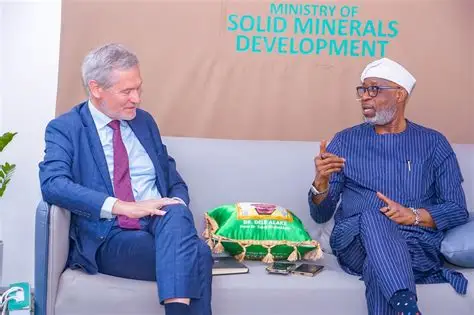
The call comes at an interesting moment. Less than two weeks earlier, Nigeria and the United States signed a critical minerals framework in New York to attract American investment into a sector the government values at about $700 billion. That figure is an estimate of the value of Nigeria’s mineral resources, not an investment commitment, as several Nigerian outlets have stressed. At the signing, Minister of Solid Minerals Development Dele Alake said Nigeria should not remain a supplier of raw materials while others capture most of the value. That sentiment overlaps with Onoja’s theme, since both stress that Nigeria should earn more from its minerals, but the two men approach it from different angles. One is inviting foreign partners to build processing and value chains, while the other emphasizes security, control and national priority.
That difference is worth examining rather than glossing over. Foreign investors, whether American, Chinese or from elsewhere, tend to ask for stable licensing, enforceable contracts and secure sites before they commit capital. A strong security presence can help with the last of those, because illegal mining and insecurity have long been cited as deterrents. At the same time, the rhetoric of nationalism can make some investors nervous if it is read as a signal that terms may tighten. The government’s challenge is to show that protecting resources and welcoming investment are compatible, with clear rules that apply to everyone.
There are other questions that the speech raises without answering. Illegal mining in Nigeria involves a wide range of actors, from organized criminal groups to small-scale artisanal miners who dig for a living and may lack licences. Policy experts often argue that enforcement works best alongside efforts to formalize small-scale operators, give them access to licences and markets, and provide alternatives for those displaced. Enforcement agencies also face scrutiny about how arrests, seizures and site recoveries are carried out, and whether the due process and community interests are respected. The reports reviewed for this article do not address how the Mining Marshals handle these issues, so readers should treat the figures as the unit’s own account.
The Mining Marshals themselves are a relatively new force within the NSCDC, created to protect mining sites and combat mineral theft. The unit and its commander have drawn a string of honors and public praise from officials and civil society groups in recent months, including awards for the fight against illegal mining. Supporters say the unit has brought more visibility and discipline to a sector once marked by impunity. Whether that translates into lasting gains will depend on prosecutions, regulatory reform and the economics of the mines that remain.
For the industry, the practical takeaways are straightforward. Licence holders will welcome any improvement in site security, but they will also want clarity on the legal framework, including how disputes over site ownership are resolved. Investors weighing the new US framework will watch for signs of how the government balances local-content and processing goals with commercial terms. Communities near mining areas, meanwhile, are likely to judge the policy by whether it brings jobs, infrastructure and a share of the revenue.
For now, Onoja’s address is best read as a statement of priorities from the officer on the front line of enforcement, rather than a formal policy. It adds a security-driven voice to a debate that is already crowded with talk of diversification, foreign partnerships and value addition. The decisions that matter, on licensing, processing requirements, revenue sharing and enforcement standards, will be made elsewhere in government, and they will determine whether “strategic resource nationalism” becomes a policy or stays a slogan.
Readers who follow Nigeria’s mining, energy and economic developments can find more coverage at BusinessTech Nigeria. The commander’s remarks are also covered in detail by Leadership and PRNigeria.