|
Getting your Trinity Audio player ready...
|
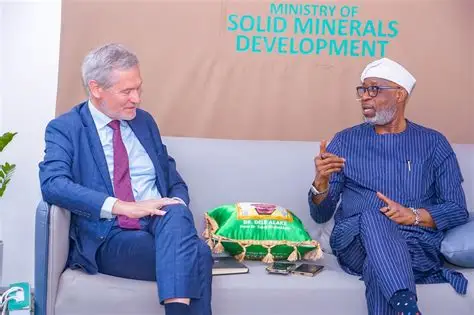
Nigeria and the United States have signed a framework agreement meant to bring American investment into Nigeria’s mining sector, which the federal government values at about $700 billion. Minister of Solid Minerals Development Dele Alake and US Deputy Secretary of State Christopher Landau signed and exchanged the document on Wednesday, September 23, at Nigeria’s Mission House in New York, on the sidelines of the 81st United Nations General Assembly. The ceremony drew attention at home, partly because of the size of the number attached to it, and partly because Nigeria has spent years trying to turn its mineral deposits into jobs and revenue beyond oil.
The first thing readers should know is what the $700 billion figure is and is not. It is the government’s estimate of the value of Nigeria’s mineral resources. It is not an investment commitment, a payment from Washington or a contract worth that amount. Several Nigerian outlets have stressed the point in recent days, including The Sun, which noted that the figure describes potential value in the ground. The agreement itself is a framework, a document that sets out areas of cooperation and a route for companies to follow, rather than a deal that moves money.
According to reporting by Daily Trust, the framework covers mineral exploration, development and processing, infrastructure and technical capacity. Other accounts add geological data to that list. It is also designed to serve as a platform for business-to-business deals between Nigerian and American firms, with a stress on building value chains and increasing local processing. Alake said the pact would strengthen cooperation around the country’s mineral resources, and that Nigeria cannot stay a supplier of raw materials while other countries capture most of the value. Lagos State Governor Babajide Sanwo-Olu and senior officials from Nigeria’s solid minerals institutions attended the ceremony, along with members of the US delegation.
The minister was careful to call the signing a beginning. “Now comes the harder and more important work: moving from agreement to implementation,” Alake said, according to published reports. He added that the two sides would work to identify viable projects and build partnerships that create value for Nigerians and for US partners. Landau, for his part, described Nigeria as an important regional partner and said Washington is committed to supporting its economic growth.
The context explains why this matters now. Governments around the world are competing to secure supplies of critical minerals, the metals and materials used in batteries, electronics, clean energy equipment and defense systems. The United States wants more diverse supply chains for these inputs, and Reuters reported that Nigeria is particularly seeking to develop its largely underdeveloped mining industry, including an emerging lithium sector. Chinese companies are already active in parts of Nigeria’s mining industry, especially in lithium, according to The Sun, so the new framework puts American firms in a more visible position in a field where they have had a smaller presence.
For Nigeria, the motivation is economic as much as strategic. The country remains heavily dependent on oil for government revenue and foreign exchange, and successive administrations have promoted solid minerals as a way to diversify. Mining supports jobs in rural areas, can feed local industries when ore is processed at home, and brings in taxes and royalties. The government’s emphasis on value addition reflects a long-standing complaint that Nigeria ships out raw ore and imports finished products, losing most of the profit along the way. The new framework refers directly to processing and infrastructure, which are the parts of the chain where that value is created.
There is a long distance between a framework and a working mine, however, and the details that will decide the outcome have not yet been made public. Reports reviewed for this article do not name specific projects, funding amounts, timelines or the US agencies and financing bodies that might take part. It is not clear how the agreement relates to existing licences or to Nigeria’s own mining regulations, or how disputes would be handled. Until those pieces emerge, the document is best understood as a statement of intent and a channel for deals, and its value will depend on what companies and governments do with it.
The practical obstacles are well known. Illegal mining and insecurity have kept investors wary in some regions, and The Sun’s coverage described parts of the sector as plagued by crime. Infrastructure is another constraint, since mines need reliable power, roads and rail links to move ore, and processing plants need steady electricity. Geological data is a third issue. Investors typically want detailed, trustworthy surveys before committing capital, which is why the framework’s focus on geological data and exploration is significant. Better data lowers risk, and lower risk usually brings cheaper financing.
Communities are the other half of the equation. Under Nigeria’s mining rules, operators are expected to sign community development agreements that provide agreed benefits to the people affected by their activities. Analysts quoted in recent commentary argue that access to Nigeria’s mineral wealth should be tied to obligations to those communities and to the environment around each site. Critics have also asked whether the country will end up repeating older patterns, in which foreign firms extract resources while the host country imports the machinery and refined products it needs. That concern is a reason to watch how local processing and technology transfer are written into any projects that follow.
For businesses, the immediate step is to watch for announcements from the Ministry of Solid Minerals Development and the US side about project pipelines, financing facilities and investor forums. American companies interested in lithium, rare earths, tin, gold or other minerals will want clarity on licensing, fiscal terms and security arrangements before they commit capital. Nigerian firms, including processors and service providers, may find openings in partnerships if the value-addition goals are taken seriously.
For the public, the sensible reading is hopeful but cautious. A formal agreement with the United States is a diplomatic milestone and may help attract serious investors, but the headline number describes potential, not cash. The proof will come in the form of signed project agreements, visible investment and local jobs, and the pace at which the government publishes details. The test of the agreement will be how much of that estimated wealth is ever mined, processed and taxed inside Nigeria.
Readers who follow Nigeria’s economy, energy and mining developments can find more coverage at BusinessTech Nigeria. Further reporting on the signing is available from The Guardian Nigeria.