|
Getting your Trinity Audio player ready...
|
Saudi Arabia surprised the oil market this week by making its crude cheaper for Asian refiners, even as global prices hover around 100 dollars a barrel. Saudi Aramco, the world’s largest crude exporter, set the November official selling price for its flagship Arab Light grade to Asia at 5 dollars a barrel below the average of the Oman and Dubai benchmarks. That is 3 dollars lower than October’s discount of 2 dollars, and it marks the widest discount since June 2020, according to pricing documents reported on Monday.
The cut was not limited to the lighter grade. Aramco also reduced the November prices of Arab Medium and Arab Heavy for Asian customers by 5 dollars a barrel each. In the same announcement, it moved in the opposite direction for Europe, raising prices for northwest Europe and the Mediterranean by 3 dollars across its grades, and it left prices for buyers in the United States unchanged. Treating Asia and Europe differently within a single pricing round is unusual enough that traders are reading it as a deliberate commercial signal, not a routine adjustment.
Most of the market was expecting the reverse. A Reuters survey of traders and refiners had pointed to an increase of as much as 5 dollars a barrel for Asia, following the recent rise in Middle Eastern benchmark prices. A Bloomberg poll reached the same conclusion. When the document appeared, the discount had deepened instead, which is why the move was described as unexpected by almost every outlet covering it.
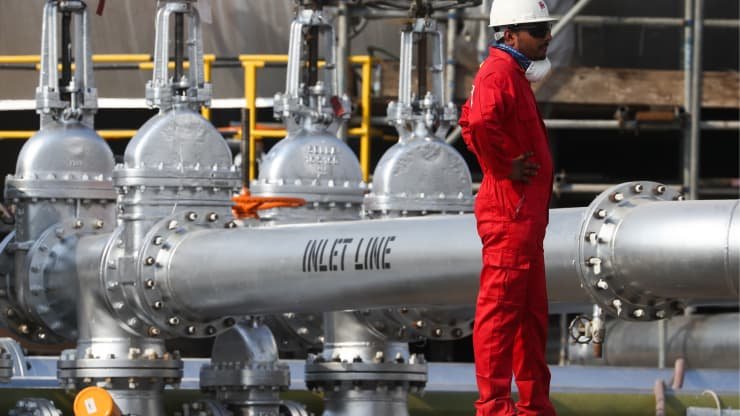
To understand why it matters, it helps to know what an official selling price does. Aramco sets one every month for each grade and destination, and it is expressed as a premium or discount to a regional reference rather than as a fixed sum. The prices apply mainly to crude supplied under long-term contracts to refiners, many of whom collect their cargoes at Ras Tanura on the Gulf coast. A larger discount makes the oil cheaper for those buyers compared with the benchmark, and it generally suggests the seller wants to move more barrels or fears losing customers to rivals.
Refining executives who spoke to Reuters on condition of anonymity said the reductions look aimed at least partly at compensating buyers for the cost of shipping. Freight rates have been at record levels since the Iran war disrupted regional routes. People familiar with the matter said last week that Aramco had been considering discounts for oil loaded off Oman, where cargoes are moved from one vessel to another outside the Strait of Hormuz. One source added that a lower price could also make up for the delays and longer voyages faced by Saudi crude exported from Egypt’s Sidi Kerir terminal, where loadings have been held up.
Behind those logistics sits a broader recovery in supply. Kpler, which tracks tankers, reported that crude moving through the Strait of Hormuz reached a seven-day average of 13.5 million barrels a day as of last Monday, the same as before the war. JPMorgan estimated Middle East crude exports at about 17.5 million barrels a day over ten days, or roughly 98 percent of the pre-war rate, while Goldman Sachs put regional flows at 23.3 million barrels a day, equal to the 2025 average. About 40 percent of Gulf crude now leaves the region without passing through Hormuz, compared with 17 percent before the conflict, helped by pipelines, ship-to-ship transfers and an escorted corridor along the Omani coast. Saudi Arabia has also resumed loading at Yanbu on the Red Sea after an earlier disruption to its East-West pipeline.
With barrels flowing again, Riyadh appears to be turning its attention from keeping the lights on to winning customers back. Months of interrupted supply pushed some Asian refiners toward other sellers, and a discount is the quickest way to reopen those relationships. The decision to raise prices in Europe fits the same reading. Cargoes loaded at Yanbu reach European buyers without going near Hormuz, which gives them a reliability advantage that Aramco evidently believes it can charge for.
The state of the global oil buffer helps explain why the pricing decision carries so much weight. Spare cushion in the system is thin. The G7 has announced another emergency release from strategic stockpiles, which is a sign that governments are drawing on reserves to steady the market. Meanwhile, Dated Brent, the price for physical cargoes that are actually changing hands, has been quoted above 120 dollars while the front-month Brent futures contract sits near 101 dollars. Buyers who need oil quickly are paying a steep premium, and refined products remain tight. Kpler data showed refined fuels leaving through Hormuz at only 677,000 barrels a day, far below the 3.6 million seen before the war, and diesel prices are at or near record highs.
That tension is what makes the Saudi cut so interesting. Crude supply is recovering, but the margin for error is slim, and a sellers’ discount in Asia reveals how seriously Aramco takes the competition for market share. On the screens, Brent futures closed at 100.32 dollars on Monday, about 2 percent lower, before inching up to roughly 100.7 dollars in Asian trading on Tuesday. Analysts will be watching whether the Saudi discount adds to the downward drift in crude or merely reflects higher shipping costs that were already hurting buyers.
Risks remain on every side. A fourth tanker was reported hit in or near the Strait of Hormuz in recent days, and traders have pointed to attacks on Saudi energy infrastructure and on vessels in the region. Iranian crude exports through the strait remain close to zero under the US naval blockade, which leaves one major supplier outside the recovery. Any escalation could quickly erase the progress in flows and make the current discount look generous, while any easing of the blockade could add more barrels and deepen the competition for Asian buyers.
For consumers and governments, the effects will arrive unevenly. Cheaper Arab Light helps refiners in China, India, Japan and South Korea control their costs, but those savings may not reach pump prices quickly because diesel shortages, refining margins and shipping costs stand in between. Economies that import fuel, including Nigeria, will watch whether easier crude pricing in Asia eventually softens the market for refined products. Readers following how energy costs feed into business and technology planning can find related reporting at Business Tech.
Aramco’s next pricing announcement, due early in November, should show whether this was a one-month tactic or the start of a longer campaign to defend its place in Asia. If tanker traffic stays steady and freight costs ease, the discount could narrow. If security worsens again, Saudi Arabia may find that the cheapest barrels in the market are also the hardest to deliver.