|
Getting your Trinity Audio player ready...
|
Dangote’s Production Targets Explained: A Doubled Refinery, Quadrupled Fertiliser and a $100 Billion Ambition
With the refinery’s record share offer set to close on Tuesday, October 13, one question keeps coming up among prospective investors and ordinary Nigerians alike: what exactly is the Dangote Group trying to produce, and by when? The answer spans refining, fertiliser and several new projects, and the dates matter as much as the numbers.
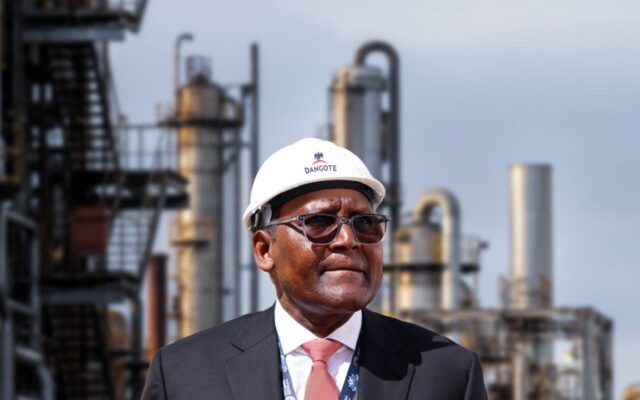
The headline target is at the refinery in Lagos. The plant, built over about a decade at roughly $20 billion, began operations in 2024 and reached full capacity earlier this year. Its original rating is 650,000 barrels a day, though reports this year describe it as processing about 700,000. The goal is to double that to 1.4 million barrels a day by adding a second crude distillation unit of about 750,000 barrels a day next to the first. The group has said the expansion should be complete by 2028, while the refinery has separately pointed to reaching 1.4 million barrels a day by early 2029. Bloomberg reported on September 24 that chief executive David Bird said the schedule is on track because the second plant uses the same designs and contractors as the first, and that the new unit carries a price of $14.3 billion. At that scale, the complex would tie for the world’s largest, and the plant would be capable of producing roughly the equivalent of 10 percent of US refining capacity, according to a Semafor analysis.
Money for the build is the main reason for the share sale. Dangote Petroleum Refinery and Petrochemicals is offering 4.1 billion shares at ₦525 each to raise about ₦2.15 trillion, or roughly $1.6 billion, with a minimum order of 10 shares, about ₦5,250. The offer has been billed as a people’s IPO, and Dangote has said he hopes to attract as many as 10 million retail investors. Uganda’s capital markets regulator cleared high-net-worth and professional investors to join in a notice dated October 6, and Kenya approved a short-form prospectus for a global depository receipt, widening access across East Africa. The refinery owner has also said the company expects to look for a listing outside Africa, most likely in the United States, within three to four years.
The refinery is only one piece. The group’s wider plan, described as Vision 2030, aims to turn Dangote into a $100 billion revenue business. Group executive Suleiman said the group is targeting $36 billion in revenue for 2026 after generating about $17 billion in the first half. Reporting on the share sale says proceeds are earmarked not just for the refinery doubling but for quadrupling fertiliser output, building potash and phosphate plants in the Democratic Republic of Congo and setting up copper refining in Zambia, as part of about $40 billion of planned investment over five years. The group’s fertiliser business already runs one of the world’s largest single-train urea plants, and the refinery itself produces petrol, diesel, aviation fuel and polypropylene, with petrochemical exports projected by analysts to bring in about $6.4 billion a year.
A second refinery is also in the plan. The group intends to build a 700,000-barrel-a-day plant and petrochemical complex in Lamu, Kenya, estimated at about $17 billion, which executives describe as a major contributor to the long-term $100 billion goal. That project’s groundbreaking was set to proceed even after a Kenyan court issued an order restricting activity on one disputed parcel of land, as reported earlier this month. Separately, Semafor reported that the group plans to list its cement unit, valued at about $13 billion, on the London Stock Exchange, with long-term plans due to be presented to investors in London.
What does the refinery’s recent record say about the targets? The plant reported an after-tax profit of $1.82 billion in the first half of 2026, compared with a loss of $476 million for the whole of 2025. It benefited from tight global fuel supplies during the Iran war, selling jet fuel across Africa and to western Europe. That context matters, because investors are being asked to back a doubling of capacity based partly on earnings helped by unusual market conditions.
The risks are straightforward. Analysts note that the expansion is being partly financed with debt, adding leverage, and that schedules for very large projects can slip. Crude supply is another issue: the refinery buys a lot of Nigerian crude and has also imported US grades, so securing feedstock for 1.4 million barrels a day is a challenge. Regulators have also made clear that open price competition and import licensing disputes could affect domestic sales.
For readers, the useful way to read the numbers is as a timeline. Fertiliser and Kenya plans stretch across the second half of the decade, the refinery doubling is aimed for 2028 to early 2029, and the IPO decision window ends this week. Anyone considering a subscription should read the prospectus, check how the offer is allocated, and keep in mind that this article is general information rather than investment advice.