|
Getting your Trinity Audio player ready...
|
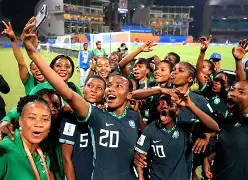
Nigeria U-17 women national team, the Flamingos, have made history by defeating Brazil 3-1 to secure their first-ever appearance in the final of the FIFA U-17 Women’s World Cup.
The remarkable victory represents a major achievement for Nigerian women’s football, as the young African side overcame one of the world’s most recognised football nations to move within one match of winning a global championship.
The Flamingos delivered an impressive performance against Brazil, combining attacking determination, disciplined defending and clinical finishing to secure their place in the final. Their achievement also strengthens Nigeria’s reputation as one of Africa’s most important countries in women’s youth football.
For a team that has spent years developing young players and competing against established football nations, reaching the final marks a significant milestone.
The result is particularly important because Nigeria had never previously reached the final of the FIFA U-17 Women’s World Cup. The team’s latest campaign has therefore taken Nigerian women’s football into unfamiliar territory, creating an opportunity for the country to compete for its first title in the competition.
The victory was secured through a dominant second-half display at the Mohammed VI Football Complex in Rabat, Morocco. After both teams failed to score before the interval, Nigeria returned with greater attacking urgency and gradually took control of the contest.
Queen Joseph broke the deadlock in the 56th minute, finishing an opportunity created by Oluwakemi Adegbuyi. Her goal gave Nigeria the advantage and changed the momentum of the semi-final.
The Flamingos continued to put pressure on Brazil, and their efforts produced another goal in the 71st minute. Awawu Bashiru doubled Nigeria’s lead after receiving an assist from Queen Joseph, giving the young Nigerians a stronger position in the contest.
Bashiru struck again in the 80th minute, completing her brace and putting Nigeria 3-0 ahead. This time, Oluebube Umejiaku provided the assist.
Brazil managed to score a consolation goal in the 89th minute through Greise Kelly, who converted an opportunity created by Yasmin Queiroz. However, the late response could not prevent Nigeria from securing a memorable 3-1 victory.
The three Nigerian goals demonstrated the attacking quality within the team, with Queen Joseph and Bashiru playing decisive roles in the result. Channels Television+1
The achievement is particularly important because Nigeria had previously reached the semi-finals but had never progressed to the championship match. Their victory over Brazil has now taken the team beyond its previous best performance at the tournament.
Nigeria’s previous strongest campaign came in 2022, when the Flamingos finished third at the competition held in India. They lost their semi-final against Colombia before defeating Germany in the bronze-medal match to secure a historic podium finish.
The 2026 campaign has therefore given Nigeria an opportunity to improve on that achievement and compete for the ultimate prize.
The victory also makes Nigeria the first African country to reach the final of the FIFA U-17 Women’s World Cup, marking an important moment for women’s football across the continent. Blueprint Newspapers Limited+1
Nigeria’s journey to the final has been particularly impressive because the team did not begin the tournament with a victory.
The Flamingos opened their campaign with a 2-1 defeat against Poland, creating an early challenge for head coach Akeem Busari and his players.
Rather than allowing the opening setback to derail their campaign, the Nigerian team responded with a 2-0 victory over Puerto Rico. Oluwakemi Adegbuyi and Precious Oscar scored the goals that secured Nigeria’s first three points.
Their next group-stage encounter produced one of the most important results of the tournament.
Nigeria defeated defending champions North Korea 3-1, ending the Asian side’s 18-match unbeaten run in regulation time at the competition. Adegbuyi, Umejiaku and Kanyinsola Rodiat Yusuf were responsible for Nigeria’s goals in that encounter.
The result provided a major confidence boost and demonstrated that the Flamingos could compete against some of the strongest teams in youth women’s football.
Nigeria eventually finished second in Group B with six points, scoring six goals and conceding four across three matches.
The team continued its progress in the knockout stages, beginning with a 2-1 victory over Mexico in the Round of 16. Oluebube Umejiaku and Mary Dunstan scored for Nigeria, while Mexico managed a late goal through Emily Delgado.
The Flamingos then faced Venezuela in the quarter-finals, where the contest remained goalless for most of the match.
With extra time approaching, Nigeria received an opportunity to secure qualification after a foul inside the penalty area. Captain Azeezat Oduntan converted the resulting penalty in the 89th minute to give her team a 1-0 victory.
That result set up the semi-final against Brazil, where Nigeria produced another impressive performance to reach the final. Channels Television+1
The team’s progress also reflects the development of Nigerian women’s football at youth level.
Nigeria has traditionally been one of Africa’s leading countries in women’s football, with the Super Falcons maintaining a strong record in continental competitions.
However, success at youth tournaments is important for a different reason. It provides young players with opportunities to gain international experience, develop their technical abilities and prepare for the demands of senior football.
The Flamingos’ performance in Morocco demonstrates the importance of building a consistent development pathway for young Nigerian footballers.
Players such as Queen Joseph, Awawu Bashiru, Oluwakemi Adegbuyi and Oluebube Umejiaku have shown that Nigeria possesses emerging talent capable of competing against established international opponents.
Their performances also provide encouragement for the country’s other youth national teams, particularly the Falconets and the senior Super Falcons.
The next challenge will be ensuring that the players continue to receive the technical support, competitive opportunities and professional development required to progress beyond under-17 football.
Nigeria’s coaching staff will also need to manage expectations carefully. Reaching a World Cup final is an important achievement, but the team must remain focused on the final itself rather than becoming distracted by the attention surrounding its historic qualification.
Brazil’s defeat also deserves attention because the South American country had entered the semi-final with an impressive tournament record.
The Brazilians had recorded three victories and two draws in their first five matches, remaining unbeaten before meeting Nigeria.
Their campaign included a difficult quarter-final against China, which they won 2-1 after coming from behind. They had also progressed past Poland through a penalty shootout.
Brazil were therefore considered a serious contender for a place in the final. Nigeria’s ability to score three times against such an opponent demonstrates the quality of the Flamingos’ attacking performance.
The result also gives Brazil an opportunity to finish the tournament by competing for third place against North Korea.
Meanwhile, Nigeria’s attention will now turn to Japan, their opponent in the championship match.
Japan secured its place in the final after defeating defending champions North Korea in the other semi-final. The encounter ended 1-1 after regulation time before Japan won 4-1 on penalties.
North Korea had taken the lead through Ri Ui-gyong in the 52nd minute, but Japan equalised deep into stoppage time after a late own goal by Won Sol-gyong.
The Japanese team subsequently converted its penalty kicks to secure qualification for the final. FIFA U-17 Women’s World Cup 2026+1
The final will give Nigeria an opportunity to win its first FIFA U-17 Women’s World Cup title and become the first African nation to lift the trophy.
Japan, however, will present another demanding challenge. The Asian side has a strong history in the competition, having won the championship in 2014 and reached the final in 2016.
The Japanese team is known for its technical organisation, possession-based approach and ability to move the ball quickly between players. Nigeria will need to maintain its defensive discipline while taking advantage of opportunities in the attacking third.
The Flamingos will also have to manage the pressure associated with playing in a World Cup final. Their victory over Brazil has guaranteed Nigeria at least a silver medal, but the players now have an opportunity to achieve something that has never been accomplished by an African team in the competition.
The final is scheduled for Saturday, November 7, 2026, in Morocco.
For Nigerian supporters, the team’s achievement has already provided a reason to celebrate. The Flamingos have progressed from an opening defeat against Poland to victories over defending champions North Korea, Mexico, Venezuela and Brazil.
Their journey demonstrates the importance of resilience, teamwork and consistent improvement throughout an international tournament.
The result against Brazil will also increase attention on the young players who have represented Nigeria in Morocco. Their performances could create further opportunities as they progress towards senior international football.
For the Nigeria Football Federation, the achievement provides an opportunity to build on the team’s progress by investing in youth development and ensuring that promising players receive the support required to reach their potential.
Nigeria’s women’s football structure has produced several internationally recognised players, but sustaining success requires long-term planning, quality coaching, competitive domestic football and investment in grassroots development.
The Flamingos’ historic run offers a strong example of what young Nigerian footballers can achieve when they receive opportunities to compete at the highest level.
As the country prepares for Saturday’s final, the focus will be on whether Akeem Busari’s team can complete its remarkable campaign by defeating Japan.
Regardless of the final outcome, the 3-1 victory over Brazil has already secured a permanent place in the history of Nigerian women’s football.
The Flamingos have moved beyond their previous semi-final appearances, established Nigeria as the first African finalist in the competition and created an opportunity to compete for a global title.
For the young players representing the country, the final is now a chance to turn an extraordinary tournament campaign into an even greater achievement.