|
Getting your Trinity Audio player ready...
|
New NASA telescope to probe dark energy, dark matter and exoplanets with Nancy Grace Roman Space Telescope launch 2026
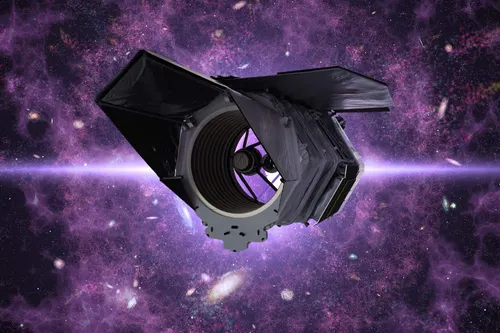
NASA is preparing for one of its most significant astronomical launches in decades, with the Nancy Grace Roman Space Telescope set to lift off from Kennedy Space Center on August 30, 2026, aboard a SpaceX Falcon Heavy rocket. The roughly four billion dollar observatory arrives nine months ahead of its original schedule, a rare feat for a flagship NASA mission, and it carries a scientific mandate broad enough to reshape how astronomers understand the universe’s largest mysteries while simultaneously hunting for planets far beyond our solar system.
Named after Nancy Grace Roman, the astronomer widely credited as the driving force behind getting the Hubble Space Telescope funded and built, the new observatory is designed to pick up where Hubble and the James Webb Space Telescope leave off, though its approach differs from both in a fundamental way. Rather than focusing on razor sharp, zoomed in views of individual objects the way Hubble and Webb do, Roman is built for breadth. Its Wide Field Instrument delivers a field of view more than 100 times larger than Hubble’s, paired with a 300 megapixel near infrared camera capable of capturing enormous swaths of sky in a single exposure. That combination of Hubble class resolution and a dramatically wider lens is what makes Roman uniquely suited to the kind of large scale cosmic surveys its mission was built around.
The telescope’s three headline goals, dark energy, dark matter, and exoplanets, sound abstract until you consider just how little scientists actually know about two of them. Ordinary matter, the stars, planets, gas, and everything else familiar to us, makes up only around 5 percent of the universe’s total content. Dark matter, detectable only through its gravitational pull on galaxies and stars rather than through direct observation, is estimated to account for roughly 27 percent. The remainder, and by far the largest share, is dark energy, the mysterious force believed to be driving the accelerating expansion of the universe. Understanding what dark energy actually is remains one of the biggest open questions in modern cosmology, and Roman’s core mission is to chip away at that uncertainty by measuring the shapes, positions, and distances of billions of galaxies with a level of statistical precision no previous telescope has been able to achieve.
To do that, Roman will rely on a technique called weak gravitational lensing, essentially tracking how the light from distant galaxies gets subtly bent and distorted as it passes through the gravitational fields of intervening dark matter. By mapping that distortion across huge portions of the sky, researchers can build what amounts to an invisible scaffolding map of the universe, tracing how dark matter has clumped and evolved over cosmic time. Combined with observations of Type Ia supernovae, which act as reliable cosmic yardsticks for measuring distance, Roman’s data should let scientists test whether the standard model of cosmology holds up at the largest scales or whether entirely new physics is needed to explain what’s actually happening.
On the exoplanet side, Roman’s ambitions are just as significant, if not necessarily as attention grabbing to the public. More than 6,350 exoplanets have been confirmed to date using techniques accumulated over the past several decades, but Roman is projected to add many thousands more essentially on its own. Its primary method for finding new worlds is gravitational microlensing, a technique that detects the temporary brightening of a background star’s light as a planet’s gravity passes in front of it, bending and magnifying that light for a brief window of time. This approach is particularly powerful for detecting planets that other methods tend to miss, including free floating rogue planets that don’t orbit any star at all, and planets located much farther from their host stars than the ones typically found through transit surveys. NASA projects Roman could detect more than 1,000 exoplanets through microlensing alone, alongside a broader transit yield expected to reach around 100,000 new worlds over the mission’s lifetime, giving astronomers the first genuinely comprehensive statistical census of how planetary systems are typically structured across the Milky Way.
Roman also carries a coronagraph instrument specifically designed to block out the overwhelming glare of a host star so that Jupiter sized exoplanets orbiting nearby can be imaged directly, a capability that pushes beyond what indirect detection methods alone can offer and lays groundwork for the kind of direct planetary imaging future missions will need to search for signs of habitability elsewhere.
Beyond its two headline missions, scientists expect Roman to become something of an all purpose discovery machine simply by virtue of how much sky it will cover and how repeatedly it will revisit the same regions. Over its planned five year primary mission, the telescope is projected to generate an archive of roughly 20,000 terabytes of data, cataloging hundreds of millions of galaxies, billions of stars, and a wide range of transient cosmic events including supernovae, variable stars, and tidal disruption events where black holes tear apart nearby stars. That repeated survey approach effectively builds the deepest, most detailed time lapse movie of the cosmos ever assembled, and researchers anticipate it will surface entirely unexpected phenomena simply because no instrument has ever observed the sky this broadly and this consistently before.
- Summary
- Companies
- Nancy Grace Roman Space Telescope due to launch on Sunday
- NASA’s new flagship space observatory follows Webb, Hubble
- Roman offers panoramic view of space, fast survey speeds
The accelerated timeline itself is notable. NASA’s original target had Roman ready no later than May 2027, but an update in early June 2026 moved the launch window forward by roughly eight months, a shift that reflects unusually smooth progress through the observatory’s final assembly and testing phases at Kennedy Space Center. Engineers completed the mating of the telescope to its payload adapter and launch hardware in early August, clearing one of the last major milestones before liftoff.
For an agency that has weathered its share of high profile delays and cost overruns on major missions, Roman’s early arrival carries some symbolic weight, arriving as the successor to two of the most celebrated observatories in scientific history while promising a genuinely different kind of contribution rather than simply extending Hubble and Webb’s legacy. Whether Roman ultimately reveals that the universe requires new physics to explain its expansion, or instead confirms existing models with unprecedented precision, either outcome would represent a landmark result. And with thousands of new exoplanets likely to emerge from its data within just the first few years of operation, Roman’s exoplanet catalog alone could reshape how astronomers think about the frequency and diversity of planetary systems throughout the galaxy.