|
Getting your Trinity Audio player ready...
|
China’s short drama industry has landed on a strategy that looks almost old-fashioned in its logic even as it’s powered by some of the newest generative AI tools available: throw dozens of cheap, quickly made titles at the market and let audience reaction decide which ones deserve real investment. Rather than pouring significant capital into a single vertical drama and hoping it lands, producers are treating each new title as a low-cost experiment, gauging early viewer engagement before committing meaningfully to promotion and distribution spend. It’s a model built entirely around minimizing downside risk in a content category defined by extremely short attention spans and just as extreme volume.
Ashley Dudarenok, founder of the marketing consultancy ChoZan, described the mechanics simply: a platform or producer can test a vertical serial’s opening clips against a defined audience segment, and only expand promotional spending once the content shows it’s actually converting viewers. That’s a meaningful departure from how traditional film and television financing works, where a much larger share of the budget gets locked in before anyone knows how audiences will respond. Short drama economics flip that risk profile, front-loading almost nothing and letting real-world viewer behavior determine where money flows next.
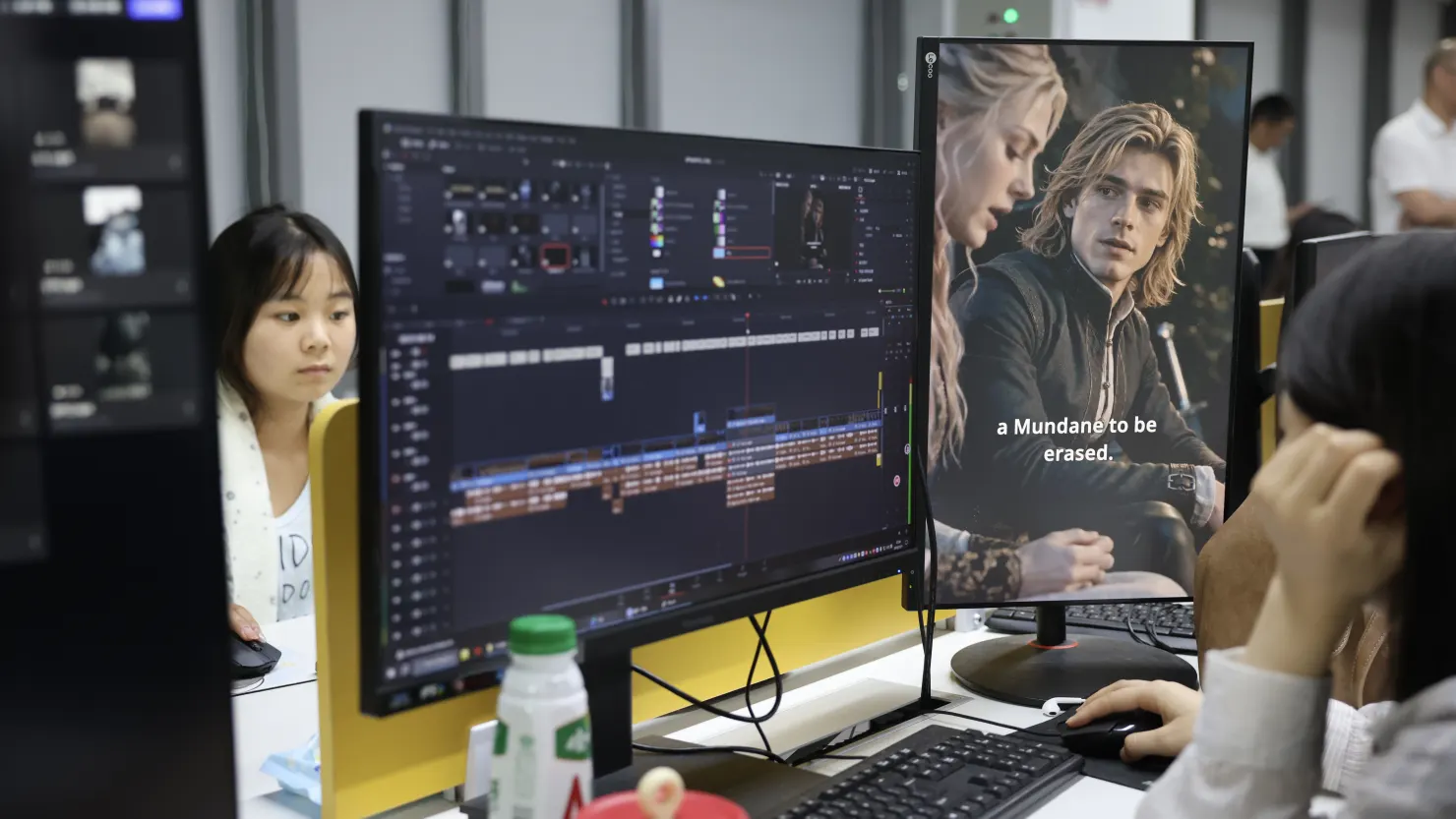
This approach only makes sense because production costs have collapsed so dramatically. According to the China Netcasting Services Association, more than 95 percent of the roughly 128,000 ultrashort dramas released in the first quarter of 2026 were AI-generated, a staggering shift from where the industry stood barely two years earlier. As recently as January 2025, fully AI generated titles accounted for just four of Douyin’s top 5,000 short dramas. By that November, the number had jumped to 217. The pace of improvement in the underlying generative video models has been fast enough to catch even seasoned industry figures off guard, including the founder of Game Science, the studio behind the global hit Black Myth: Wukong, who reportedly described himself as deeply shocked after seeing what ByteDance’s Seedance 2.0 model could produce when it launched earlier this year.
The financial upside of this flood the zone strategy has been real, at least for platforms and the biggest players. Vertical titles can generate strong advertising revenue, with opt-in video ads reportedly earning roughly 11 times Mintegral’s Android benchmark during the first half of the year. Companies like Hongguo, the short-drama platform backed by ByteDance, can afford to saturate feeds with free content, competing on scale and sheer exposure rather than relying on individual title sales. That’s a fundamentally different competitive posture than traditional entertainment, where distribution costs and licensing deals typically gate how much content actually reaches viewers.
But the volume-first approach comes with a brutal cost structure underneath the surface-level growth numbers. Heavy spending on distribution and audience acquisition can erode much of the margin that cheap AI production initially creates, and industry data suggests that erosion has already become severe. Revenue generated per thousand views for AI short dramas has fallen sharply, dropping from roughly 60 yuan in the second half of 2025 down to somewhere between 15 and 30 yuan in 2026. As many as 90 percent of AI short-drama companies are reportedly operating at a loss right now, even as overall market revenue keeps climbing. China’s micro-drama market is projected to exceed 120 billion yuan in revenue during 2026, a figure that would put it ahead of the country’s entire theatrical box office industry, yet most of the companies producing that content aren’t actually profitable individually.
That paradox, a booming overall market built on a foundation of individually unprofitable producers, is reshaping who survives in the space. More than 80 percent of small and mid-sized production teams have reportedly suspended updates entirely as revenue-sharing payouts on platforms like Hongguo have plunged by over 90 percent in some cases. One widely circulated example involved a production that racked up 25 million views but generated only about 33,000 yuan in revenue, roughly $4,875, nowhere close to covering production costs. That kind of outcome has pushed a growing number of producers to look overseas instead, where a Yunnan-based creator’s three-minute AI short film reportedly cost just 3,000 yuan to produce, about $443, but generated tens of millions of views internationally and more than $500,000 in revenue, an extraordinary return that domestic Chinese audiences increasingly aren’t providing anymore given how saturated the local market has become.
The human cost of this shift has been visible too. In Zhengzhou, a production company called Zhoutu Culture, which had been shooting so many ultrashort dramas that its founders calculated owning luxury cars for use as props would eventually cost less than renting them, ended up sending those very cars away for good as the economics of live-action production deteriorated under AI competition. The founder, Wang Huan, has spoken about considering leaving the industry altogether, torn between financial pressure and a genuine hope that audiences might eventually demand higher-quality live action work again rather than settling for algorithmically generated content.
Regulators and platforms have started responding to the strain on traditional production. By May, ByteDance pledged 1.5 billion yuan specifically to support live action short dramas, while six major platforms collectively announced at least 6 billion yuan in planned investment aimed at the same goal. Government funding has also been allocated across 11 provinces to support higher quality productions, suggesting officials are aware that a market driven entirely by AI-generated volume risks hollowing out the skilled crews, actors, and creative talent that built the industry in the first place.
There’s also a copyright dimension complicating this entire ecosystem. Because so many short dramas are adapted, often loosely and sometimes without proper licensing, from popular web novels, disputes over ownership have become common. One production company, Huace Group, secured exclusive adaptation rights to a popular online novel only to discover that copycat versions had already circulated before its own production was even ready to launch. The company eventually won a lawsuit over the matter, but the case dragged on for more than two years without any compensation actually being paid. With somewhere around 150,000 short dramas released nationwide between 2021 and 2025, keeping track of who legitimately owns what has become nearly impossible for both regulators and rights holders.
What emerges from all of this is an industry defined less by any single breakout hit and more by sheer volume and rapid iteration, where AI has made experimentation essentially free but has also compressed margins to the point where most producers are losing money even as the overall market grows. The winners, as one industry analysis put it, are likely to be those who combine cheap, fast iteration with genuine editorial discipline and real ownership of their intellectual property, rather than those simply chasing the next viral clip with content that could be pulled apart or copied within days of release. For more coverage of how AI is transforming media and entertainment industries worldwide, readers can follow ongoing reporting on Techchora.
Further detail on China’s short video and micro drama regulatory environment is available through the China Netcasting Services Association, and background on generative video model developments referenced in this report can be found through ByteDance’s official research publications.