|
Getting your Trinity Audio player ready...
|
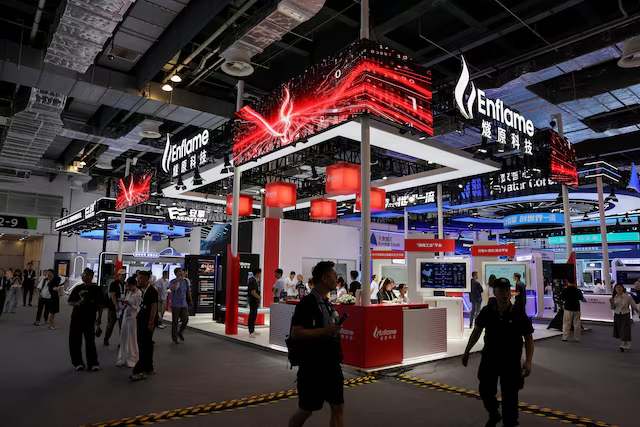
AI chipmaker Enflame sets subscription date for near $900 million Shanghai IPO, marking China’s largest AI chip listing of 2026
Shanghai Enflame Technology has confirmed the mechanics of its long anticipated initial public offering, moving into the subscription phase of a listing that will raise close to $900 million on the Shanghai Stock Exchange’s STAR Market. The Tencent backed AI chip designer plans to issue 43.0 million shares, targeting proceeds of roughly 6 billion yuan, a figure that has been reported anywhere between $883 million and $888 million depending on exchange rate timing. Whatever the final tally, it will rank as one of the largest AI semiconductor listings China has seen this year.
The timing is notable. Enflame’s IPO registration became effective on July 9, 2026, moving the deal from acceptance to registration in under six months, a relatively fast turnaround for a STAR Market listing of this size. That speed reflects how eager Chinese regulators are to get homegrown AI chip suppliers into public markets, particularly as export restrictions on advanced foreign processors continue to reshape the domestic semiconductor landscape. Enflame is widely described as the last of China’s so called four little dragons of AI chipmaking to reach the public markets, following the earlier debuts of Moore Threads, Biren Technology and MetaX Integrated Circuits. All three of those peers have traded well above their offer prices since listing, with Moore Threads climbing 425 percent after its December debut, a track record that has likely made underwriters and investors more comfortable pricing Enflame’s own offering aggressively despite the company still operating at a loss.
Founded in Shanghai in 2018 by former AMD engineer Zhao Lidong, Enflame develops cloud based deep learning chips under its Yunsui product line, alongside a broader stack of AI acceleration hardware and software. The company was last valued at roughly $2.8 billion ahead of the listing, according to the Hurun Global Unicorn Index, and it plans to use IPO proceeds primarily to fund research, development and industrialization of its fifth and sixth generation AI chips, which are expected to debut in 2027 and 2029 respectively. A smaller portion of the raise is earmarked for collaborative software and hardware integration projects rather than working capital or debt repayment, underscoring that this listing is being framed as a technology funding round as much as a liquidity event for existing shareholders.
Tencent’s relationship with Enflame sits at the center of how investors are likely to evaluate this IPO. The gaming and social media giant holds roughly 20.3 percent of the company and has been its single largest customer for years, a dynamic that has only intensified rather than eased ahead of the listing. Tencent accounted for approximately 83.8 percent of Enflame’s total revenue in 2025, up sharply from around 38 percent the year before, according to figures disclosed in the company’s prospectus. That concentration cuts both ways. On one hand, it has effectively pre-funded Enflame’s product roadmap, giving a startup with a modest 1.7 percent share of China’s domestic AI accelerator market the order volume needed to keep shipping advanced silicon at meaningful scale. On the other, it leaves Enflame acutely exposed if Tencent’s own AI infrastructure spending priorities shift, or if pricing leverage in that relationship continues to squeeze margins the way it reportedly already has.
Financially, the picture is one of narrowing losses rather than outright profitability. Enflame’s revenue grew from 301 million yuan in 2023 to 990 million yuan in 2025, while net losses attributable to shareholders shrank from roughly 1.665 billion yuan to about 1.164 billion yuan over the same stretch. Cumulative losses across the three year period exceed 4.3 billion yuan, with heavy research and development spending cited as the primary drag on the bottom line. Company disclosures suggest management expects to reach profitability sometime between 2026 and 2027, a timeline that will be watched closely once the stock begins trading, since the STAR Market’s rules specifically permit companies without current profits to list as long as they meet other technology and revenue thresholds designed to nurture strategically important sectors like semiconductors.
Enflame does not operate in a vacuum, and its position relative to domestic rivals matters for how the IPO is likely to be received. Huawei remains the dominant player in China’s AI server and accelerator market, and Cambricon, once known mainly for years of losses, has turned profitable and posted 2.89 billion yuan in first quarter 2026 revenue alone. Enflame’s differentiated approach, built around a domain specific architecture rather than trying to directly replicate mainstream GPU ecosystems, avoids head-on competition with those larger players but also means it carries higher upfront research costs and a steeper climb to build out a competing software ecosystem. Its most recent chip reportedly packs 144 gigabytes of on-chip memory, a specification aimed squarely at the large language model training and inference workloads that Chinese cloud providers and internet companies are racing to support domestically as access to Nvidia’s top tier processors remains constrained by US export controls.
The broader context here is China’s push for semiconductor self-sufficiency, a policy priority that has turned the STAR Market into something close to a dedicated launchpad for AI chip startups. CITIC Securities is sponsoring the deal, and state linked investors including the National Integrated Circuit Industry Investment Fund Phase II hold small stakes in Enflame alongside Tencent, reflecting how closely intertwined public policy and private capital have become in this sector. For a company that has spent years building chips largely for one dominant customer, going public is as much about proving it can eventually stand on its own as it is about raising fresh capital.
Retail and institutional investors will get their first real signal of how the market is pricing this bet once subscription opens and order books begin to fill. Given the strong aftermarket performance of Enflame’s three predecessor dragons, expectations are running high, though the company’s continued reliance on Tencent for the bulk of its revenue remains the clearest risk factor hanging over an otherwise closely watched debut. Readers tracking the broader wave of AI chip IPOs in China will find Enflame’s listing a useful bellwether for how much appetite public markets still have for pre-profit semiconductor bets tied to the AI boom. More detail on Enflame’s technology roadmap is available on the Enflame corporate website, while listing updates and regulatory filings are published directly by the Shanghai Stock Exchange.