|
Getting your Trinity Audio player ready...
|
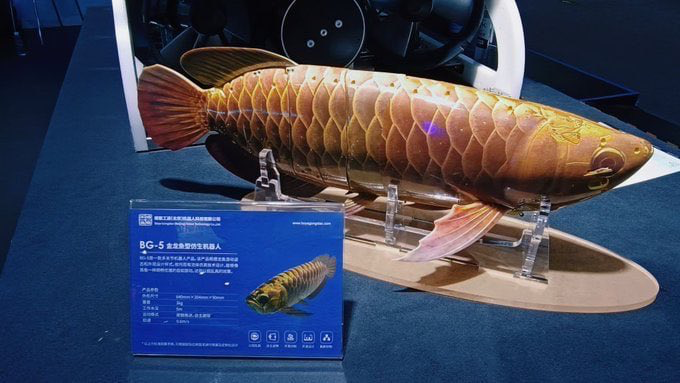
A small, gold-scaled robot swimming in a display tank at Beijing’s Shougang Park spent much of last week fooling visitors into thinking they were watching a live fish. The BG-5 Golden Dragon Fish, developed by Boyagongdao Marine Technology Group, was demonstrated at the 2026 China International Fair for Trade in Services, known as CIFTIS, and quickly became one of the exhibition’s most talked-about attractions once crowds realized the graceful, gold-scaled creature rising and turning in the tank wasn’t an arowana at all.
The robot is modeled closely on the golden arowana, a fish prized in parts of Asia for its metallic scales and long, streamlined body, and Boyagongdao’s design team appears to have leaned into that resemblance deliberately rather than settling for a rough approximation. According to the company’s product catalogue, the BG-5 measures 640 millimeters long, 204 millimeters wide and 90 millimeters high, and weighs around 3 kilograms, dimensions close enough to a real adult arowana that onlookers reportedly needed to watch it change direction before accepting it wasn’t alive.
What sets the BG-5 apart from a typical underwater drone is how it moves through the water. Rather than relying on a propeller, the robot propels itself using a flexible, multi-joint tail, described in Chinese reporting from Jimu News as a three-joint structure divided into seven segments, engineered to reproduce the undulating, side-to-side motion real fish use to swim. That biomimetic propulsion approach is intended to make the robot both more maneuverable in tight or cluttered underwater spaces and considerably less conspicuous than a conventional underwater vehicle, an advantage that matters for tasks ranging from environmental monitoring to inspection work in sensitive locations.
The BG-5’s autonomy is arguably its most technically significant feature. An exhibition staff member told Jimu News that the robot does not follow a route programmed in advance. Instead, onboard sensors allow it to detect obstacles in its surroundings and adjust its path in real time, giving it the ability to navigate changing underwater conditions without constant remote-control input, something that becomes especially useful in environments where a human operator cannot realistically manage every movement. According to specifications shared at the exhibition, the robot operates at a maximum depth of 5 meters and reaches a top speed of 0.6 meters per second, figures that position it as a compact, shallow-water platform rather than a deep-sea exploration tool. Reporting on the device also notes it supports path planning, task allocation and formation control, meaning multiple BG-5 units could theoretically coordinate together to cover a larger area during a single mission.
The potential applications Boyagongdao and Chinese state media have floated span both civilian and security-related uses. Xinhua, China’s state news agency, described the robot’s fluid, almost imperceptible swimming motion as powered by fluid simulation technology, framing it as a showcase of the country’s growing biomimetic robotics capabilities. Beyond the novelty factor, outlets covering the unveiling pointed to more practical roles the platform could fill, including underwater infrastructure inspection, environmental and water-quality monitoring, search operations, and marine ranching support, alongside more sensitive defense-related surveillance applications that a fish-shaped, low-profile robot would be uniquely suited for compared with a bulkier, propeller-driven vehicle.
The BG-5 is not an entirely new creation rushed out for this year’s trade fair. Boyagongdao had previously displayed the robotic fish at earlier Beijing technology events this year, and its CIFTIS appearance drew renewed attention largely because of its refined autonomous obstacle avoidance and increasingly convincing biomimetic movement compared with earlier public demonstrations. That iterative development pattern mirrors how Chinese robotics companies more broadly have approached public unveilings this year, refining and re-showcasing platforms at successive expos rather than treating each appearance as a single, one-time launch event.
China’s investment in underwater robotics extends well beyond a single fish-shaped novelty. Universities, research institutes and commercial developers across the country are actively working on autonomous underwater systems for coral reef monitoring, offshore infrastructure inspection, marine ranching operations, emergency rescue missions and deep-sea research, according to reporting from Arabian Post. That broader ecosystem suggests the BG-5 fits into a much larger national push toward biomimetic and autonomous marine technology rather than representing an isolated engineering curiosity, and it follows earlier Chinese biomimetic projects, including a previously developed robotic shark platform reportedly built with military applications in mind.
The unveiling also lands at a moment when China has been showcasing an unusually wide range of advanced robotics platforms at public events throughout 2026, from humanoid robots performing martial arts routines at the country’s Spring Festival Gala to legged robots demonstrating obstacle-clearing agility at technology expos. The BG-5’s appearance at CIFTIS, an exhibition specifically focused on trade in services rather than pure technology showcasing, signals that Chinese firms increasingly see events like this as an opportunity to court international commercial interest in robotics exports, not just domestic recognition.
Whether the BG-5 moves from trade-fair demonstration to genuine commercial or operational deployment will likely depend on how well its underwater endurance, sensor reliability and autonomous navigation perform outside the controlled conditions of an exhibition tank. For now, the robot has succeeded in doing exactly what Boyagongdao appears to have designed it to do, blurring the line between machine and marine life closely enough that even a crowd of onlookers standing a few feet away needed a moment to tell the difference. Continuing coverage of how Chinese robotics innovations are shaping global technology markets is available on Business Tech. Additional detail on the robot’s unveiling is available through Arabian Post’s coverage of the exhibition, and further specifications and background can be found through ChinaTechNews.com’s reporting on the BG-5.