|
Getting your Trinity Audio player ready...
|
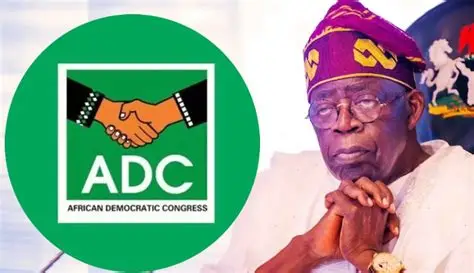
The African Democratic Congress (ADC) has accused the ruling All Progressives Congress (APC) of working to secure President Bola Tinubu’s return to office without a competitive election, following the Federal High Court judgment that invalidated the party’s leadership structure and raised questions about its 2027 presidential ticket.
Kola Ologbondiyan, Director of Media and Publicity of the ADC Presidential Campaign Council, made the allegation in Abuja, arguing that the ruling and other developments affecting opposition parties threatened Nigeria’s democratic process.
He said the APC was more interested in retaining power than allowing Nigerians to choose their leaders through a credible electoral contest.
“One thing is now very clear to all Nigerians: Tinubu is not preparing for an election. He is preparing for a coronation,” Ologbondiyan said.
The ADC spokesman also accused the ruling party of using state institutions, including security agencies and the judiciary, to weaken opposition activities ahead of the 2027 general election.
He alleged that opposition members and supporters had faced intimidation and attacks in several states, including Kaduna, Kogi, Katsina, Kebbi and Sokoto. He also cited an attack on a Nigeria Democratic Congress (NDC) campaign venue in Delta State, which reportedly resulted in the deaths of party members.
Ologbondiyan described the alleged incidents as threats to democratic freedoms and called on security agencies to remain politically neutral.
The campaign council also questioned the preparedness and neutrality of the Independent National Electoral Commission (INEC). It alleged that the commission’s voter register database had been compromised and raised concerns about the presence of individuals sympathetic to the APC in sensitive positions.
The allegations came amid the controversy surrounding the November 5 judgment delivered by Justice Peter Lifu of the Federal High Court in Abuja. The court nullified the emergence of the David Mark-led ADC leadership and invalidated decisions taken under its authority, including the process through which Atiku Abubakar emerged as the party’s presidential candidate.
The case originated from a suit filed by Nafiu Bala Gombe, a former deputy national chairman of the ADC, who challenged the process through which Mark and other members of the party’s leadership assumed office.
Justice Lifu ruled in favour of Gombe, a decision that created uncertainty over the party’s leadership and the validity of its nominations for the 2027 elections.
The ADC rejected the judgment and accused the ruling party of benefiting from the legal crisis. It maintained that an earlier judgment delivered by Justice Musa Liman on July 2, 2026, had recognised the process that produced Mark as national chairman and Rauf Aregbesola as national secretary.
The party subsequently began legal proceedings to challenge the November 5 ruling. Aregbesola also appealed the judgment and sought a stay of execution pending the determination of the appeal.
The controversy deepened on Wednesday, November 11, when the Federal High Court released the Certified True Copy of Justice Lifu’s judgment. The release followed a protest by Atiku’s supporters, who had demanded the authenticated document to enable the former vice president and the party to pursue their legal options.
However, the ADC’s interpretation of the judgment has since become another point of disagreement. Party lawyer Kalu Kalu argued that the judgment did not expressly invalidate Atiku’s candidacy because the former vice president’s name did not appear in the court’s orders.
The lawyer accused those interpreting the ruling as a direct disqualification of Atiku of reading consequences into the judgment that the court did not expressly pronounce.
This position has added another legal dimension to the dispute, as the court’s decision invalidated the leadership structure under which the primary was organised, while the ADC maintains that the precise effect on individual candidates must be determined from the judgment itself and subsequent legal proceedings.
Minister of Aviation and Aerospace Development, Festus Keyamo, has also argued that the ADC could still participate in the 2027 elections even if candidates produced by the David Mark-led leadership, including Atiku, were eventually excluded.
Meanwhile, Ologbondiyan insisted that the court dispute would not end the ADC’s political activities. He maintained that the party would continue its campaign and pursue all available legal remedies.
The ADC’s accusation has drawn attention to the growing tension between the ruling party and opposition groups as preparations for the 2027 general election continue. The party says Nigerians should be allowed to choose their leaders through an open electoral process rather than face circumstances that could restrict political competition.
The APC and the Federal Government have not established through any court finding that they orchestrated the judgment. The ADC’s claims of political interference and intimidation remain allegations that require independent examination.
The appeal process will be important in determining the legal status of the ADC leadership and the candidates nominated under it. Until the courts resolve the dispute, uncertainty will continue to surround the party’s preparations for the presidential election.