|
Getting your Trinity Audio player ready...
|
Apple’s New Macs Take Aim at Microsoft and Nvidia With a Bold Pitch: Skip the Data Center Entirely
Apple’s newest desktop computers started shipping Tuesday, and the company’s pitch to corporate buyers isn’t really about speed or design this time. It’s about money. Apple executives are telling businesses that running AI workloads on a Mac sitting on someone’s desk can end up cheaper than renting the equivalent computing power from a cloud provider, a direct challenge aimed squarely at Microsoft and Nvidia’s dominance over enterprise AI infrastructure.
The updated Mac Mini and Mac Studio lineup, some Mac Studio configurations priced at nearly $20,000, is built around Apple’s newest M6 and M5 Pro chips. That price tag sounds steep until you compare it against what businesses currently pay to rent equivalent AI computing capacity from major cloud providers, where costs are typically billed per token, the basic unit measuring how much text or data an AI model actually processes. Apple’s argument boils down to a fairly simple idea: buy the hardware once, and there’s no meter running afterward.
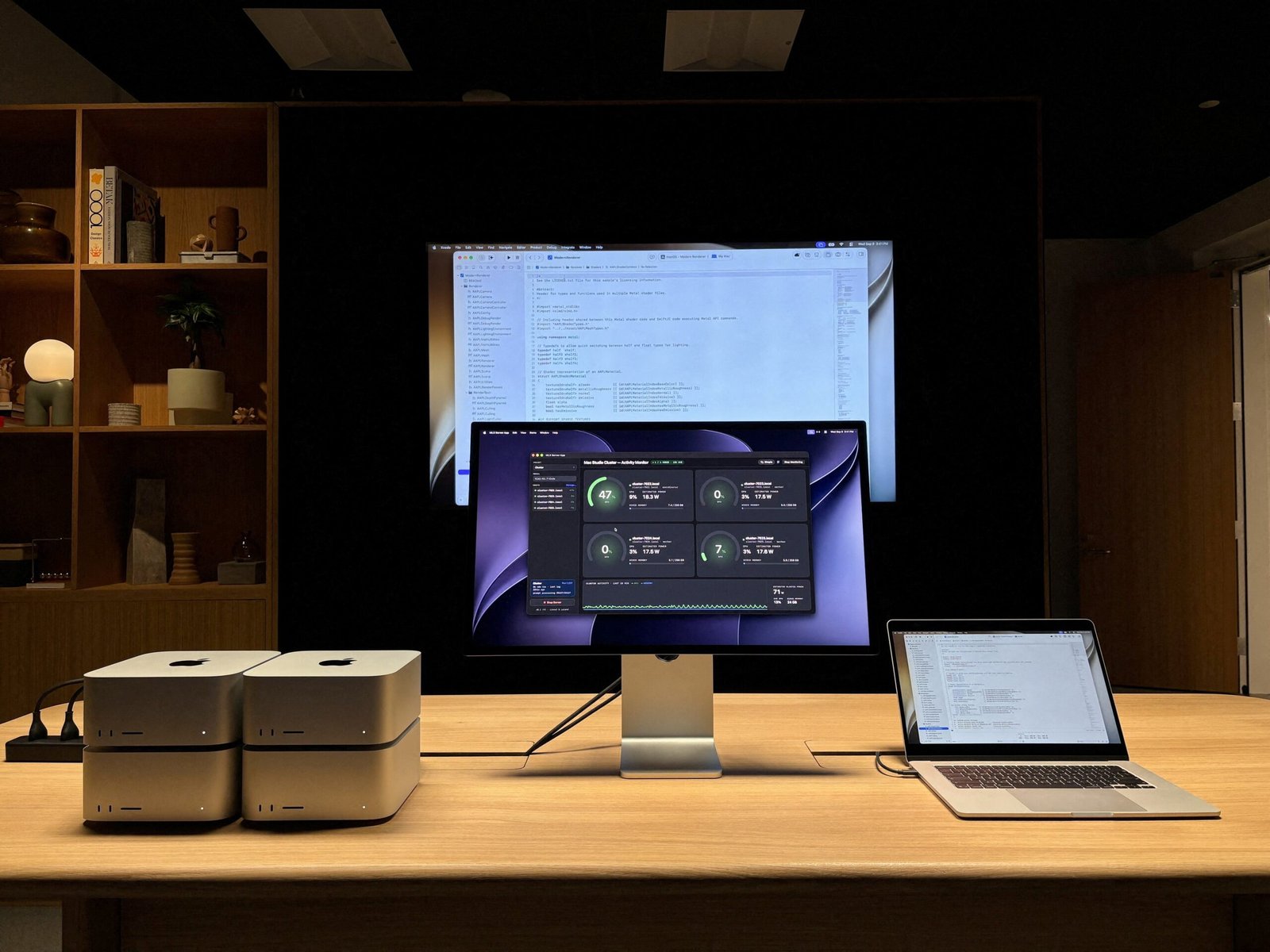
What makes this pitch newly credible is a feature Apple has been quietly building into its Mac Studio line for roughly two years without much fanfare. It’s a custom chip-to-chip networking system called RDMA over Thunderbolt, allowing multiple Mac Studios to be physically linked together and effectively pool their processing power into one larger system. Apple demonstrated exactly what that looks like at its product launch event earlier this month, showing four Mac Studios wired together running an AI model containing a trillion parameters, a rough measure of how complex and capable a given AI model actually is, to locate and repair a bug in graphics code. Tasks at that scale have traditionally required an actual data center to handle. Apple’s demonstration ran the entire thing off a single wall outlet.
Johny Srouji, Apple’s chief hardware officer, framed the value proposition plainly, arguing that once a company has bought the machine, it’s already paid for the computing power it delivers, with no additional per-token billing attached no matter how heavily the hardware gets used afterward. Srouji also pitched a broader architectural advantage to corporate buyers: because Apple’s chips across its entire product line, from the cheapest iPhone up through its priciest Mac Studio, share common underlying design principles, AI models developed on one device can scale up or down across the whole lineup without needing to be rebuilt from scratch for each new piece of hardware.
Apple isn’t going to have this pitch to itself for long. Nvidia and various PC manufacturers are rolling out competing desktop machines of their own, hardware expected to headline a Microsoft Windows event scheduled for San Francisco next month. Microsoft has its own name for this general push toward local, on-device AI computing, with CEO Satya Nadella describing the goal as delivering what he calls unmetered intelligence, capability that doesn’t come with an ongoing usage bill attached. Asked for comment, Microsoft told Reuters it’s been working closely with its chip partners to streamline AI workloads through its Windows ML software tools, and confirmed that features similar to Apple’s RDMA setup remain an active area of investment on its end.
Nvidia, for its part, declined to comment directly on Apple’s new lineup. But the company’s stance on this particular battlefield became fairly clear earlier this summer, when CEO Jensen Huang downplayed any real interest in competing head-on with Apple during the launch of Nvidia’s own new PC chip, saying instead that Nvidia’s focus is on expanding what Windows-based PCs are capable of more broadly. That framing lines up with where Nvidia’s actual business still sits: the company’s core stronghold remains the data center, the exact market Apple is now trying to convince corporate customers they don’t necessarily need to rent from.
Whether that argument actually lands with enterprise buyers is a genuinely open question, and Apple faces a steep climb regardless of how compelling its cost pitch turns out to be. According to IDC analyst Linn Huang, Apple currently holds only about 4.6 percent of the enterprise desktop computer market, compared to Windows’ commanding 91.3 percent share. That’s an enormous gap to close, and it reflects decades of corporate IT departments building their entire software stacks, security policies and employee training around Windows machines rather than Macs. Apple is betting that its years of experience wringing maximum performance out of battery-constrained devices like the iPhone gives it a genuine technical edge when it comes to efficient, cost-effective local AI processing, but turning that technical edge into actual enterprise market share is a considerably harder, slower fight than simply shipping faster chips.
The new Macs are being positioned specifically for intensive, recurring AI workloads, things like writing and debugging code or running complex, multi-step business processes, the kind of repeated, heavy usage where cloud token costs from providers like OpenAI or Anthropic can add up fast over time. If a company is running those kinds of tasks constantly rather than occasionally, Apple’s argument is that the upfront cost of the hardware pays for itself faster than continuing to rent capacity indefinitely. Whether enough corporate buyers actually run the numbers and agree is likely to become clearer only once Microsoft unveils its own competing hardware push next month, giving businesses a genuine side-by-side choice between renting AI computing power and simply owning it outright.