|
Getting your Trinity Audio player ready...
|
China’s push to secure enough electricity for its rapidly expanding AI data center network is accelerating the country’s nuclear ambitions on two fronts at once, driving both a historic buildout of conventional reactors and a heavily funded race toward nuclear fusion, long regarded as the holy grail of clean energy. According to reporting from the Financial Times, more than half of the 58 conventional nuclear reactors currently under construction anywhere in the world are located in China, a scale of buildout no other country is currently attempting to match.
The underlying pressure driving this expansion is straightforward. Consulting firm Wood Mackenzie projects that China’s data center power consumption will reach 774 terawatt-hours by 2030, a roughly fourfold increase from current levels, as the country’s AI infrastructure buildout continues accelerating alongside its broader manufacturing and export economy. That surge in electricity demand is colliding directly with Beijing’s separate commitment to reach carbon neutrality by 2060, a combination that has made expanding clean, reliable power generation an urgent strategic priority rather than a longer-term planning exercise.
China’s response spans both near-term and longer-horizon technologies simultaneously. While traditional nuclear power plants in China remain led primarily by the government and state-owned enterprises, a newer wave of private companies backed by state-linked funds has begun entering the market specifically to build small modular reactors, compact nuclear plants designed to be cheaper and faster to construct than the large-scale reactors that have historically defined the industry. Junhe Nuclear, established in Shanghai last year, has already raised 300 million yuan, roughly $42 million, in venture investment and is currently in the design phase for its first demonstration SMR, with commercial operation targeted for 2031. The company’s strategy involves repurposing the sites and existing workforce of aging coal-fired power plants rather than building entirely new facilities from scratch, an approach one company official described directly to the Financial Times as turning the AI-driven power supply gap into precisely the opportunity Junhe was built to capture.
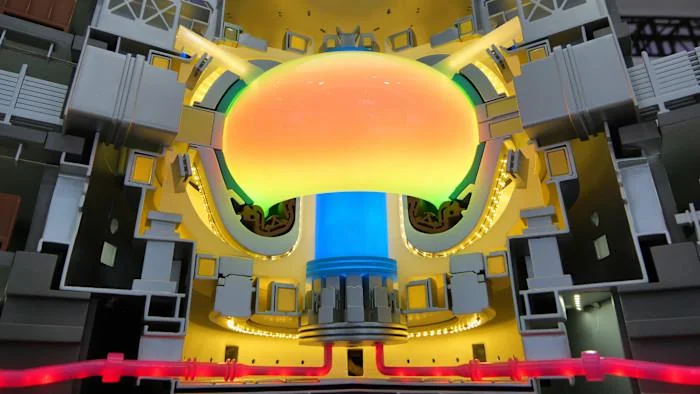
On the fusion side of the equation, a separate Shanghai-based startup called Nova FusionX is developing what’s known as field-reversed configuration technology, one of several competing technical approaches researchers globally are pursuing in the effort to make fusion power commercially viable. Fusion has long been considered the most technically difficult form of nuclear energy to achieve at scale, since it requires replicating the same physical process that powers the sun, but unlike conventional fission reactors, fusion carries no risk of meltdown and produces no long-lived radioactive waste, making it an especially attractive long-term target for countries trying to balance massive energy demand growth against genuine environmental and safety concerns.
Beijing’s commitment to fusion research extends well beyond individual startups. China’s current Fifteenth Five-Year Plan, covering 2026 through 2030, designates fusion energy as one of eight strategic technologies warranting what the plan describes as extraordinary measures to secure breakthroughs, positioning the field as a genuine frontline of broader great-power technological competition rather than a niche research pursuit. Since January 2023, China has mobilized a conservatively estimated $6.5 billion specifically for fusion infrastructure, according to analysis from the Special Competitive Studies Project, a scale of sustained public investment that stands in contrast to the more fragmented, venture-driven funding model that has characterized much of the fusion sector in the United States.
That funding gap has not translated into a clear technological lead for China, at least not yet. The United States achieved the first confirmed instance of fusion ignition, the milestone where a fusion reaction produces more energy than was used to trigger it, at Lawrence Livermore National Laboratory in December 2022, and American researchers and private companies still hold a meaningful edge in fusion science specifically, according to analysts cited by the South China Morning Post, even as China’s raw pace of nuclear infrastructure construction has pulled ahead. Analysts tracking the sector expect China to overtake the United States in total operational nuclear capacity in the coming years, driven largely by how efficiently Beijing has streamlined reactor approval and construction timelines compared with the far slower regulatory and financing processes that have historically constrained nuclear development in the U.S. and Europe.
The Financial Times’ analysis framed China’s approach as a deliberate strategic bet: while cost concerns and environmental opposition have stalled nuclear power development across much of the developed world, China’s willingness and institutional capacity to build reactors quickly and at scale is turning what many other countries treat as a politically difficult energy source into an opportunity for the country to dominate yet another future industry, alongside its existing leads in solar panel manufacturing, battery production and electric vehicles.
The AI-fusion connection is not purely one-directional either. Beyond simply needing more electricity to power data centers, AI itself is increasingly being applied to accelerate fusion research directly, using machine learning models to help solve complex plasma physics problems that have historically required extensive human expertise, including real-time stabilization of unstable plasma behavior inside experimental reactors. That symbiotic relationship, AI systems demanding enormous amounts of power while simultaneously helping researchers solve the scientific problems standing between current fusion experiments and commercial viability, has become a recurring theme across fusion research programs globally, not just in China, with American fusion startups backed by AI industry figures pursuing similar convergence between the two technologies.
Whether China’s aggressive, state-coordinated approach to nuclear expansion ultimately proves faster or more sustainable than the more market-driven fusion race unfolding in the United States remains an open question likely to play out over the next decade. What is already clear is that the scale of electricity AI infrastructure now demands has moved nuclear power, both the conventional reactors China is building today and the fusion technology it is racing to commercialize, from a long-term policy aspiration into an urgent, near-term industrial priority for the world’s second-largest economy. Continuing coverage of how AI’s energy demands are reshaping global power infrastructure investment is available on Business Tech. Additional detail on China’s nuclear buildout is available through the South China Morning Post’s coverage of the trend, and further background on the global AI-fusion connection can be found through the World Economic Forum’s analysis of the topic.