
|
Getting your Trinity Audio player ready...
|
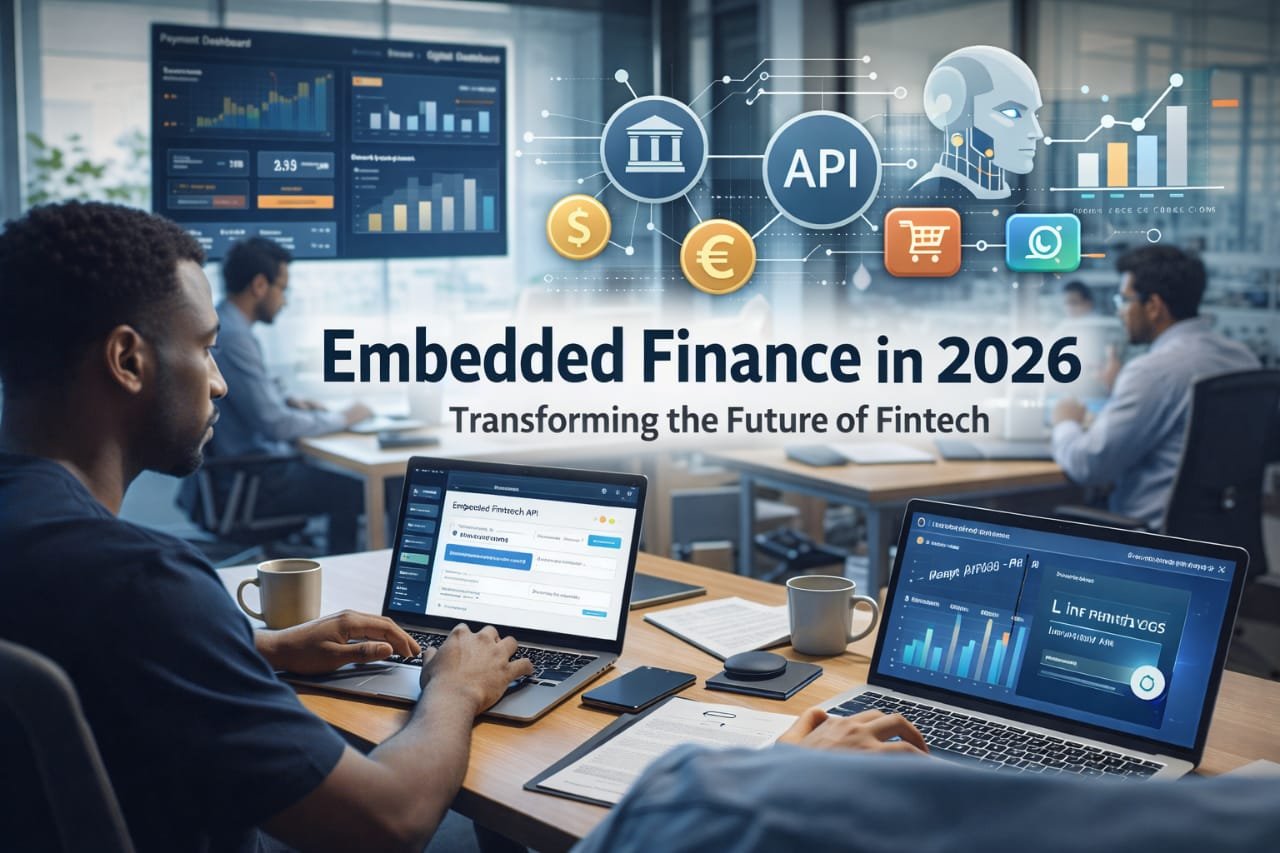
Learn how embedded finance in 2026 is reshaping fintech with APIs, AI, and digital payments, enabling businesses to integrate financial services seamlessly.
Embedded finance has evolved from a buzzword into a structural shift that is transforming how businesses deliver, consumers use, and markets monetize financial services across the globe. In 2026, the concept extends far beyond fintech startups and neobanks. Companies now integrate financial services directly into ecommerce platforms, logistics networks, SaaS tools, and even social media ecosystems. For developers, founders, and investors, understanding embedded finance is essential to navigating the next phase of financial innovation.
At its core, embedded finance refers to the integration of financial services such as payments, lending, insurance, and banking directly into non-financial platforms. Instead of redirecting users to traditional banks or standalone fintech apps, companies now offer financial functionality seamlessly within their own products. Financial APIs, cloud infrastructure, and regulatory frameworks that support open banking and real-time transactions power this shift.
The broader expansion of digital payments and financial infrastructure drives the momentum behind embedded finance in 2026. As global commerce becomes increasingly digital, businesses are under pressure to reduce friction in transactions, improve user experience, and unlock new revenue streams. Embedded finance delivers on all three fronts by allowing companies to own the financial layer of their customer journey.
Across emerging markets, particularly in Africa, Southeast Asia, and Latin America, embedded finance is playing a critical role in financial inclusion. In these regions, traditional banking infrastructure often fails to serve millions of individuals and small businesses. By integrating financial services into platforms that people already use, such as ride-hailing apps or online marketplaces, companies are effectively bypassing legacy systems and accelerating access to financial tools.
In Nigeria, for instance, fintech platforms are embedding payment and lending solutions into everyday services, enabling small merchants to accept digital payments and access working capital without ever interacting with a traditional bank. This convergence of commerce and finance is not just a technological trend. It represents a fundamental shift in how financial services are distributed.
The rise of embedded finance is also closely linked to the evolution of digital banking. While neobanks initially disrupted the industry by offering app-based alternatives to traditional banks, the next wave of innovation is happening beyond standalone banking apps. Financial services are becoming invisible, integrated into the background of user experiences.
For developers, this shift is driven by the growing availability of financial APIs. Companies specializing in financial infrastructure now provide modular tools that allow businesses to integrate payments, identity verification, lending, and compliance features with minimal friction. These APIs abstract away the complexity of banking systems, enabling developers to build financial products faster and at lower cost.
The increasing sophistication of financial APIs has also led to the emergence of embedded lending and buy-now-pay-later models. Ecommerce platforms can now offer credit at the point of sale, while SaaS platforms can provide financing to their business users based on real-time data. This data-driven approach to lending is transforming credit risk assessment, making it more dynamic and inclusive.
Artificial intelligence is another key driver of embedded finance in 2026. AI is being used to enhance fraud detection, personalize financial products, and automate compliance processes. In embedded finance ecosystems, where transactions occur at high volume and speed, AI plays a crucial role in ensuring security and efficiency.
Fraud prevention, in particular, has become a major focus as digital transactions continue to rise globally. Embedded finance platforms are leveraging machine learning models to detect anomalies in real time, reducing the risk of fraud while maintaining a seamless user experience. This is especially important in cross-border payments, where regulatory requirements and risk factors can vary significantly.
The integration of AI into financial services is also enabling more personalized user experiences. Platforms can analyze user behavior and transaction data to offer tailored financial products, such as customized lending terms or targeted insurance coverage. This level of personalization is becoming a competitive advantage for companies operating in the embedded finance space.
From an investor perspective, embedded finance represents one of the most attractive opportunities in fintech. The market is expanding rapidly, with projections indicating that embedded finance could generate trillions of dollars in revenue globally over the next decade. Investors now prioritize companies that provide underlying infrastructure and actively integrate financial services into high-growth platforms.
However, the growth of embedded finance is not without challenges. Regulatory scrutiny is increasing as governments and financial authorities seek to ensure consumer protection and financial stability. In 2026, regulators are focusing on issues such as data privacy, anti-money laundering compliance, and the accountability of non-financial companies offering financial services.
The regulatory landscape is evolving differently across regions. In the European Union, open banking regulations have created a strong foundation for embedded finance by mandating data sharing between banks and third-party providers. In the United States, regulatory fragmentation presents challenges but also opportunities for innovation. Meanwhile, in emerging markets, regulators are often balancing the need to promote financial inclusion with the need to mitigate risk.
For fintech founders, navigating this regulatory complexity is a critical part of building successful embedded finance products. Compliance is no longer an afterthought. It is a core component of product design. Companies are investing heavily in compliance technologies and partnerships with licensed financial institutions to ensure they meet regulatory requirements.
The concept of banking-as-a-service is central to the embedded finance ecosystem. It allows non-financial companies to offer banking services without obtaining a full banking license. Instead, they partner with regulated banks that provide the necessary infrastructure and compliance support. This model has enabled a wide range of companies, from startups to large enterprises, to enter the financial services space.
The expansion of embedded finance is also reshaping competition in the financial industry. Traditional banks are facing pressure to adapt as financial services become increasingly decentralized. Some banks are responding by offering their own APIs and partnering with fintech companies, while others are struggling to keep pace with the speed of innovation.
At the same time, big technology companies are becoming major players in embedded finance. By leveraging their massive user bases and data capabilities, these companies can integrate financial services at scale. This trend is raising questions about market concentration and the potential risks associated with large tech firms dominating financial ecosystems.
Cross-border payments are another area where embedded finance is driving significant innovation. Historically, international transactions have been slow, expensive, and complex. Embedded finance platforms are addressing these challenges by integrating real-time payment systems and leveraging blockchain-based infrastructure to reduce costs and improve transparency.
For businesses operating globally, the ability to offer seamless cross-border payments is a major competitive advantage. It enables them to expand into new markets and serve customers more effectively. For consumers, it means faster and cheaper transactions, which is particularly important for remittances and international ecommerce.
The role of digital identity in embedded finance cannot be overlooked. As financial services become more integrated into digital platforms, verifying user identity becomes increasingly important. Advances in biometric authentication and decentralized identity systems are helping to enhance security while reducing friction in user onboarding.
Digital identity solutions are also playing a key role in compliance, particularly in know-your-customer and anti-money laundering processes. By integrating identity verification into embedded finance platforms, companies can streamline compliance while maintaining a seamless user experience.
The intersection of embedded finance and lending is creating new opportunities for small and medium-sized enterprises. Companies leverage transaction data and platform analytics to offer financing solutions tailored to the specific needs of businesses. This approach holds particular value in emerging markets, where access to traditional credit remains limited.
For developers building fintech products, the embedded finance ecosystem offers a wide range of opportunities. Whether it is integrating payments into a mobile app, building a lending platform, or developing compliance tools, the availability of APIs and cloud infrastructure has lowered the barriers to entry. However, it also requires a deep understanding of financial systems, user behavior, and regulatory requirements.
The importance of financial infrastructure in enabling embedded finance cannot be overstated. Behind every seamless payment or lending experience is a complex network of systems that handle transactions, manage risk, and ensure compliance. Companies that build and maintain this infrastructure are becoming the backbone of the fintech industry.
As embedded finance continues to evolve, its impact on the global economy is becoming more pronounced. It is not just changing how financial services are delivered. It is redefining the relationship between businesses and their customers. Financial services are becoming a core part of digital experiences, rather than a separate layer.
For startup founders, the key question is no longer whether to integrate financial services, but how to do it effectively. This involves choosing the right partners, designing user-centric products, and navigating regulatory requirements. It also requires a clear understanding of the value that embedded finance can bring to their business.
Investors, on the other hand, are looking for signals that indicate sustainable growth and competitive advantage. Companies that can successfully integrate financial services while maintaining strong unit economics are likely to attract significant investment. This includes not only fintech startups but also companies in other sectors that leverage embedded finance to enhance their offerings.
The future of embedded finance in 2026 and beyond is likely to be shaped by continued innovation in AI, blockchain, and financial APIs. As these technologies evolve, they will enable even more sophisticated and integrated financial services. At the same time, regulatory developments will play a crucial role in determining how the industry evolves.
For a deeper understanding of how these trends intersect with broader fintech developments, explore related insights on payments, digital banking, financial APIs, compliance, lending, and financial infrastructure. These interconnected areas provide the foundation for the next generation of financial innovation.
Ultimately, embedded finance represents a shift towards a more integrated and accessible financial system. It is breaking down traditional barriers and creating new opportunities for businesses and consumers alike. For those building, investing, or operating in fintech, it is a trend that cannot be ignored.