|
Getting your Trinity Audio player ready...
|
Former Barcelona and Spain defender Gerard Piqué has criticised the 12-match suspension handed to FC Andorra goalkeeper Jesús Owono following the death of Tenerife striker Jesús de Miguel, arguing that the punishment unfairly holds the goalkeeper responsible for the tragic consequences of an on-field collision.
Piqué, who is the majority shareholder of FC Andorra, said the Spanish Football Federation should have assessed Owono’s actions during the incident rather than allowing the tragic outcome to determine the severity of the punishment. He described the collision as an accident and questioned whether the maximum suspension permitted under the regulations was appropriate in the circumstances.
The former Spain international made his position known in a video published on TikTok late on Monday, November 16. His comments came three days after the Spanish Football Federation’s disciplinary committee confirmed the 12-match ban against Owono, who plays for his club in Spain’s second division.
Piqué argued that the punishment placed the 25-year-old goalkeeper in an unfair position because it appeared to make him answer for consequences he did not intend or control.
He said disciplinary action should be based on the nature of the challenge rather than the devastating outcome that followed. While acknowledging the pain caused by De Miguel’s death, Piqué maintained that Owono should not be treated as though he deliberately caused the tragedy.
The incident happened during a second-division match between FC Andorra and Tenerife on November 2. The game was in stoppage time, with both teams level at 2-2, when Owono rushed out of his goal to challenge for an aerial ball.
The goalkeeper collided heavily with De Miguel, who was attempting to contest the ball. The impact left the Tenerife forward requiring urgent medical attention on the pitch. Owono was shown a red card following the incident, while the match was eventually abandoned.
De Miguel, who was 30, was taken to hospital and admitted to intensive care. His condition later deteriorated, and he died on November 3, leaving his family, teammates, club and supporters devastated.
The death sent shockwaves through Spanish football, with clubs, players and football organisations expressing condolences. The incident also attracted international attention because it involved a collision during an ordinary football contest that ended with the death of a professional player.
Following the incident, the Spanish Football Federation’s disciplinary committee reviewed the referee’s report and imposed a 12-match suspension on Owono. The punishment represented the maximum sanction available under the relevant disciplinary provision.
According to the committee, the referee’s report stated that Owono had been sent off for violently striking an opponent in the chest with his leg while using excessive force when the ball was in play. The disciplinary body said the nature of the conduct and the circumstances surrounding the incident justified the maximum suspension.
The federation also decided that the 2-2 scoreline would stand, meaning the abandoned match would not have to be resumed. It described that decision as the most respectful approach given the extraordinary circumstances surrounding De Miguel’s death. AFP+1
Piqué, however, believes the punishment raises questions about how football authorities distinguish between dangerous conduct and an accidental collision with fatal consequences.
To explain his position, he referred to another incident involving Albacete player José Corpas, who received a three-match suspension after accidentally kicking Sabadell player Quadri Liameed in the head during a separate match. Liameed was hospitalised but recovered.
Piqué questioned why the disciplinary outcomes should be so different when both incidents involved players colliding during a football match. He argued that the punishment should reflect the action itself and not simply the severity of the eventual injury.
The FC Andorra shareholder also recalled an incident from his own playing career involving former Barcelona goalkeeper Víctor Valdés during a Champions League semi-final against Chelsea in 2012.
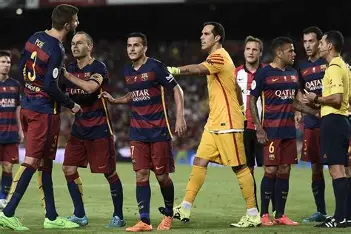
Piqué explained that he had collided with Valdés while both players were moving towards the ball. The impact left him unconscious and required hospital treatment. He said the fact that Valdés was involved in the collision did not make the goalkeeper responsible for what happened to him.
He used the experience to illustrate how quickly an accidental collision can produce serious consequences in football, particularly when players approach the same ball from opposite directions at speed.
Piqué’s argument does not change the federation’s disciplinary decision, but it highlights a wider disagreement over how football regulations should address incidents that result in unusually severe consequences. Reuters+2
Despite defending his goalkeeper, Piqué did not suggest that the death of De Miguel should be treated lightly. He acknowledged the loss and said no suspension could bring the Tenerife striker back.
He also recognised that the tragedy had affected Owono deeply. The goalkeeper has previously spoken about the emotional difficulty of dealing with the incident, describing the days following De Miguel’s death as the hardest of his life.
In a statement released through FC Andorra, Owono expressed immense pain over the loss and extended his thoughts to De Miguel’s family, friends and everyone who loved him. He also said he would face any matters arising from the incident with respect.
The goalkeeper has not confirmed when he will return to competitive football. His club’s manager, Carles Manso, said Owono would be given the time and support needed to decide whether he wanted to continue playing.
Manso explained that the club would not pressure the Equatorial Guinea international into making an immediate decision. He said Owono was spending time with his family and close friends, and that the club would respect his decision about whether and when to return.
The emotional impact of the incident has therefore extended beyond the disciplinary suspension. Owono is dealing with the death of another professional footballer following a collision in which he was directly involved, while Tenerife’s players and staff are also trying to cope with the loss of a teammate.
Piqué suggested that the goalkeeper might need more than the 12 matches covered by the suspension before he would be ready to play again. His comment reflected the possibility that Owono’s absence could continue beyond the formal disciplinary period because of the psychological effects of the incident.
Tenerife have also faced the difficult task of returning to competition after losing De Miguel. The club and its supporters have paid tribute to the striker, while players and officials from across Spanish football have expressed sympathy for his family.
The Tenerife manager, Álvaro Cervera, previously said the 12-match punishment might appear light when considered against the death of the player. However, he also acknowledged that the disciplinary committee had to work within the existing regulations.
Cervera explained that the federation appeared to have applied the maximum punishment allowed by the rules because the regulations did not specifically provide another sanction for the circumstances surrounding the incident. He said he would keep his personal opinion about the punishment to himself.
His comments illustrated the difficult position facing football authorities. The disciplinary committee had to assess the conduct recorded by the referee, while clubs and supporters were also responding to the human consequences of the incident. Tenerife coach+1
The case has also attracted attention because Spanish police opened an investigation following De Miguel’s death. Police sources told AFP that the investigation was being conducted under judicial supervision, a procedure associated with deaths considered unnatural.
The existence of an investigation does not establish that Owono committed a criminal offence. The football suspension is a disciplinary decision made by the sport’s governing authority, and it should not be confused with a finding of criminal responsibility.
That distinction is important as the incident continues to generate debate. The federation’s decision addressed the goalkeeper’s conduct under football rules, while any separate legal assessment would have to follow the appropriate judicial process.
For FC Andorra, the immediate priority appears to be supporting Owono as he considers his future. The club has indicated that he will not be forced to return before he feels ready, while Piqué has made clear that he believes the punishment should not place additional blame on the goalkeeper for the tragedy.
The controversy surrounding the 12-match suspension is unlikely to remove the grief experienced by De Miguel’s family and teammates. It has, however, raised difficult questions about the relationship between sporting discipline, accidental collisions and the consequences of dangerous challenges.
Piqué’s position is that Owono should be judged for the action recorded during the match, not treated as responsible for every consequence that followed. The federation, meanwhile, has justified its decision by pointing to the referee’s report and the maximum sanction available under its disciplinary rules.
As Owono takes time away from football, the debate over the punishment continues. For both clubs, the incident remains first and foremost a human tragedy, with the loss of a 30-year-old footballer leaving a lasting impact on Spanish football.