|
Getting your Trinity Audio player ready...
|
Honor’s New MagicOS 11 Looks Suspiciously Like iOS 27, and Nobody’s Being Subtle About It
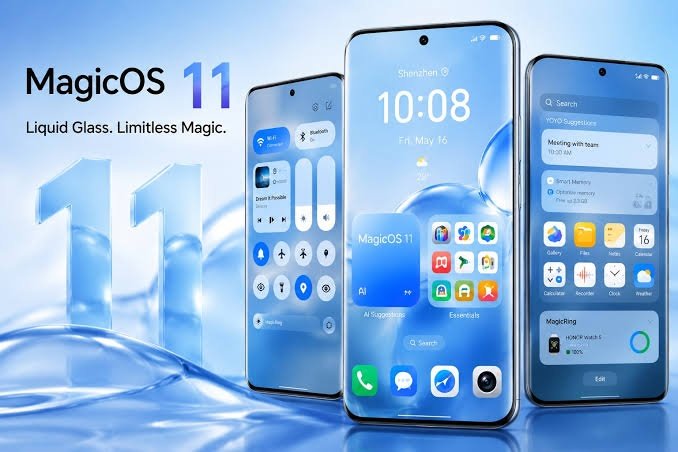
Honor unveiled its next Android skin at its Global Developer Conference this week, and the reaction from the tech press has been almost uniformly the same: this looks a lot like Apple’s software. MagicOS 11, built on top of Android 17, leans so heavily into Apple’s Liquid Glass design language that multiple outlets covering the reveal didn’t bother softening the comparison, with headlines flatly stating Honor had copied iOS rather than merely drawn inspiration from it.
It’s worth being fair about how common this kind of borrowing actually is across the phone industry. Apple regularly lifts features Android manufacturers introduced first and markets them as breakthroughs, and Android skins have leaned on Apple’s visual language for years in smaller, more scattered ways. What’s different here is the sheer completeness of it. Where brands like OPPO and Vivo have sprinkled translucent, glass-like touches across select parts of their own recent software updates, Honor appears to have applied the look system-wide, covering the home screen, lock screen, Control Center equivalent, notifications, widgets, app icons, the Photos app, and even Honor’s own Magic Capsule notification feature. One reviewer described the resemblance as feeling less like inspiration and more like Honor’s design team took a screenshot of an iPhone running iOS 27 and rebuilt it piece by piece using Android components.
Honor’s own framing, unsurprisingly, focuses on the engineering rather than the resemblance. The company says the new look is built on two custom architectures it calls Luminous and Hummingbird. Luminous is described as a deeper restructuring of Android at the system level, meant to give interface elements a consistent, layered glass effect rather than just applying transparency as a surface-level filter over existing menus. Hummingbird, meanwhile, is focused specifically on animation smoothness and general responsiveness, and Honor claims the combination delivers roughly 20 percent faster system animations compared to MagicOS 10, despite the added visual complexity that typically comes with rendering all that transparency and light refraction in real time.
One detail in particular has drawn extra attention: MagicOS 11 includes a slider in its customization settings that lets users adjust exactly how strong the glass effect looks throughout the interface, dialing it anywhere from barely-there transparency to something closer to Apple’s fully saturated look. That would be a fairly unremarkable customization option on its own, except that Apple introduced almost the exact same slider control for its own Liquid Glass effect in iOS 27 when it was unveiled at WWDC earlier this year, making the overlap here a little harder to write off as coincidence.
To Honor’s credit, the update isn’t purely a visual reskin bolted onto existing software. The company used the same event to detail a meaningfully upgraded version of its Yoyo AI assistant, which Honor says now supports more than 1,000 distinct use-case scenarios and can integrate with over 10,000 third-party AI services, though that expanded integration is currently limited to the Chinese market. More notably, Honor says the assistant is now capable of executing task sequences spanning up to 100 steps, positioning Yoyo less as a simple voice command tool and more as something closer to an autonomous agent capable of working through a genuinely long chain of actions without needing constant reconfirmation at each stage. Honor also introduced a memory management feature it’s calling Storage Space 2.0, which uses data compression and automatic cleanup of redundant files to free up device storage, along with a smaller but genuinely useful addition letting the phone stay connected to two Bluetooth headsets simultaneously.
Honor is also expected to bring an AirDrop-style sharing feature to devices running MagicOS 11, letting users transfer files simply by holding two phones close together, similar to functionality that’s reportedly being built into Android 17 at the platform level more broadly rather than as something unique to Honor. Leaked builds of Samsung’s competing One UI 9 have shown a comparable feature under development too, suggesting Google may be adding this kind of proximity-based sharing as a standard Android 17 capability that multiple manufacturers will end up shipping around the same time, rather than one company beating the others to it exclusively.
MagicOS 11 is currently being tested in beta on Honor’s existing Magic 8 lineup, including the Magic 8, Magic 8 Pro, Magic 8 Pro Air, and the premium Magic 8 RSR Porsche Design model, ahead of its full public debut alongside the upcoming Honor Magic 9 series later this month, which will presumably ship with the software installed by default.
Whether Honor’s version of Liquid Glass ends up feeling genuinely useful in daily use, or simply looks impressive in demo videos before the novelty wears off, is something reviewers will only really be able to judge once the software reaches more hands outside of Honor’s own beta testing group. What’s already clear is that MagicOS 11 arrives as part of a broader moment across Chinese Android manufacturers, with OPPO’s recently detailed ColorOS 17 pursuing a similar translucent, frosted-glass aesthetic of its own, suggesting Apple’s Liquid Glass look, introduced across iOS just last year, has already become something close to the default visual reference point the entire Android ecosystem is measuring itself against.