
|
Getting your Trinity Audio player ready...
|
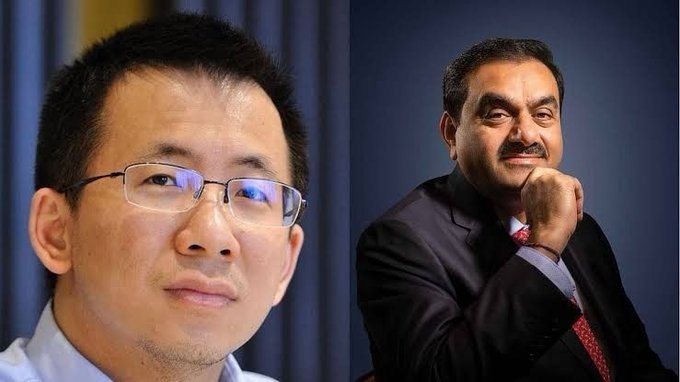
TikTok Founder Zhang Yiming Becomes Asia’s Richest Person for the First Time, Overtaking Gautam Adani
Zhang Yiming has never sat atop Asia’s wealth rankings before. That changed this week, with the ByteDance founder’s fortune climbing past $105 billion and pushing him ahead of Indian industrialist Gautam Adani to become the region’s richest person, according to the Bloomberg Billionaires Index. It’s a milestone moment for the 43-year-old entrepreneur, whose wealth has been on a genuinely startling trajectory since Bloomberg first started tracking it back in 2019.
The numbers involved are close enough that the ranking could shift again with the next round of updated data. Zhang’s estimated net worth sits at roughly $105.5 billion, edging out Adani’s approximately $104.8 billion by a margin Bloomberg itself has noted is narrow enough to move as valuations get revised. Both men currently sit near identical territory on the global rich list too, with Zhang ranked 18th worldwide and Adani just two spots behind at 20th, sandwiching interactive brokers billionaire Thomas Peterffy, who also comes in around the $105 billion mark between them. At the very top of the global list, well ahead of everyone in Asia, sits Tesla and SpaceX’s Elon Musk, whose fortune Bloomberg currently estimates at roughly $892 billion.
What’s driving Zhang’s surge isn’t TikTok’s advertising business, at least not primarily. It’s ByteDance’s aggressive push into generative AI. The company’s Doubao chatbot and its Seedance video-generation model have reshaped how investors are pricing ByteDance as a whole, with the privately held company’s valuation now sitting around $550 billion according to recent estimates. Zhang’s fortune alone jumped by more than $12 billion just this month, driven by updated marks that major institutional holders including BlackRock, Fidelity Investments and T. Rowe Price placed on their ByteDance stakes, valuations that Bloomberg then folds into its own wealth calculations for Zhang given his substantial ownership stake in the company.
This isn’t actually the first time Zhang has climbed the Asia rankings this year either. Back in June, Bloomberg’s index had already lifted him past Reliance Industries chairman Mukesh Ambani into the number two spot in Asia, a jump that followed Bloomberg cutting the risk discount it applies to ByteDance’s valuation from 25 percent down to 10 percent, once the company’s messy restructuring saga in the United States finally reached a resolution. That restructuring, which had put TikTok’s US operations under genuine threat of a forced shutdown amid years of regulatory pressure over Chinese ownership, eventually settled into an arrangement involving Oracle as part of a joint venture structure, removing a major source of uncertainty that had been weighing down how outside analysts valued ByteDance overall.
It’s worth noting that not every wealth tracker agrees on exactly how rich Zhang actually is right now. Forbes’ real-time billionaires list put his net worth at roughly $84 billion as of Wednesday, a meaningfully lower figure than Bloomberg’s estimate. That gap comes down almost entirely to methodology, specifically how each outlet chooses to value ByteDance, a company that remains privately held and doesn’t have publicly traded shares offering a clean, continuously updated market price the way a stock like Tesla or Adani’s listed businesses do. Bloomberg applies its own 10 percent risk discount to account for that uncertainty, while Forbes evidently arrives at a more conservative valuation through its own separate process. Whenever a private company’s valuation drives someone’s ranking on these lists, that kind of disagreement between trackers is fairly common and worth keeping in mind before treating any single figure as gospel.
On the other side of the ledger, Adani’s slide from his earlier position tells its own story. His fortune had actually peaked around $120 billion back in June, according to Bloomberg’s tracking, before a rebalancing of the MSCI index wiped out roughly $15 billion of his conglomerate’s market value at the end of August. A broader market selloff, driven by rising oil prices and climbing bond yields, pushed Adani Group shares down further still in the weeks since, compounding the earlier hit and ultimately opening the door for Zhang to slip past him.
Zhang’s own path to this point traces back to 2012, when he founded ByteDance out of a Beijing apartment after stints working at travel search portal Kuxun, at Microsoft, and at property search platform 99fang.com. Despite stepping down as ByteDance’s chief executive in 2021, he’s reported to have retained majority voting control over the company, more than 50 percent, giving him substantial ongoing influence over ByteDance’s direction even without holding the CEO title day to day. That continued backing of ByteDance’s AI ambitions has reportedly persisted even through periods of intense scrutiny, including when TikTok chief executive Shou Chew faced pointed questioning from US lawmakers back in 2023 over the company’s data practices and ties to China.
Rounding out the rest of Asia’s wealthiest tier below Zhang and Adani, Ambani holds third place with roughly $81.3 billion, followed by Uniqlo founder Tadashi Yanai at approximately $63.7 billion and bottled water tycoon Zhong Shanshan at around $59.1 billion. That lineup underscores just how much of a departure Zhang’s rise represents from the traditional wealth patterns that have defined Asia’s richest list for years, patterns built largely around infrastructure, energy, retail and manufacturing empires. Zhang’s fortune instead traces back to a short-video recommendation algorithm that’s since evolved into one of the more ambitious AI plays coming out of China, echoing a broader global shift where AI-linked fortunes, from Musk’s rocket and chip ambitions to Nvidia’s Jensen Huang, have increasingly come to define the upper tiers of the world’s wealth rankings.