|
Getting your Trinity Audio player ready...
|
Porsche Completes €1 Billion Bugatti Rimac Exit to HOF Capital, Raises 2026 Cash Flow Outlook
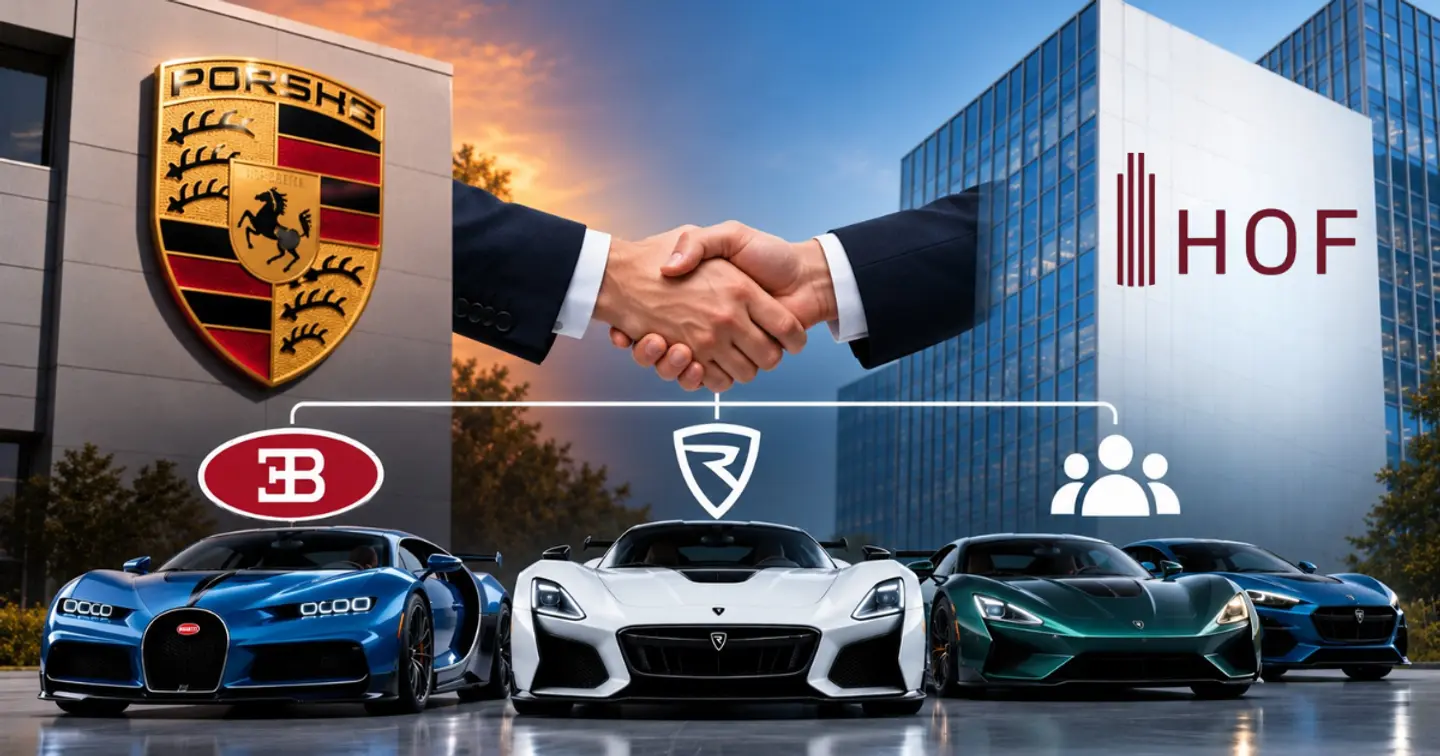
Porsche has closed the book on its five year run as a stakeholder in Bugatti, confirming Wednesday that it has completed the sale of its holdings in Bugatti Rimac and the wider Rimac Group after clearing the last of the regulatory hurdles standing in the way.
The German sports car maker sold its 45 percent stake in Bugatti Rimac along with its roughly 20.6 percent holding in Rimac Group to a consortium led by HOF Capital, a US based investment firm. BlueFive Capital is the largest backer within that group, joined by a mix of other institutional investors from both the United States and Europe. The agreement was first struck back in April, and it took until this week for the deal to actually close once regulators signed off.
The numbers behind the sale are what has analysts paying attention. Porsche expects to pull in around one billion euros, close to 1.2 billion dollars, from the transaction. A quarter of that, 250 million euros, is being set aside specifically to shore up the company’s pension obligations rather than flowing straight into general operations. With that cash now locked in, Porsche raised its full year 2026 automotive net cash flow margin forecast to a range of 5.5 to 7.5 percent, a meaningful step up from the 3 to 5 percent guidance it had been working with before the deal closed.
Context matters here. Porsche has spent the better part of this year trimming its portfolio to concentrate on the business that actually built its brand, high performance sports cars, at a moment when the wider European auto industry is under real strain. Demand in China has softened more than executives had hoped, and the shift toward electric vehicles has moved slower than the industry’s own timelines predicted, squeezing margins across nearly every major manufacturer on the continent. Walking away from a joint venture built around an ultra low volume electric hypercar brand fits that broader retrenchment.
Bugatti Rimac itself dates back to 2021, when Porsche and Rimac Group joined forces to combine Bugatti’s decades of hypercar engineering with Rimac’s newer expertise in electric powertrains. With Porsche now out of the picture, Rimac Group holds onto its 55 percent stake in the joint venture, while the share that used to belong to Porsche now sits with the HOF Capital led group. That consortium has also picked up a roughly 23.5 percent stake in Rimac Group itself, giving it three seats across the supervisory boards of both companies.
There are leadership changes tied to the transition as well. Christophe Piochon is stepping down from his roles as president of Bugatti Automobiles and chief operating officer of Bugatti Rimac. Mate Rimac, who has led Bugatti Rimac as CEO since the joint venture launched, is taking on the added title of president of Bugatti Automobiles. Rimac has described the closing of the deal as a genuinely positive moment for the company, crediting Porsche’s years of partnership with helping the brand build the foundation it now stands on.
For Volkswagen Group, which owns Porsche, the sale effectively ends its long standing connection to Bugatti, a relationship that stretched back well before the Rimac partnership even existed. Bugatti’s own product pipeline keeps moving regardless of who owns the equity behind it. The Tourbillon, the brand’s newest hypercar, remains in final testing, and its dedicated production facility, La Manufacture in Molsheim, opened on schedule this past July.
For Porsche, the more immediate story is what the freed up capital and improved cash flow outlook signal to investors watching a company that has spent much of 2026 trying to prove it can steady itself through a difficult stretch for the industry. A cleaner balance sheet and a narrower focus on its core lineup give it more room to do that, even if it means giving up a seat at the table for one of the most extreme cars on the road today.