|
Getting your Trinity Audio player ready...
|
Runnable Hits $21M to Bet AI Agents Can Go From Building Businesses to Growing Them
Runable, a Bangalore-based startup building general-purpose AI agents, has raised $21 million as it pushes into a more ambitious phase of its roadmap: helping small businesses not just get off the ground with AI, but actually run and grow using it. The company has built its reputation around a fairly simple pitch. Describe a task in plain English, whether that’s building a website, drafting a slide deck, producing a report, or generating a marketing video, and Runable’s agent handles the execution end to end rather than requiring the user to stitch together multiple specialized tools.
That positioning puts Runable in a crowded but rapidly expanding category. Investors have been pouring money into agentic AI startups throughout 2026, and the specific niche Runable occupies, general-purpose agents aimed at small businesses and solo operators rather than large enterprises, has become one of the more interesting battlegrounds precisely because it’s underserved. Big enterprise software vendors tend to build agent tooling aimed at Fortune 500 procurement teams, while small business owners are frequently left juggling five or six separate subscriptions just to cover research, content creation, scheduling, and outreach. Runable’s bet is that consolidating all of that into a single conversational agent is worth paying for, and worth building a company around.
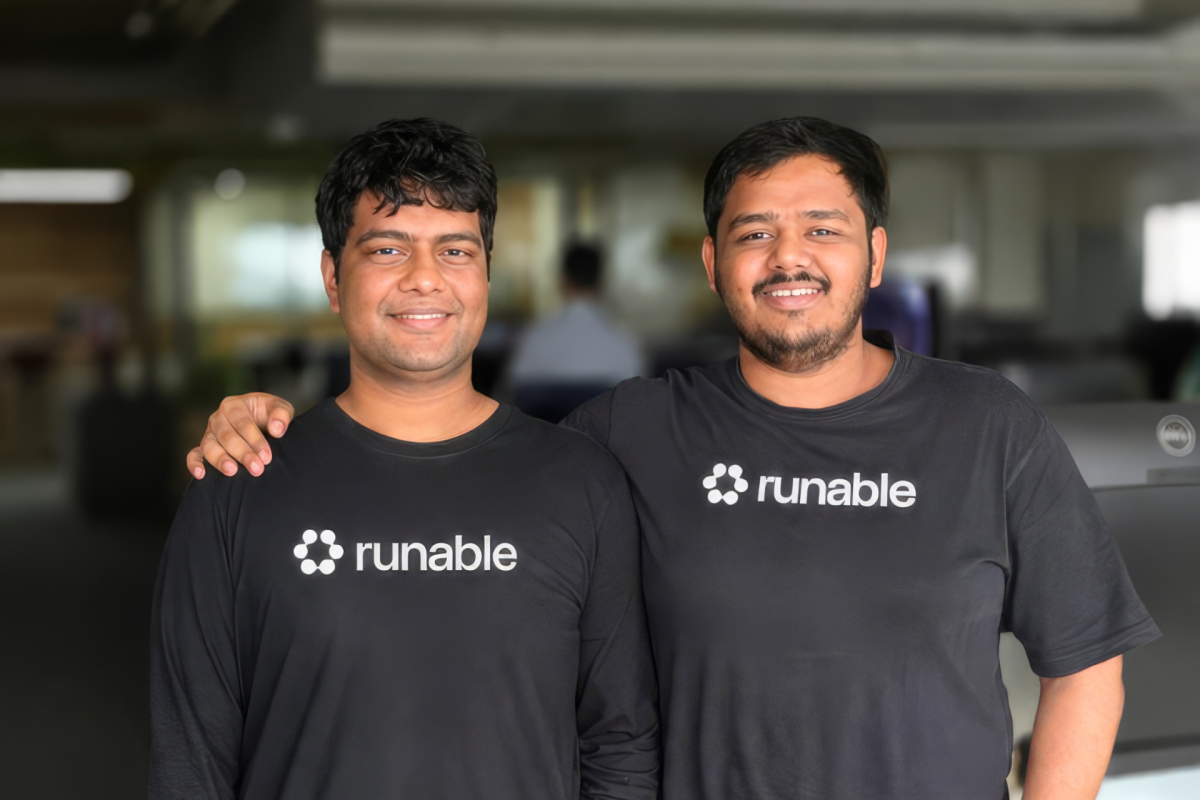
The company’s growth trajectory so far has been notably fast for a startup founded only in 2025. Runable Systems Private Limited was incorporated in Bangalore in May of that year by co-founders Umesh Kumar and Saksham Sarda. Kumar, a computer science graduate from IIT Roorkee who has described himself as a three-time founder, serves as CEO, while Sarda, who previously worked in a creative director role at the marketing-tech company Outgrow and sits on the Forbes Technology Council, handles the product and content side of the business. That split, deep technical systems work paired with content and user-experience orchestration, has shaped how Runable positions itself in the market: less a pure coding agent and more a visual-deliverable agent aimed at people who need finished outputs rather than raw code.
Early traction backs up that positioning. Following the launch of Runable 2.0 earlier this year, the company said it crossed $2 million in annualized recurring revenue within roughly three weeks, a pace the team described as among the fastest ever for a product in this category. The company has also built a community-facing side to its growth strategy, hosting hackathon-style events like RunTogether that bring in participants ranging from students to engineers at established companies including Oracle and Adobe, giving builders a chance to turn ideas into working prototypes in a matter of hours using Runable’s tooling.
On the product side, Runable has steadily expanded what its agent can actually produce. Beyond the original website and presentation generation capabilities, the platform now handles research-grade reports with citations and data analysis, audio and podcast production including text-to-speech and voice cloning, and short-form video content aimed at social platforms. The company has positioned itself against a long list of point solutions, from presentation tools to writing assistants to video generators, arguing that consolidating those functions into one agent saves users from managing a stack of separate subscriptions. Runable has said its typical user saves roughly $129 a month by replacing multiple standalone tools with a single platform, and the company reports it has attracted more than 500,000 users worldwide across its web and mobile products.
The startup’s pricing sits at the more accessible end of the AI agent market, with a free tier available alongside paid plans that scale up from around $20 a month, undercutting several comparable general-purpose agents that charge $35 to $50 monthly. That pricing strategy fits squarely with Runable’s target customer: small business owners, solo founders, and freelancers who need capable automation but don’t have enterprise software budgets to work with.
The bigger strategic question, and the one this new funding round is really testing, is whether an agent that’s good at building things, a website, a deck, a report, can be extended into an agent that’s good at growing things, meaning ongoing tasks like lead follow-up, customer support triage, and marketing execution that require sustained judgment rather than a single well-defined output. That’s a materially harder problem. Building a presentation from a prompt is largely a one-shot creative task with a clear finish line. Running customer support or managing an outbound sales pipeline requires an agent to make judgment calls continuously, adapt to changing context, and avoid the kind of errors that compound over time rather than showing up once and getting corrected.
This shift mirrors a broader trend playing out across the agentic AI funding landscape throughout 2026. Investors have moved from funding agents that complete discrete, verifiable tasks toward funding agents meant to operate more autonomously over longer stretches of time, embedded more deeply into how a business actually functions day to day. That transition comes with real infrastructure demands, since agents running continuously rather than completing single tasks tend to consume far more compute and context, and keeping those costs manageable while maintaining reliability has become one of the central engineering challenges facing nearly every company in this space right now.
Runable will need to prove it can make that leap credibly. The company’s early success came largely from nailing a specific, well-scoped use case: turning a text prompt into a polished, shareable deliverable quickly and cheaply. Extending that same underlying technology into the messier, more open-ended work of actually growing a business, chasing leads, managing customer relationships, adjusting strategy based on real-world feedback, is a different kind of bet entirely, and one that plenty of well-funded competitors are chasing simultaneously. Whether Runable’s combination of low pricing, broad functionality, and fast early growth is enough to establish real staying power in that harder segment will likely become clearer over the next year, as the fresh capital gets put to work expanding both the product’s capabilities and its reach beyond the small business audience it first built for. For more coverage of funding rounds and product developments across the AI agent industry, readers can follow ongoing reporting on Techchora.
Additional details on Runable’s product lineup and pricing are available directly through the company’s official website, and broader trends in agentic AI investment can be tracked through Crunchbase’s startup funding database.