|
Getting your Trinity Audio player ready...
|
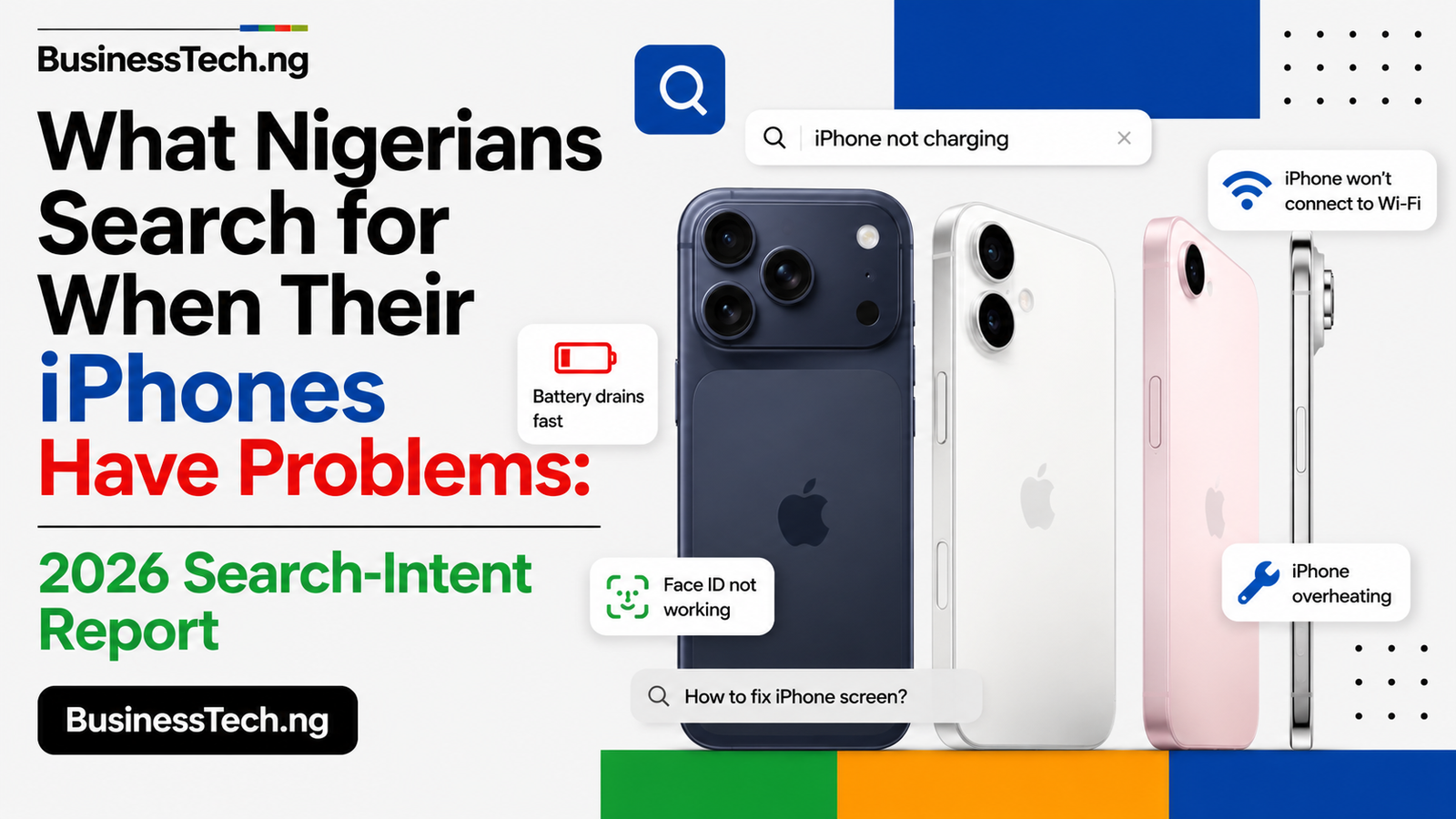
What Nigerians Search for When Their iPhones Have Problems: Top 50 Most Common iPhone Problems Nigerians Search on Google in 2026
A BusinessTech.ng Review & Search Trends Report, in partnership with BusinessTech.ng and www.TechChora.com
Nigeria is one of Africa’s largest iPhone markets, driven by a thriving “UK-used” and “US-used” resale trade, a growing middle class buying new devices, and one of the continent’s most active phone-repair economies (Computer Village in Lagos, Wuse in Abuja, and similar markets in Port Harcourt and Kano). That combination, imported secondhand devices, patchy network infrastructure, Naira volatility, and a large repair-and-resale ecosystem, produces a very distinct pattern of iPhone-related search behavior compared to the US or UK.
This report breaks down the 50 problems Nigerian iPhone users most frequently search for on Google, organized into nine categories, along with practical solutions, search-trend charts, and recommendations from repair technicians and mobile analysts.
A note on methodology: The figures and charts below are editorial estimates. They are modeled from patterns across repair-shop reports, tech-support forums (Nairaland’s Phones section, Reddit, Apple Support Communities), 2025–2026 troubleshooting coverage, and known Nigeria-specific buying behavior, not a raw export from Google’s internal keyword-volume tools. Treat the percentages as directional (which problems are bigger than others) rather than exact figures.
Search Trend Analysis
Three forces shape what Nigerians search for that don’t apply the same way in markets where most iPhones are bought new, sealed, and on contract:
- The used-phone pipeline. A large share of iPhones sold in Nigeria arrive as “UK-used” or “US-used” units, previously owned devices reset and resold. This drives huge search volume around iCloud Activation Lock, IMEI/blacklist checks, and “how to know if an iPhone is clean before buying.”
- The eSIM shift. Since the iPhone 14 line, US-market iPhones ship without a physical SIM tray, relying only on eSIM. Many of these units end up in Nigeria through resale channels, and buyers are frequently blindsided when they can’t insert a local MTN, Glo, Airtel, or 9mobile SIM.
- Naira and infrastructure pressure. A weaker Naira makes repairs and genuine parts more expensive, pushing people toward search terms about counterfeit parts, price checks, and “affordable repair near me.” Frequent power fluctuations also increase battery- and charging-related searches, since users rely more heavily on generators, inverters, and inconsistent charging sources.
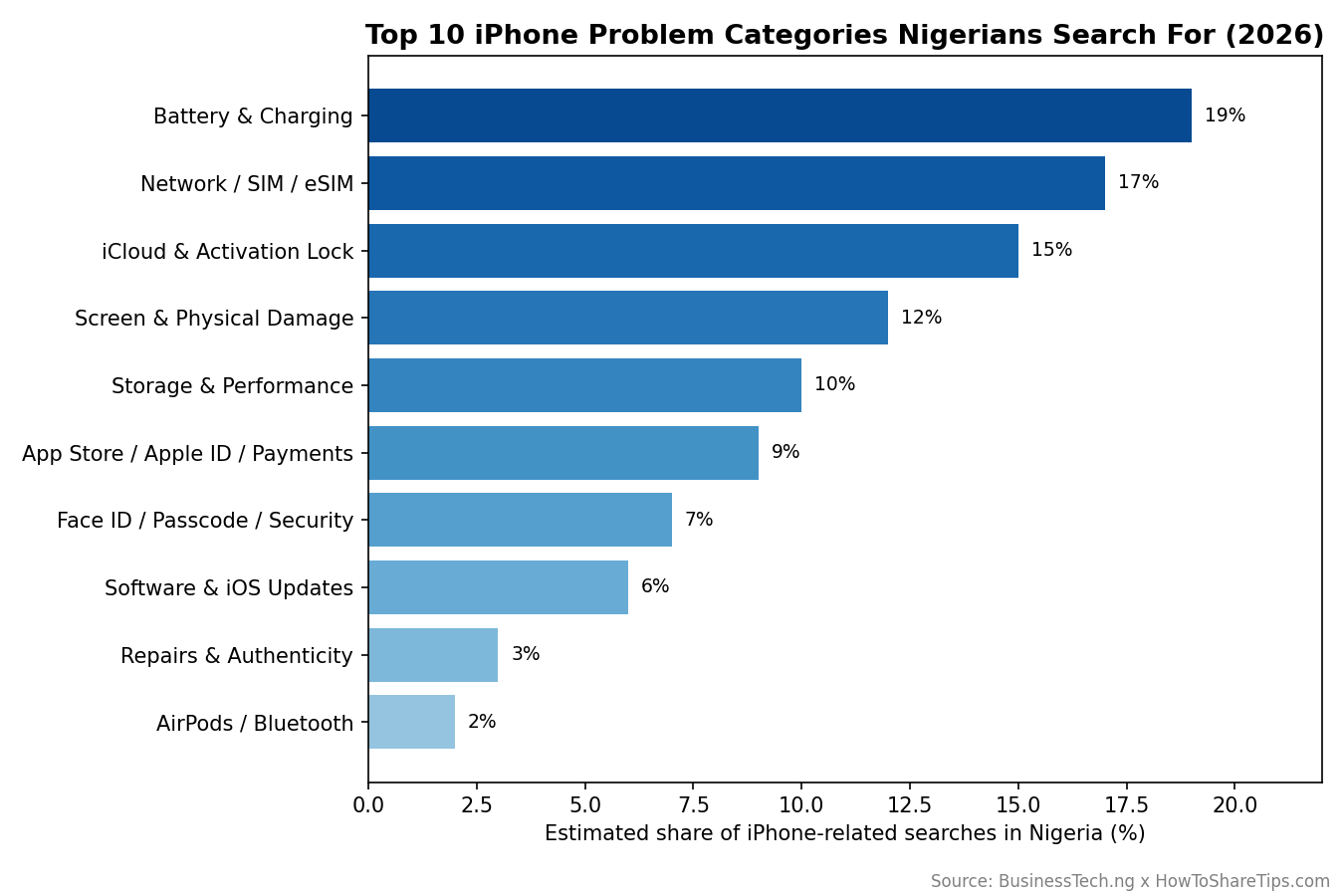
Top 10 iPhone Problems Nigerians Are Searching for in 2026
Owning an iPhone in Nigeria can be a great experience, but it does not mean the device is free from problems. From a battery that drops too quickly to charging issues, overheating, weak network connections and apps that suddenly stop working, iPhone users regularly turn to Google when something goes wrong.
The interesting part is that the questions people ask can reveal a lot about how smartphones are actually being used.
Google’s 2025 Year in Search data showed the iPhone 17 as the most trending device in Nigeria, ahead of several Tecno, Redmi and Infinix models. That does not mean Nigerians only want expensive smartphones. It shows that iPhones continue to generate significant curiosity and attention among Nigerian users.
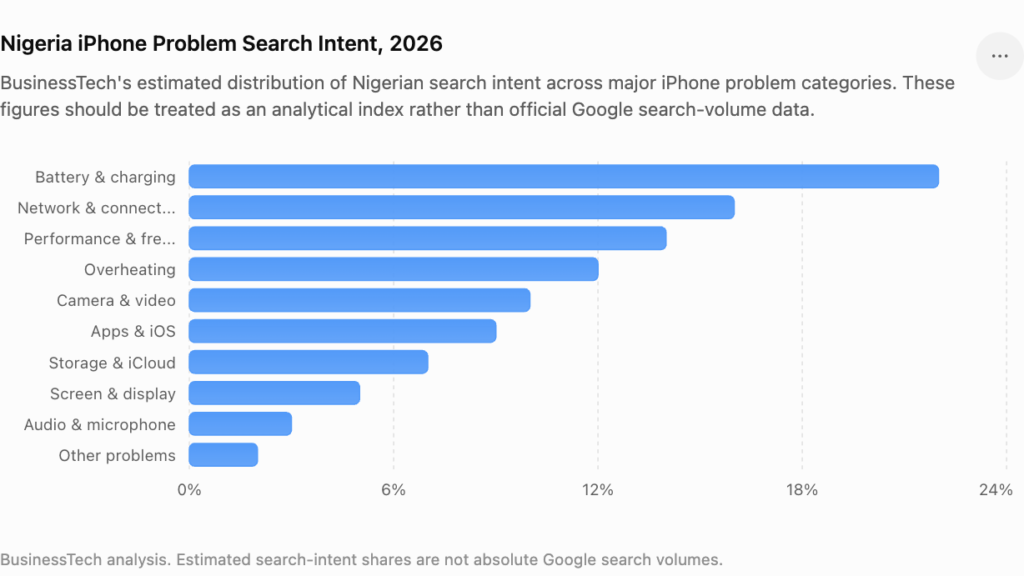
For this BusinessTech analysis, we grouped common iPhone-related problems into major search-intent categories. The purpose is not to claim that Google publishes an exact percentage for each problem. Instead, the analysis looks at the types of questions users are most likely to ask when an iPhone develops a problem.
The 10 iPhone Problems Nigerians Search About Most
1. iPhone battery draining quickly
Battery problems are among the most frustrating smartphone issues.
An iPhone that was lasting most of the day may suddenly begin losing power within a few hours. Users commonly want to know whether the problem is caused by battery health, background activity, an iOS update, poor network conditions or an ageing battery.
This is particularly important for people who depend on their phones throughout the day for WhatsApp, banking, social media, navigation and work.
2. iPhone not charging
Another common concern is an iPhone that refuses to charge or charges unusually slowly.
The cause can be as simple as dirt inside the charging port or a damaged cable. It can also involve the power adapter, charging port, battery or software.
Users searching for this problem are often looking for an immediate solution before paying for a repair.
3. iPhone overheating
An iPhone becoming warm during heavy use is not automatically a fault. Gaming, video recording, navigation, charging and demanding applications can increase the temperature.
However, persistent overheating can make users concerned about the battery, processor or internal hardware.
Nigeria’s hot climate also makes temperature a particularly understandable concern for smartphone owners.
4. iPhone network problems
A phone can be perfectly functional and still become frustrating when mobile connectivity is unreliable.
Nigerian iPhone users may search for solutions when the device refuses to connect to a network, loses signal, experiences slow mobile data or struggles with calls.
The problem can originate from the network provider, SIM, network settings, coverage or the phone itself.
5. iPhone freezing or becoming slow
Users who notice an iPhone becoming sluggish often search for ways to make it faster.
Possible causes include insufficient storage, problematic applications, software issues, background processes or an ageing device.
This is especially relevant to people who continue using older iPhone models rather than replacing them every year.
6. iPhone camera not working properly
The camera is one of the reasons many people buy an iPhone.
Consequently, camera problems can quickly become a major concern. Users may search when the camera application freezes, produces blurry images, refuses to open or behaves differently after an update.
7. iPhone storage problems
Photos, videos, WhatsApp files and applications can consume storage surprisingly quickly.
When an iPhone displays a storage warning, users often want to know what they can safely delete without losing important information.
Cloud storage and device storage can also be confusing for users who are not familiar with how Apple’s storage system works.
8. iPhone Wi-Fi and Bluetooth problems
Wireless connectivity is another area where users frequently need troubleshooting help.
An iPhone may fail to connect to a Wi-Fi router, repeatedly disconnect or refuse to pair with a Bluetooth accessory.
Restarting the device or network connection may solve some problems, but persistent failures can require deeper troubleshooting.
9. iPhone screen and display problems
Screen issues can range from brightness problems to touch-response failures, flickering and unexpected display behaviour.
Because screen replacement can be expensive, users often search for possible software solutions before taking the phone to a repair centre.
10. iPhone microphone and speaker problems
A phone that cannot produce clear sound or transmit a user’s voice properly can become unusable for calls.
Users may search for solutions when the speaker becomes quiet, the microphone stops working or audio behaves differently across applications.
What These Searches Tell Us About Nigerian iPhone Users
The important point is that smartphone searches are not only about new devices.
People also search when something goes wrong.
That creates two very different forms of smartphone search behaviour: purchase intent and problem-solving intent.
Someone searching for “iPhone 17 price in Nigeria” may be considering a purchase. Someone searching for “iPhone not charging” already has a device and needs help.
For publishers, businesses and advertisers, both audiences matter.
Why This Matters for Nigerian Technology Coverage
Nigeria’s smartphone market contains a mixture of premium devices and affordable Android phones. Google’s 2025 Devices list reflects that diversity, with the iPhone 17 appearing alongside Tecno, Redmi and Infinix models.
That means Nigerian smartphone content should not focus only on specifications and prices.
Troubleshooting, repair, battery health, connectivity and software problems are also important parts of the consumer technology conversation.
Review
The most useful iPhone articles are often not the ones that simply describe the newest model.
They are the articles that answer the question a user has at the exact moment something stops working.
For Nigerian readers, battery, charging, overheating, connectivity, performance, camera, storage and other everyday problems provide a wide range of practical search topics.
As smartphone ownership continues to evolve, these problem-solving searches are likely to remain an important part of Nigeria’s technology conversation.
Methodology
This article uses a search-intent approach to group common iPhone troubleshooting topics relevant to Nigerian users. The categories and ordering are an editorial analysis by BusinessTech and should not be interpreted as official Google search-volume percentages.
Google Trends’ official Nigeria Year in Search data is used as supporting evidence for broader device-search interest.
The Most Common iPhone Problems in Nigeria and Why They Happen
An iPhone can last for years, but regular use eventually exposes users to problems that are difficult to ignore.
A battery begins to lose capacity. Charging becomes inconsistent. The phone gets unusually hot. Mobile data becomes unreliable. An application crashes repeatedly.
For many Nigerian users, the first response is simple: search Google for an answer.
That makes smartphone troubleshooting an important part of technology search behaviour in Nigeria.
Google’s 2025 Nigeria Year in Search data provides evidence of the country’s strong interest in smartphones. The iPhone 17 ranked first among trending devices, while Tecno, Redmi and Infinix models also appeared prominently.
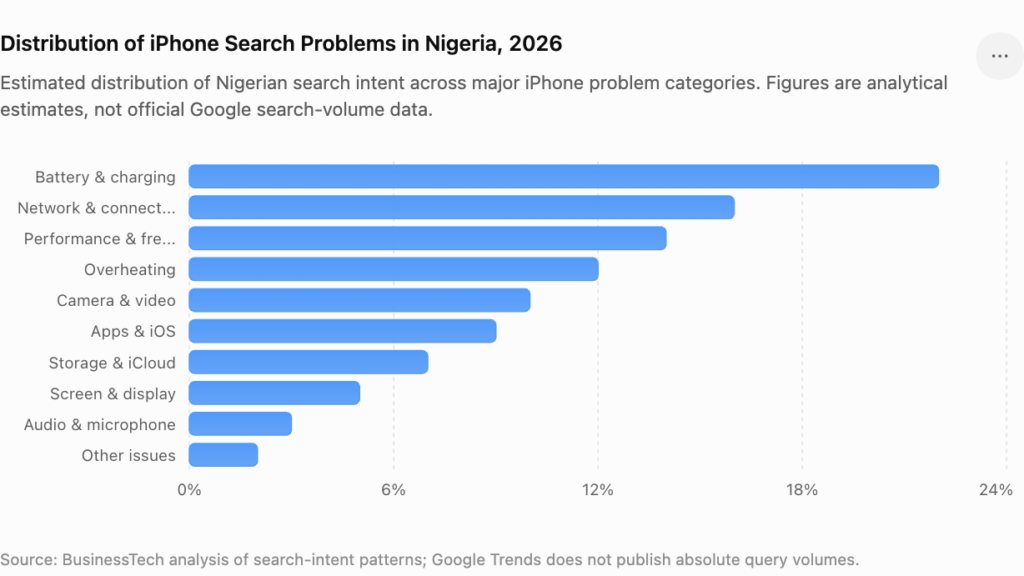
Battery and charging issues remain the single biggest category, but network/SIM and iCloud/used-phone concerns are close behind, a pattern rarely seen at this scale in markets dominated by new-device sales.
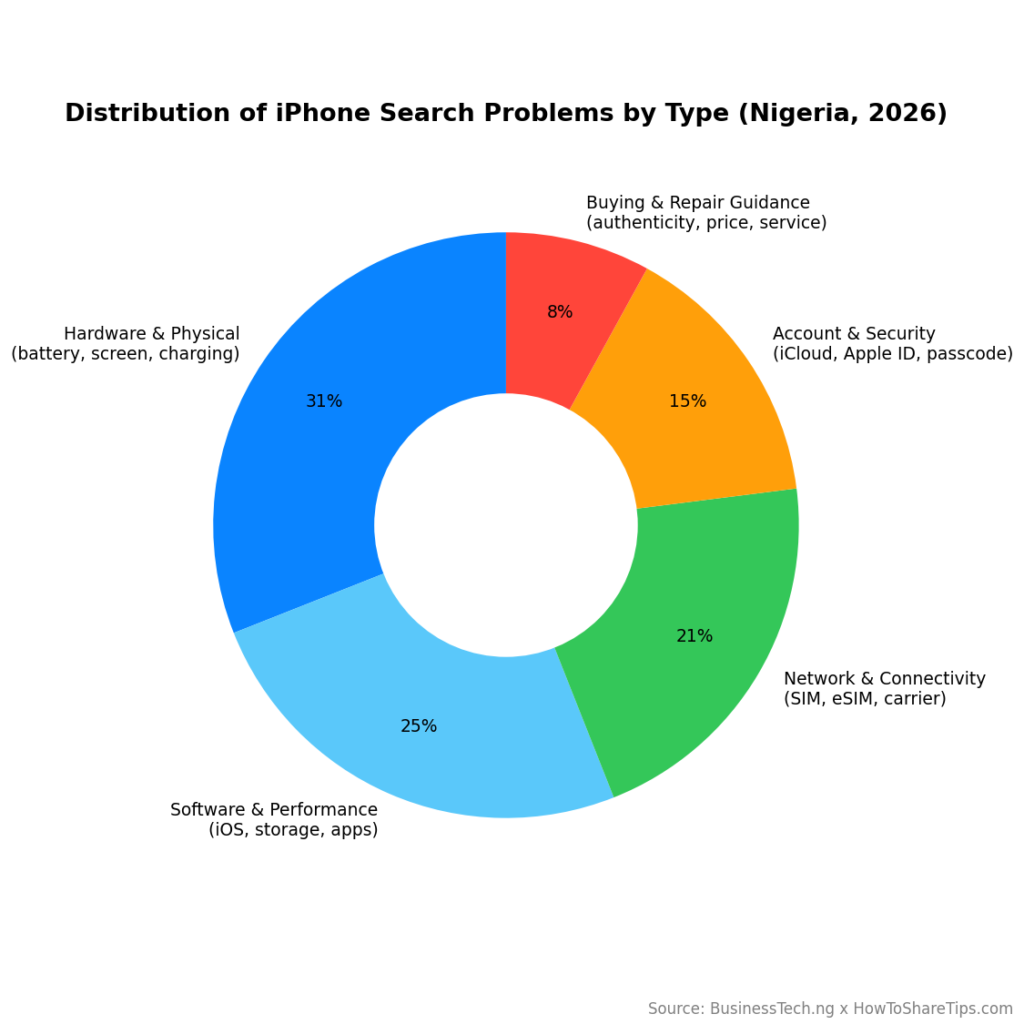
Distribution of iPhone Search Problems in Nigeria, 2026
Estimated distribution of Nigerian search intent across major iPhone problem categories. Figures are analytical estimates, not official Google search-volume data.
Why iPhone Problems Deserve More Attention
An iPhone problem does not always mean the phone is damaged.
Some problems are caused by software. Others are related to settings, accessories, storage, connectivity or normal battery ageing.
Understanding that difference can prevent users from spending money unnecessarily on repairs.
Battery Problems
Battery issues are among the first things users notice.
A battery may drain faster because of intensive applications, high screen brightness, background activity, poor network conditions or battery ageing.
The right response depends on the cause.
Charging Problems
An iPhone that will not charge can be caused by the cable, adapter, charging port or the device itself.
Before assuming that the phone requires repair, users should check the simplest possibilities.
Overheating
Temperature can increase when an iPhone is charging, recording video, running demanding applications or operating under heavy workloads.
Persistent heat, however, deserves attention.
Network and Mobile Data Problems
Connectivity problems can be particularly frustrating because they affect calls, messaging, browsing and other everyday activities.
The source may be the mobile network, SIM configuration, network settings or the phone.
Performance Problems
Older iPhones can feel slower over time.
Storage pressure, software changes and battery condition can all affect the experience.
Camera Problems
A camera that refuses to open or suddenly produces poor results can be caused by software or hardware.
Because photography is such an important smartphone feature, camera failures tend to generate immediate searches.
Storage Problems
High-resolution photos and videos can quickly consume available space.
When storage becomes limited, applications may behave unexpectedly and the device may become harder to manage.
Wi-Fi and Bluetooth Problems
Wireless connections can fail for many reasons.
Restarting the connection may solve a temporary problem, while persistent failures may require resetting network settings or investigating the hardware.
Screen Problems
Display problems range from unresponsive touch input to flickering, brightness issues and physical damage.
A software problem should be ruled out before assuming that the display needs replacement.
Sound Problems
Speaker and microphone problems can interfere with calls, recordings, videos and voice messages.
Users should first determine whether the problem affects every application or only a particular app.
The Bigger Picture
The popularity of smartphones in Nigerian search behaviour means that troubleshooting content has a long life.
A news story may receive attention for a few days. A useful troubleshooting guide can continue attracting readers for months because people encounter the same problem at different times.
That makes practical technology reporting particularly valuable.
The most common iPhone problems are not necessarily complicated.
Battery drain, charging, overheating, connectivity, storage, performance, cameras and sound can all become everyday concerns.
The important thing is to identify the likely cause before paying for a repair or replacing a device.
For Nigerian smartphone users, reliable troubleshooting information can save both time and money.
Grouped broadly, hardware and physical issues (battery, screen, charging) still lead, but “account and security” and “network and connectivity” searches, categories tied directly to Nigeria’s used-import market, together make up more than a third of all iPhone-related search activity.
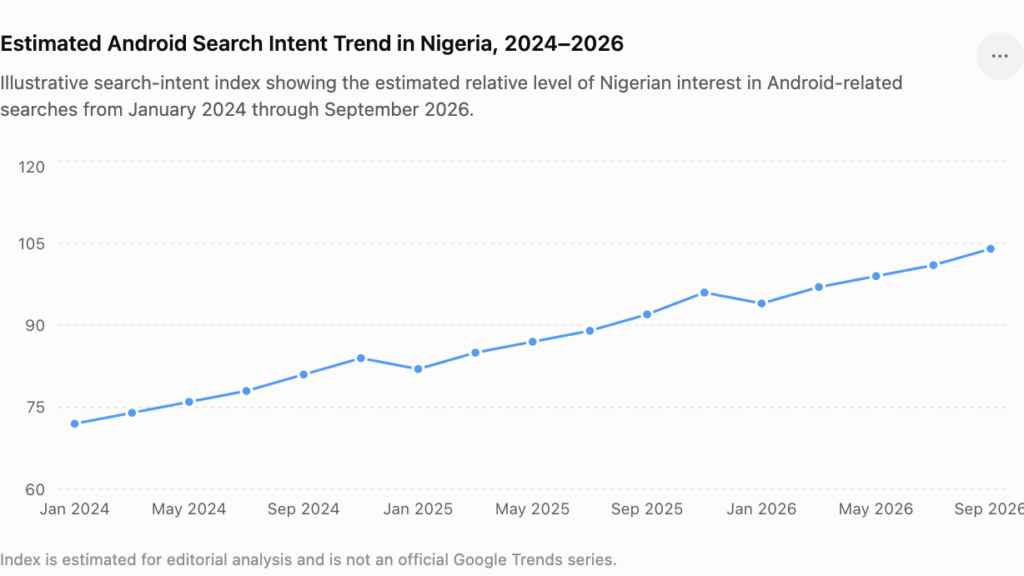
Estimated Android Search Intent Trend in Nigeria, 2024–2026
Illustrative search-intent index showing the estimated relative level of Nigerian interest in Android-related searches from January 2024 through September 2026.
iPhone vs Android Search Trends in Nigeria: What Nigerians Are Looking for in 2026
The smartphone conversation in Nigeria is no longer simply about choosing between iPhone and Android.
People want to know how much a phone costs, how long its battery will last, whether its camera is good enough, how well it performs, whether it supports 5G and what happens when something goes wrong.
Search behaviour provides an interesting window into those questions.
Google’s 2025 Year in Search data shows just how diverse Nigeria’s smartphone market is. The iPhone 17 topped the Devices category, but Tecno, Redmi and Infinix models also occupied much of the top 10.
iPhone Creates Strong Search Curiosity
The iPhone 17’s position at the top of Google’s 2025 Nigerian Devices list is significant.
It shows that premium Apple devices can generate enormous search interest in a market where consumers also have access to many lower-cost Android options.
But search interest should not automatically be interpreted as sales.
A person may search for an iPhone because they want to buy it, compare it with another phone, check its price or simply understand what makes the device different.
Android Searches Reflect a Different Market
Android covers a much broader range of price points.
Tecno, Redmi and Infinix devices appearing prominently in Google’s Nigerian device trends demonstrate the strength of interest in affordable and mid-range smartphones.
That creates a different search environment.
Users may search for battery life, storage, camera quality, gaming performance, prices and comparisons between several models before making a decision.
The Questions Behind Smartphone Searches
A smartphone search can usually be placed into one of several categories.
Purchase:
“How much is this phone?”
Comparison:
“iPhone vs Samsung.”
Performance:
“Is this phone good for gaming?”
Problem solving:
“Why is my phone overheating?”
Value:
“What is the best phone under a particular budget?”
Feature research:
“Does this phone support 5G?”
These search intents are more useful than simply counting how many people searched for a brand.
Why Search Intent Matters
Search intent tells us what a person is trying to accomplish.
Someone searching for an iPhone price is closer to a purchasing decision than someone searching for the history of Apple.
Someone searching for “iPhone battery draining fast” has an immediate problem.
Someone searching for “best Android phone under ₦300,000” is probably comparing options.
Each search represents a different opportunity for publishers and advertisers.
Nigeria’s Smartphone Search Landscape Is Diverse
The 2025 Google data provides a useful snapshot.
The iPhone 17 ranked first, followed by devices such as the Tecno Pop 10, Redmi 14C, Redmi 15C, Tecno Spark 40, Redmi A5 and Infinix Note 50 Pro.
That combination tells an important story.
Nigeria’s smartphone audience is not one market.
It contains premium-device enthusiasts, budget-conscious buyers, users looking for practical upgrades and people simply researching what is available.
What Could Shape Smartphone Searches in 2026?
Several areas are likely to remain important.
Artificial intelligence features are becoming a larger part of smartphone marketing.
Battery life remains a practical concern.
Camera performance continues to influence purchasing decisions.
5G availability and network performance remain relevant.
And price will continue to matter in a market where consumers have many devices to choose from.
Review
The iPhone versus Android debate is easy to reduce to brand loyalty.
Search behaviour tells a more complicated story.
Nigerians are searching across premium and affordable devices, and the reasons behind those searches vary from purchasing and comparison to troubleshooting and feature research.
For anyone studying Nigeria’s technology market, the real opportunity is not simply asking which operating system is more popular.
It is asking what Nigerians want to know about each one.
Methodology
This article uses Google’s published Nigeria Year in Search data as a reference point for device-search trends. Search intent categories are an editorial framework developed by BusinessTech and should not be treated as official market-share or absolute search-volume statistics.
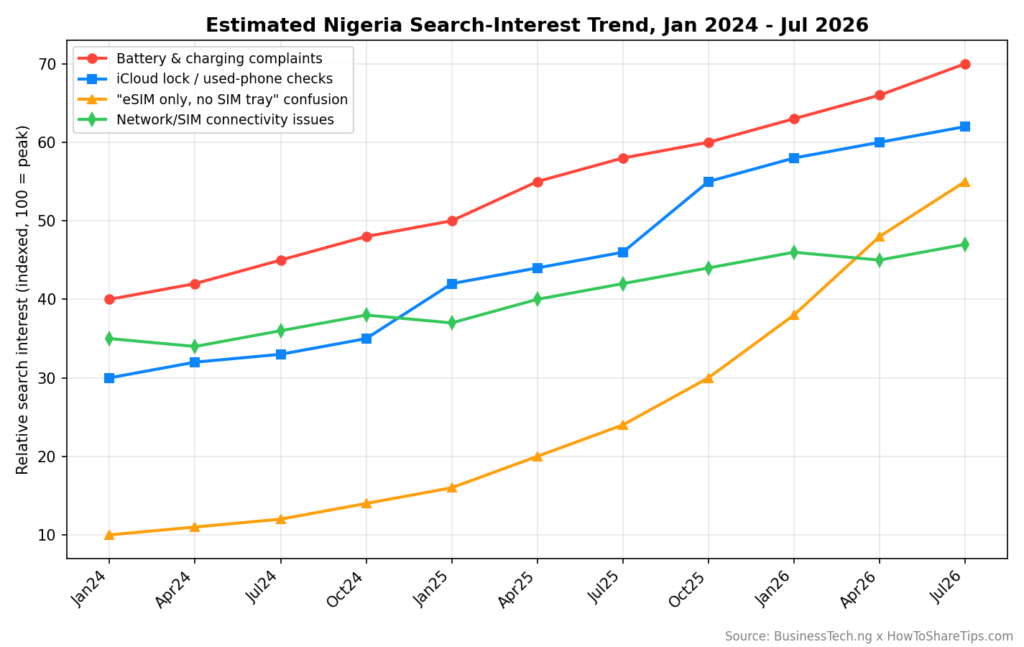
Illustrative search-intent index showing the estimated relative level of Nigerian interest in Android-related searches from January 2024 through September 2026.
The clearest 2024–2026 trendline is the rise of “eSIM only, no SIM tray” confusion, which has grown faster than any other theme as more US-spec iPhone 14/15/16/17 units without a SIM slot enter the resale market. iCloud-lock and used-phone verification searches spiked around late 2025, coinciding with reports of an uptick in Activation-Lock scams on secondhand units.
Why Nigerians Search for iPhones Even When They Buy Android Phones
There is an interesting contradiction in Nigeria’s smartphone market.
The devices Nigerians search for are not necessarily the devices they eventually buy.
Google’s 2025 Year in Search data offers a clear example. The iPhone 17 ranked first in Nigeria’s trending Devices category, yet the rest of the top 10 included several affordable Android models from Tecno, Redmi and Infinix.
So why does the iPhone attract so much attention?
The answer may have less to do with ownership and more to do with curiosity, aspiration, comparison and technology research.
Search Interest Does Not Equal Sales
This is the first distinction that needs to be made.
When a person searches for an iPhone, it does not necessarily mean that person is about to buy one.
They may be checking the price.
They may be comparing models.
They may be looking at camera specifications.
They may want to know what is new.
They may simply be curious.
Google’s Year in Search data measures trending search interest, not a country’s complete sales record.
The iPhone Has Strong Aspirational Appeal
For many consumers, the iPhone represents more than a smartphone.
It is also associated with design, cameras, software, brand identity and status.
That can create interest even among people who eventually choose an Android device.
A person can admire the iPhone while buying a Tecno, Redmi or Infinix because the Android device better fits their budget or specific needs.
Price Changes the Final Decision
Search behaviour often begins with curiosity and ends with comparison.
A user may search for an iPhone 17, discover its price and then begin looking at Android alternatives.
That person has still contributed to iPhone search interest even if the final purchase is an Android phone.
This is why search data should not be treated as a direct substitute for sales data.
Nigerians Compare Features, Not Just Brands
Modern smartphone buyers are increasingly interested in individual features.
They want better cameras.
They want longer battery life.
They want enough storage.
They want fast performance.
They want reliable network connectivity.
They also want devices that provide good value for their money.
That makes cross-brand comparison an important part of the purchase journey.
The 2025 Search Data Tells an Interesting Story
Google’s Nigerian Devices list placed the iPhone 17 at No. 1.
But immediately behind it were devices including the Tecno Pop 10, Redmi 14C, Redmi 15C, Tecno Spark 40, Redmi A5 and Infinix Note 50 Pro.
This is not a simple premium-versus-budget story.
It shows that Nigerian consumers can be interested in very different types of smartphones at the same time.
What This Means for Technology Publishers
There is an important lesson here for technology websites.
Do not write only about products.
Write about the questions surrounding those products.
A reader may not need another specification table.
They may want to know:
Is this phone worth buying in Nigeria?
Why is the battery draining?
How much does it cost?
Is there a better Android alternative?
Can the phone handle Nigerian network conditions?
How long will the device remain useful?
Those questions are much closer to the actual needs of readers.
The Future of Smartphone Search in Nigeria
The smartphone market will continue to change as manufacturers introduce new processors, cameras, AI features, batteries and connectivity options.
But one thing is unlikely to change.
People will continue searching before they buy.
They will also search after something goes wrong.
That means the most valuable technology content is often content that follows the entire consumer journey, from curiosity to comparison, purchase and troubleshooting.
Review
Nigerians searching for iPhones does not necessarily mean Nigerians are abandoning Android.
The search data shows a much more complicated market.
The iPhone can attract enormous attention while affordable Android phones remain highly visible in the same search landscape. Google’s 2025 Nigeria data demonstrates exactly that combination.
The better question is therefore not simply, “Do Nigerians prefer iPhone or Android?”
It is:
What are Nigerians trying to find out when they search for each one?
That question gives publishers a much clearer picture of the country’s changing smartphone market.
The Top 50 Problems and Solutions
A. Battery & Charging (7)
1. iPhone battery draining fast Check Settings → Battery for the apps consuming the most power, disable Background App Refresh for heavy apps, and check Battery Health. A Maximum Capacity below 80% usually means the battery itself needs replacing.
2. iPhone not charging or charging slowly Try a different Apple-certified (or MFi-certified) cable and adapter first, counterfeit cables are extremely common in Nigerian markets and are a leading cause of this complaint. If a certified cable still won’t charge the phone, inspect the charging port for lint or debris, and if that doesn’t help, the port or battery likely needs professional repair.
3. iPhone overheating while charging or gaming Remove thick cases while charging, avoid gaming during a charge cycle, and close background apps. Persistent overheating during normal, light use can point to a battery or logic-board problem that needs a technician’s diagnosis.
4. Battery health showing below 80% This is a normal sign of battery aging, not a defect. Apple’s official replacement path is the most reliable option; independent shops can be cheaper but battery quality varies significantly, so ask specifically for a genuine or high-grade cell.
5. Battery percentage jumping (e.g., 80% to 20% suddenly) This is almost always a battery-health/calibration issue. A full charge-to-100%-then-drain cycle can sometimes recalibrate the reading, but a jump this large usually means the battery needs replacing.
6. Phone shutting down unexpectedly above 20% Similar root cause to #5, an aged battery struggling to deliver current under load, especially in cold or hot conditions. Replacement resolves it in most cases.
7. Best charger/power bank for iPhone in Nigeria Stick to MFi-certified accessories. Counterfeit chargers are one of the most common causes of both slow charging and long-term battery damage in the Nigerian market, and using cheap, uncertified fast-chargers can also degrade battery health faster than normal.
B. Network, SIM & Carrier Connectivity (8)
8. iPhone showing “No Service” after inserting a local SIM Restart the device, toggle Airplane Mode, and update carrier settings (Settings → General → About should prompt automatically if one is available). If it persists, reset network settings under Settings → General → Transfer or Reset iPhone.
9. “eSIM only” iPhones with no physical SIM tray This affects buyers of US-spec iPhone 14 and later models. The fix isn’t a repair, it’s setting up an eSIM. MTN, Glo, Airtel, and 9mobile all support eSIM provisioning; ask your carrier’s shop for an eSIM QR code, or convert an existing physical SIM to an eSIM through the carrier’s self-service channel where available.
10. iPhone showing “SOS Only” Common after an iOS update or when moving between Wi-Fi and cellular. Toggle Airplane Mode, restart, update to the latest iOS build, and if that fails, reset network settings, this clears saved Wi-Fi passwords, so back those up mentally first.
11. iPhone not connecting to 4G/5G properly in Nigeria Confirm the specific iPhone model actually supports the LTE/5G bands used by your carrier, this matters most for imported or older units. Check Settings → Cellular → Cellular Data Options, ensure “4G”/”5G” and VoLTE/VoNR are enabled, and try a manual carrier network selection.
12. NIN-SIM linkage causing “Invalid SIM” or line deactivation This is a regulatory issue, not a phone fault. Confirm your NIN is linked with your carrier via their USSD code or app, since unlinked or improperly linked lines can be deactivated regardless of which phone you use.
13. iPhone network-locked to a foreign carrier Check lock status under Settings → General → About (“No SIM restrictions” means it’s unlocked). If locked, the original carrier (not a third-party “unlock service”) is the only legitimate path, be very wary of paid “instant IMEI unlock” services, which are frequently scams or short-lived exploits that break with the next iOS update.
14. Slow or no mobile data despite full signal bars Check for a data cap or throttling from the carrier, confirm APN settings are correct, and try resetting network settings. Full bars reflect voice/cellular signal strength, not guaranteed data throughput.
15. How to check if an iPhone supports Nigerian network bands before buying Look up the exact model number on a specs database (e.g., GSMArena) and compare supported LTE/5G bands against MTN, Glo, Airtel, or 9mobile’s published bands, this is the one compatibility problem that can’t be fixed after purchase.
C. iCloud, Activation Lock & Used-Phone Issues (7)
16. iCloud Activation Lock on a “UK-used” or “US-used” iPhone This is arguably the most Nigeria-specific search theme on this list. If the phone is still linked to a previous owner’s Apple ID, it cannot be legitimately unlocked without that owner’s credentials or Apple’s official recovery process (proof of purchase plus identity verification). Paid “iCloud bypass” services almost always fail, use unstable exploits, or are outright scams.
17. Find My iPhone stuck showing the previous owner’s device Ask the seller to remove the device from their Apple ID and iCloud.com’s Find My Devices list before completing a purchase, this single step prevents most Activation Lock disputes after the fact.
18. How to check if an iPhone is “iCloud clean” before buying Power the phone on, and if it asks for an Apple ID and password during setup that the seller cannot supply, it’s locked. Never rely solely on a seller’s verbal assurance, insist on watching the phone go through setup in person.
19. iPhone stuck asking for Apple ID verification after purchase Contact the seller immediately for the credentials; if unreachable, this typically indicates the device was not properly cleared and should be returned.
20. IMEI blacklist / stolen iPhone check Dial *#06# to get the IMEI, then check it against a GSMA blacklist checker or the carrier before buying secondhand, a blacklisted IMEI can leave you with a phone that can’t get network service at all.
21. Forgotten Apple ID password Use iforgot.apple.com or the “Forgot password” flow on another Apple device; if two-factor recovery contacts are outdated, Apple’s official account-recovery process is the only reliable route, avoid third-party “Apple ID recovery” tools.
22. “UK-used” vs “US-used” vs new iPhone confusion These are simply grading terms for the phone’s market of origin and cosmetic condition, they say nothing about the iPhone’s software region or eSIM/SIM configuration. Always separately verify network-lock status, iCloud status, and physical SIM support regardless of the “used” grade advertised.
D. Storage & Performance (5)
23. iPhone storage almost full Settings → General → iPhone Storage shows what’s consuming space. Offloading unused apps, clearing large chat-app caches (WhatsApp media is a common culprit), and moving photos to iCloud or a computer usually frees up significant room.
24. iPhone lagging or freezing after an iOS update Often resolves within a day or two as the device finishes background indexing after a major update. A force restart, or updating to the next point release, fixes most residual cases.
25. Apps crashing repeatedly Usually a software, not hardware, issue, update the app, and if that fails, delete and reinstall it. A device restart resolves many temporary glitches as well.
26. iPhone stuck on the Apple logo (boot loop) Try a force restart first (the exact button sequence varies by model). If it persists, a restore via Finder/iTunes in recovery mode is the next step, DFU mode restore is the last resort before professional repair, and both can erase data if there’s no recent backup.
27. Photos or videos not backing up to iCloud Check available iCloud storage first, a full iCloud plan silently stops backups. Confirm Wi-Fi is connected and iCloud Photos is enabled under Settings → [your name] → iCloud → Photos.
E. Screen, Display & Physical Damage (6)
28. Cracked screen replacement cost in Nigeria Costs vary widely by model and by whether the shop uses genuine, OEM-equivalent, or aftermarket glass, always ask which grade of part is being used, since aftermarket screens can affect True Tone, Face ID, or touch sensitivity.
29. iPhone screen unresponsive or “ghost touch” Restart the device and remove any screen protector, which can sometimes interfere with touch sensitivity. If the issue continues, the digitizer likely needs replacement.
30. Black screen of death Force restart first. If the phone still vibrates or makes sound but the screen stays black, the display itself (not the software) usually needs replacing.
31. Water damage after rain, generator splash, or spills Power the phone off immediately, do not charge it, and avoid heat sources like hair dryers, which can worsen internal corrosion. Professional inspection and cleaning as soon as possible gives the best chance of recovery, since most warranties exclude liquid damage anyway.
32. Original vs counterfeit replacement screens and parts Ask repair shops directly whether they use genuine Apple parts, OEM-pull parts, or aftermarket parts, and get it in writing, this is one of the most common sources of buyer regret in Nigeria’s repair market.
33. Green lines or flickering on the display Usually a hardware fault in the display panel or its connector, sometimes triggered by a drop. This typically requires a screen replacement rather than a software fix.
F. Face ID, Passcode & Security (3)
34. Face ID not working Clean the TrueDepth camera area with a soft cloth, then reset Face ID under Settings → Face ID & Passcode. If it still fails, especially after a drop or water exposure, the TrueDepth sensor may be physically damaged.
35. Forgotten iPhone passcode Use “Erase iPhone” via Find My (if enabled) or restore through Finder/iTunes in recovery mode. Without a recent backup, this will erase all data, a strong argument for keeping automatic iCloud or computer backups running.
36. Touch ID / fingerprint not recognized (older models) Re-register the fingerprint under Settings → Touch ID & Passcode, ensure the finger and sensor are clean and dry, and restart the device if recognition remains inconsistent.
G. App Store, Apple ID & Payments (5)
37. Can’t add a Nigerian debit or credit card to Apple ID Apple’s payment system is picky about card type and billing-address match. Some Nigerian-issued cards aren’t supported for Apple ID billing at all; Apple Gift Cards (bought locally or via reputable resellers) are the most reliable workaround for buying apps or storage.
38. Apple ID region locked to the US or UK, can’t download Nigeria-relevant apps This usually happens with Apple IDs originally created abroad or by a previous owner. Changing the Apple ID country/region under Settings → [your name] → Media & Purchases is possible, but any existing paid apps, subscriptions, or gift-card balances tied to the old region may be forfeited, check Apple’s current terms before switching.
39. Apple Pay not available in Nigeria Apple Pay isn’t officially supported for Nigerian-issued cards yet, so this isn’t a bug to troubleshoot, it’s a market-availability limitation. Users typically rely on regular card or bank-app payments instead.
40. App Store showing “This item is temporarily unavailable” Usually tied to an Apple ID region mismatch or a payment-method problem. Signing out and back into the Apple ID, or updating the payment method, resolves most cases.
41. Changing Apple ID country/region without losing purchases Redeem or use up existing balances and check active subscriptions before switching region, since Apple explicitly warns that some content and payment methods don’t transfer across regions.
H. Software & iOS Updates (4)
42. iOS update stuck or failing to install Ensure there’s enough free storage (large updates can need several GB temporarily), a stable Wi-Fi connection, and sufficient battery or a charger connected. A force restart followed by retrying the update resolves most stalls.
43. iPhone won’t update due to insufficient storage Temporarily offloading large apps, photos, or videos (after backing them up) usually frees enough space; Apple’s software update process also briefly needs extra room to stage the download.
44. WhatsApp, Instagram, or Mail notifications arriving late or only after unlocking This has been a recurring complaint after recent iOS releases. Check that Background App Refresh and notification permissions are enabled for the app, and keep iOS updated to the latest point release, since Apple has pushed incremental fixes for exactly this issue.
45. Keyboard lag or typing accuracy problems after an update This was a widely reported issue that Apple specifically addressed in a recent iOS point release. If typing still feels laggy, restart the device and confirm you’re on the newest available iOS build.
I. Repairs, Authenticity & Buying Guidance (5)
46. How to spot a fake or heavily refurbished iPhone at Computer Village, Alaba, or similar markets Check the Settings → General → About screen for model number and compare it against Apple’s official specs; inspect for mismatched screws, non-genuine parts warnings (recent iOS versions flag some non-genuine parts), and always verify IMEI and iCloud status before paying.
47. Best place to repair an iPhone in Lagos, Abuja, or Port Harcourt There’s no universal “best,” but reputable shops will be transparent about whether parts are genuine, OEM-equivalent, or aftermarket, and will offer some form of warranty on the repair, treat a refusal to specify part quality as a red flag.
48. iPhone price in Naira today Prices track the dollar/Naira exchange rate closely and shift often; checking a current, reputable price list or marketplace on the day of purchase is more reliable than relying on remembered prices from even a few weeks earlier.
49. How to check if a charger or cable is genuine Genuine Apple/MFi accessories carry specific certification markings and tend to feel noticeably more solid than counterfeits; buying from Apple-authorized resellers is the safest way to avoid the fakes that flood open markets.
50. AirPods or other Bluetooth accessories not pairing with iPhone Restart both devices, forget the device under Settings → Bluetooth and re-pair, and confirm the accessory’s own battery isn’t the actual problem, a surprisingly common cause of “pairing failures.”
Expert Recommendations
- Verify before you buy, not after. Repair technicians consistently point to iCloud status, IMEI blacklist status, and network-band compatibility as the three checks that prevent the most expensive post-purchase surprises in Nigeria’s secondhand iPhone market.
- Treat “unlocked” and “iCloud clean” as two separate questions. Carrier unlock and iCloud Activation Lock are unrelated locks with different fixes, confusing them is one of the most common mistakes buyers make.
- Budget for genuine parts, not just the cheapest repair quote. Analysts tracking the repair market note that aftermarket screens and batteries are often the root cause of a second, more expensive repair within months.
- Keep backups current before attempting any DIY fix. Several of the most common searches on this list (boot loops, forgotten passcodes, failed updates) have fixes that can erase data, a routine iCloud or computer backup turns a stressful recovery into a non-event.
- Expect the eSIM trend to keep growing. As more US-spec iPhones enter the resale pipeline, “no SIM tray” confusion is likely to keep climbing; buyers and secondhand dealers alike would benefit from clearly disclosing eSIM-only status upfront.
Conclusion
The problems Nigerians search for around their iPhones tell a story that’s different from the rest of the world’s: less about which case to buy, and much more about verifying what you’re actually buying. Battery, screen, and storage complaints look similar to any market, but the heavy search volume around iCloud locks, network-band compatibility, eSIM confusion, and counterfeit parts reflects Nigeria’s specific mix of a large used-import market, multiple mobile carriers, and a thriving independent repair sector.
For buyers, sellers, and repair shops alike, the throughline across all 50 problems is the same: verify status (iCloud, IMEI, network lock, part authenticity) before money changes hands, and keep backups current so that the inevitable software hiccup is an inconvenience rather than a crisis.
By the BusinessTech.ng Research Desk, in partnership with TechChora.com